For seven months, Florida's Republican leaders refused to even acknowledge that a grand jury report existed. On Wednesday, August 26, 2026, CBS News Miami got a copy of it anyway.
The report is about $10 million that was supposed to pay for health insurance for poor Florida children. It says that money was "misappropriated" and that the transfer was "part of a sophisticated scheme to fund political activities."
We laid out the money trail a month ago, back when the report was still locked up. The new part is what the grand jury says about the person Florida just sent to the U.S. Senate.
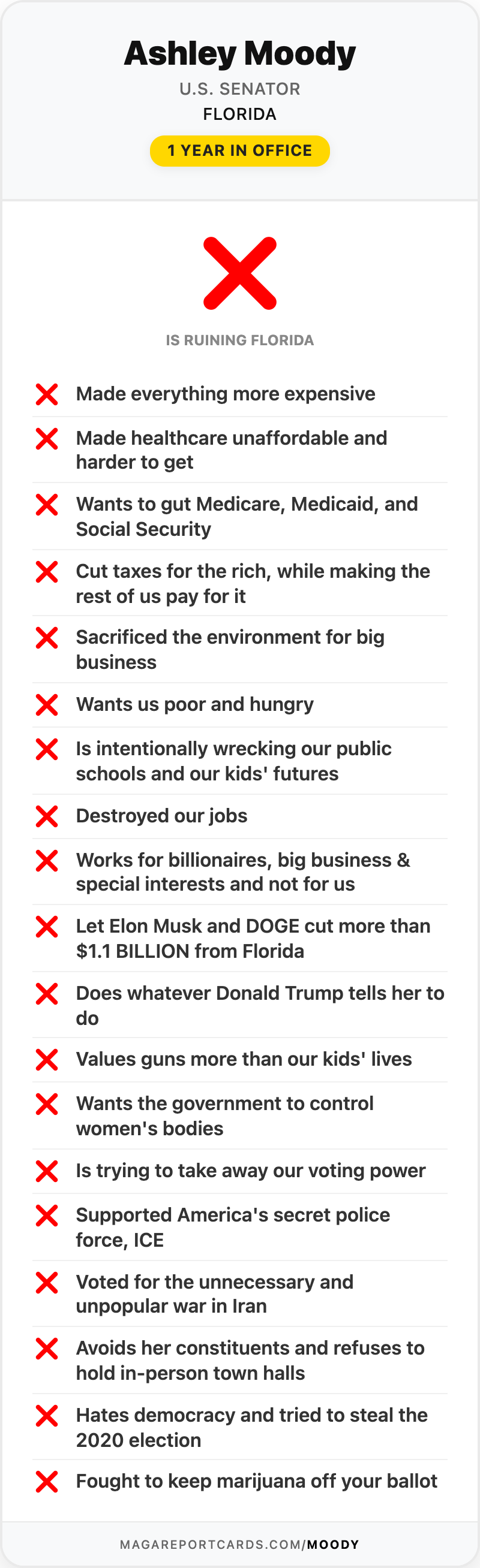
Ashley Moody was Florida's attorney general when this happened. According to the grand jury, she knew about the plan to divert the $10 million, and she personally gave her top deputy the green light to sign.
What the grand jury actually found
Start with the finding itself, because it is blunt.
"Despite our finding that the money was misappropriated, we find insufficient evidence to charge anyone criminally."
Nobody was charged. That is not the same as nothing happened. The grand jury explained exactly why it couldn't charge anyone:
"Nobody will take responsibility for deciding the $10 million of taxpayer money would go to Hope Florida… or had any memory of who made it."
And then it said what it could see anyway:
"While we can't prove who is responsible, we can plainly see that taxpayer money was misused for political purposes and we would like to see changes made to prevent this from happening again."
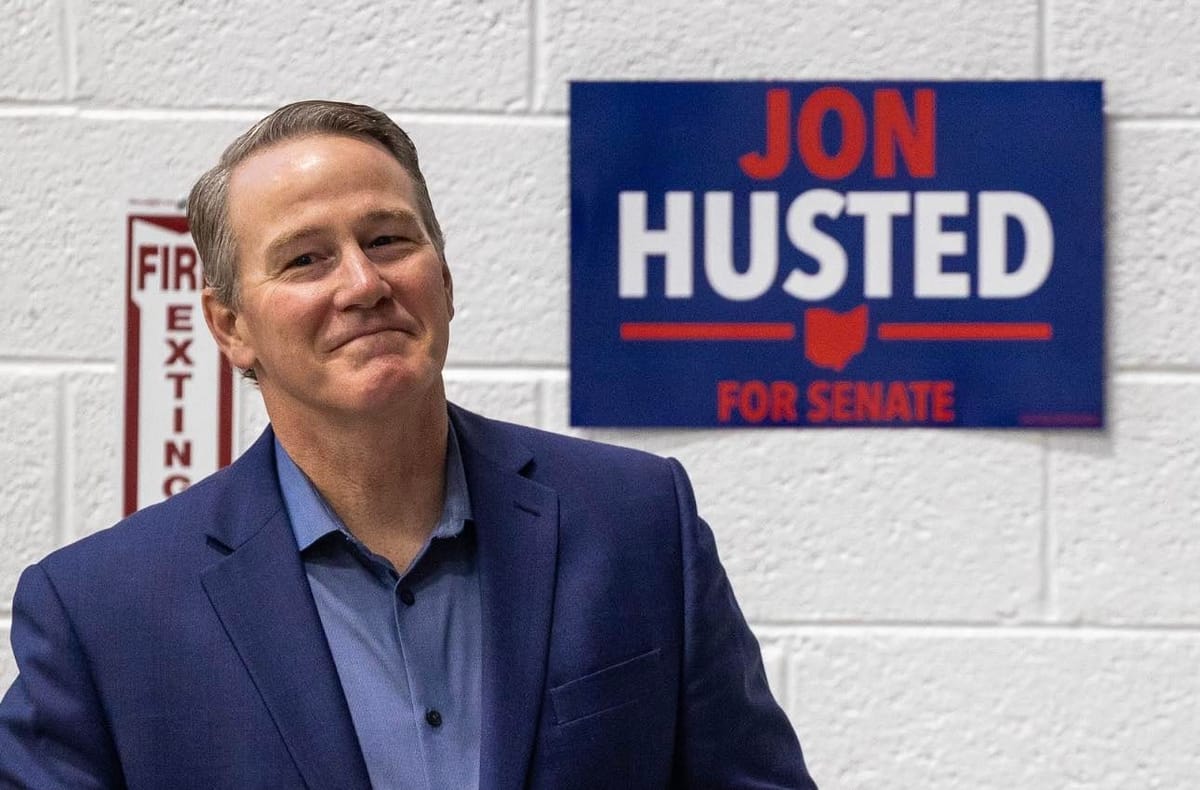
Moody was never called to testify. Neither was Governor Ron DeSantis. Neither was James Uthmeier, the governor's chief of staff at the time, who is now Florida's attorney general and whose political committee ended up with most of the money.
The objection — and the fix
Here is the part that has never been public before.
The money came from a settlement with the health care giant Centene, which had been overbilling Florida for prescription drugs in a program that covers children. Florida was owed $67,048,611. In September 2024, state officials rewrote the deal so that only $57 million came back to taxpayers and $10 million went instead to the Hope Florida Foundation — the nonprofit built around First Lady Casey DeSantis' signature initiative.
Centene's own lawyers were uneasy. They wanted the settlement to say plainly that the Florida attorney general was the one directing them to send $10 million to a charity tied to the governor's wife.
Moody's office did not want that.
Her chief deputy, John Guard, told the grand jury he had "reservations" about the deal. He said that "esoterically" he agreed the $10 million was taxpayer money that "belonged to the state of Florida." He said "Florida Statutes require the legislature to decide how money is spent."
He also, according to the report, raised the political risk with his boss:
"[Guard] did have political concerns about the dedication of $10,000,000 to Hope Florida, which he raised with AG Moody, because he knew the deal would be viewed by the legislature as a constraint on their spending authority."
So Moody's chief deputy understood three things: the money belonged to taxpayers, the legislature is the branch that decides how taxpayer money gets spent, and lawmakers would be angry if they found out.
Now read what happened next, in the grand jury's words:
"His political concerns were resolved by the change to the agreement making the settlement AHCA's agreement rather than the AG's settlement agreement, as the problem would now be AHCA's problem rather than the AG's problem."
Nothing about the money changed. The $10 million still left the taxpayers. It still went to Hope Florida. The only thing that changed was whose name was on the paper. Instead of the attorney general directing Centene, it would now be the governor's health agency — the Agency for Health Care Administration — directing Centene.
That satisfied Guard. And then, the report says:
"after consulting AG Moody, she authorized Mr. Guard to sign the settlement agreement in its final form."
The grand jury added that Guard signed it "without conducting his due diligence to ensure the proper appropriation of taxpayer funds."
Why the rush
The grand jury was also unimpressed by the timing.
Florida sat on this case for three years. A draft settlement returning the full $67 million was sent to state officials on July 14, 2021. Ohio and Mississippi settled in 2021. Indiana, Massachusetts and California settled in 2023. Florida did nothing — and ignored Centene's own requests to wrap it up.
Then, in early September 2024, Florida suddenly wanted it done immediately. The grand jury did the arithmetic:
"The Centene settlement itself seems rushed as it materialized rapidly after years of inactivity. Then, once reached, it took a mere 7 days to fund. We believe the rush was due to the impending election which was just 45 days away."
The settlement gave Centene seven days to wire the $10 million to Hope Florida. It gave Centene more than a year to repay the $57 million owed to Florida taxpayers.
The grand jury also noticed what did not happen. There was no press release from the health agency or the governor's office bragging about recovering millions for taxpayers, the way other states did. And there was "no notification to the Legislature of the Centene settlement" at all.
Two of the officials who signed the agreement did so on September 27, 2024 — the day after Hurricane Helene made landfall. Cassandra Pasley, chief of staff at the Florida Department of Health, testified she was working at the state's Emergency Operations Center when she was pulled aside and asked to sign. She had never seen the document and did not know a settlement was in the works. She signed it that evening. She told the grand jury she was not aware any of the money would end up in a political action committee, and that she would not have signed if she had known.
Where the money went
Centene wired the $10 million on October 4, 2024. Within 25 days it was gone.
Two outside groups applied for $5 million grants each. Both got them, one within hours of applying. Both had written in their applications that the money would not be used for political purposes. A forensic accountant who analyzed the bank records for the grand jury traced $8.5 million of it into Uthmeier's political committee, Keep Florida Clean. From there, $7 million went to the Republican Party of Florida and $1.23 million to another committee Uthmeier chaired.
That money went into the campaign against Amendment 3, the marijuana legalization initiative. Amendment 3 got 5,950,589 votes — 55.90%. Florida requires 60%. It failed.
Moody had spent years trying to keep marijuana legalization away from Florida voters. In December 2019 she took an earlier initiative to the Florida Supreme Court, arguing its ballot summary was misleading, and in April 2021 the court kept that one off the 2022 ballot. Her office made the same case against Amendment 3, urging the court to reject it as misleading and not limited to a single subject — and lost, 5-2, in April 2024. Six months later, settlement money was paying for ads against it.
Two months after the amendment failed, DeSantis appointed her to the United States Senate.
Seven months of silence, and counting
The report was filed under seal with the Leon County Clerk's Office on January 28. One source familiar with the investigation told CBS News Miami that multiple people named in it, including Uthmeier, have spent the seven months since blocking its release through closed court proceedings. The Florida Center for Government Accountability asked the court to let it argue for release. That request is still pending.
She is not the only Republican attorney general whose record is sitting behind a seal. In Texas, the only two known occasions when Ken Paxton has had to answer questions about his own conduct under oath are two depositions sealed in a Collin County courthouse, which his Democratic opponent's campaign said it would ask a court to unseal on the same day this report surfaced.
Moody has refused repeated requests to talk about Hope Florida. Not to CBS Miami, which sent written questions to her Senate office and her campaign. And not to state Rep. Alex Andrade, the Republican who uncovered the diversion in the first place and who told CBS Miami in July that she has never responded to him either. Meanwhile the foundation at the center of it has kept moving further out of reach — its financial records now live at the office of a Republican compliance firm in Alabama — the same firm that keeps the books for the super PAC supporting her Senate campaign.
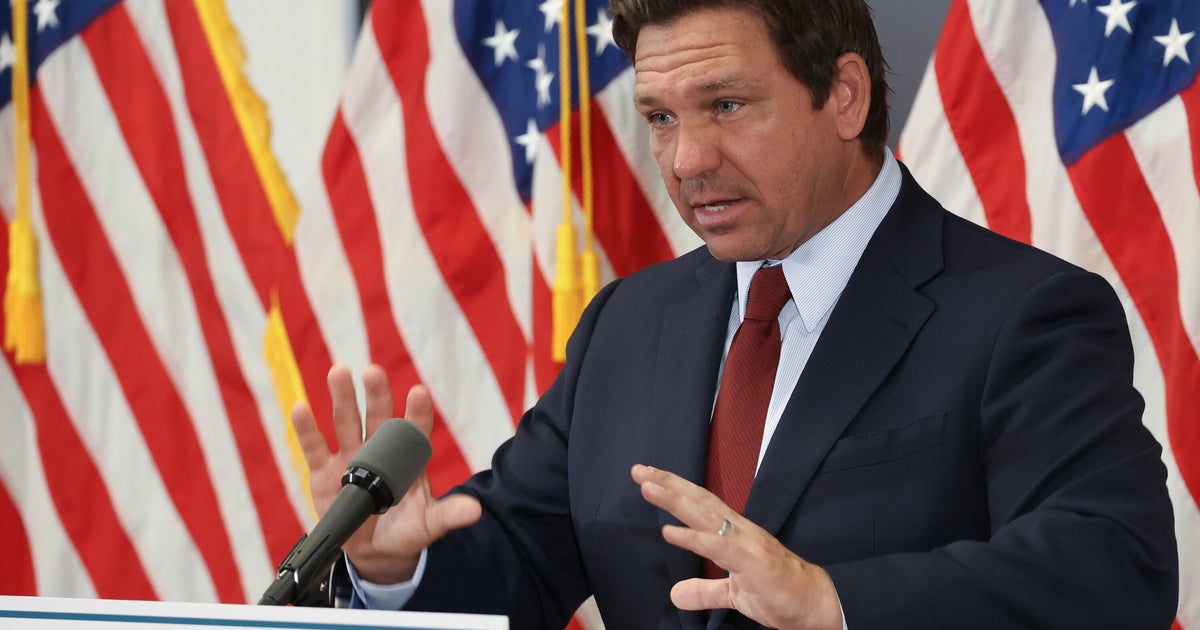
DeSantis was asked about Hope Florida at a news conference on Wednesday. "I wasn't involved in the settlement agreement, but I'm very happy with how everything was done," he said. He called the whole thing a hoax. Uthmeier has called it a "big nothingburger."
The grand jury that heard the testimony disagreed. Its closing line:
"As taxpayer money, it should have been treated as such instead of being allocated for partisan political purposes and without transparency."
What the record shows
A Florida grand jury found that $10 million owed to taxpayers — money that came from a company caught overbilling a health program for poor children — was misappropriated and spent on a political campaign. The report says Ashley Moody's chief deputy told the grand jury the money belonged to the state and that only the legislature decides how state money is spent, that he raised his political concerns about the deal with Moody directly, and that those concerns were resolved not by stopping the transfer but by rewriting the paperwork so another agency would carry the blame. Moody then authorized him to sign. Taxpayers got $57 million instead of $67 million, on a repayment schedule that gave Centene a year — while the $10 million bound for a political committee had to be wired in seven days. Moody is asking Floridians for a full Senate term in November and has not answered a single question about any of it.
Source
Jim DeFede, Grand jury finds DeSantis administration "misappropriated" $10 million in taxpayer money to Hope Florida, CBS News Miami, August 26, 2026.