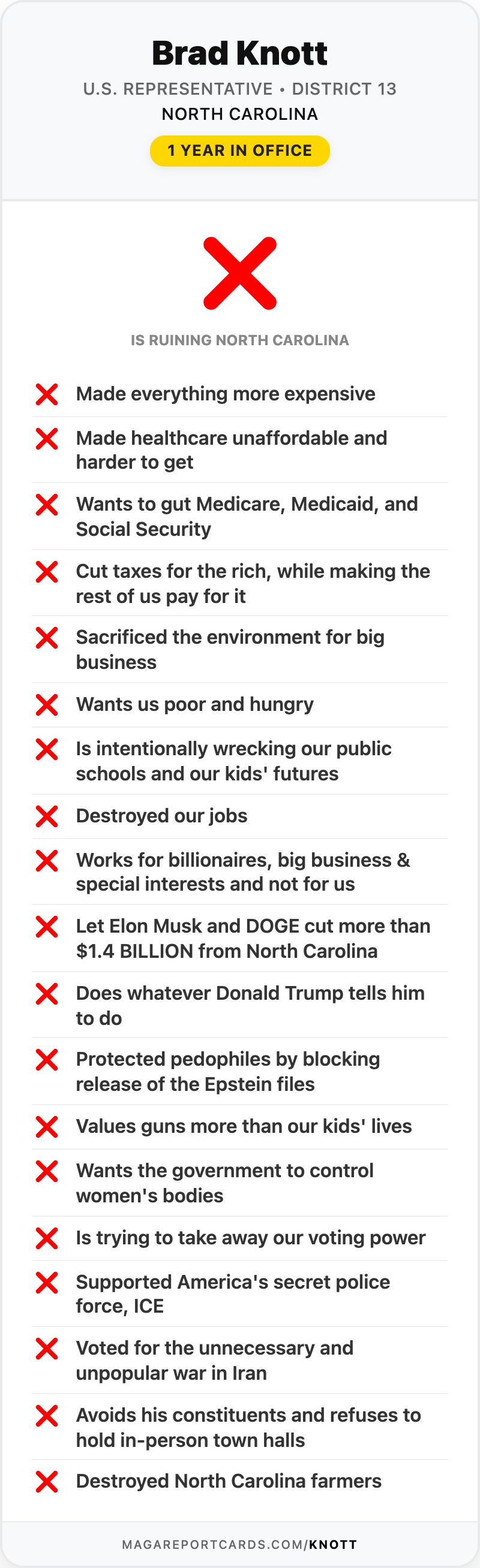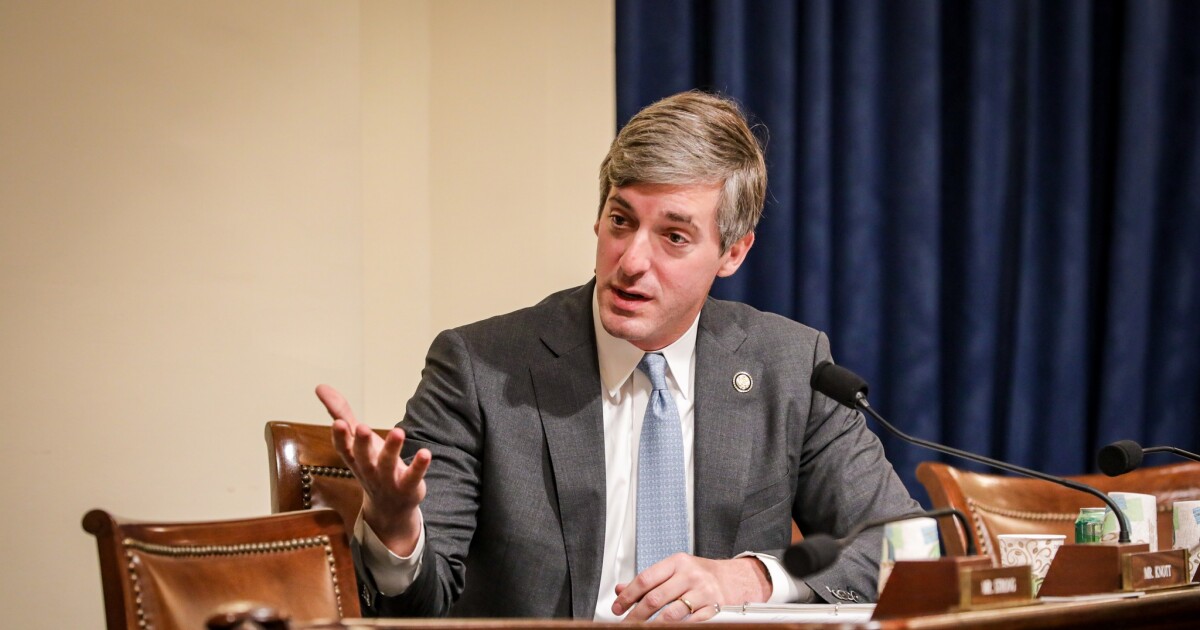
On September 19, 2025, WUNC's Colin Campbell wrote up a town hall that Brad Knott had held for North Carolina's 13th District.
The first sentence of the story tells you most of what you need to know:
"Instead of holding an in-person town hall, Knott took questions from his constituents over the phone for about 45 minutes."
It was his third such event since taking office in January 2025. All by telephone. To join, you registered in advance and waited for an automated call.
Then a constituent asked him about Medicaid.
The question
A resident of Angier — a small town in Harnett County, in the rural southern end of Knott's district — asked him about the Medicaid cuts in Trump's budget bill, which Knott had voted for.
"As our representative, how do you support these cuts? How do you reconcile them with the need to ensure continued access to health care for rural communities like the one I live in?"
That is a direct, specific, entirely fair question from someone who lives with the consequences.
The answer
"We allocated tens of billions of dollars if there are emergencies in rural healthcare spheres and spaces, and if there are changes that need to be made, we stand ready to do it, whether it's in Congress or the state legislature of North Carolina."
Take that apart.
"We allocated tens of billions of dollars if there are emergencies." That's the rural health fund written into the same law that made the cuts — money states have to apply for, set against a much larger permanent reduction. It's the standard answer, and we've watched it get used before: Mississippi's Michael Guest spent a recess promoting $206 million from that fund after voting for the law projected to take billions out of the state's Medicaid funding.
"If there are changes that need to be made, we stand ready to do it." He is describing a future Congress fixing a law he voted for. He was in the room when it passed. He had a vote. He used it.
"whether it's in Congress or the state legislature of North Carolina." And here the responsibility gets handed to Raleigh — to the state that will be absorbing the loss.
The other argument he made was that the provisions wouldn't take effect for two years, leaving time to adjust.
It is closer to fifteen months. Both the work requirement and the new six-month eligibility redeterminations begin with the first quarter that starts after December 31, 2026 — January 1, 2027, about fifteen months after he said it. What he has right is the part he didn't say out loud: the date falls after the next election.
What's actually coming to North Carolina
North Carolina stands to lose an estimated $49.9 billion in federal Medicaid funds over the next decade. The Modern Medicaid Alliance puts up to 195,000 North Carolinians at risk of losing coverage.
In the same WUNC story, Governor Josh Stein is cited warning that the bill could threaten five North Carolina hospitals with closure, as they take on more uninsured patients who can't pay their bills.
And this is a young program in North Carolina. The state expanded Medicaid only at the end of 2023; hundreds of thousands of people gained coverage, many of them in exactly the rural counties Knott represents. The ink was barely dry when Congress voted to pull the funding out from under it.
The Angier resident wasn't asking a hypothetical.
Three town halls, zero rooms
There's a reason the format matters here.
On a telephone town hall, the office controls who gets on the line, which questions reach the member, and when the call ends. There's no follow-up. There's no one else in the room hearing the answer and deciding whether it satisfied them. There's no moment where a congressman has to look at a person and say "the fund will cover it."
In March 2025, the chairman of the National Republican Congressional Committee, Richard Hudson — himself a North Carolina congressman — told House Republicans in a closed-door meeting to stop holding in-person town halls and use tele-town halls and Facebook Live instead. We wrote about what happened when Hudson took his own advice and told his constituents the Medicaid cuts were "just rumors."
Knott's constituents have asked for the real thing. In April 2025, the Johnston County Democratic Party publicized an Indivisible invitation to Knott for a town hall in Johnston County. What his district got instead were three calls.
To Knott's credit, on that third call he did take a hard question and answer it in his own words rather than dodge it. The problem isn't that he refused to speak. It's what he said — and that he said it to a phone line he controlled instead of a room he didn't.
What he's told them since
This is the same member of Congress who voted for the SAVE Act months after having voted from an address he didn't live at, and who got to Washington on nearly $2 million his own family put into a super PAC.
The pattern isn't hard to read. On the votes that cost his district money, he votes with his party. On the questions his district asks about it, he takes them by phone.
The Angier resident wanted to know how a representative reconciles a vote with the people it hurts.
Two years, he said. We stand ready.
Source
Colin Campbell, "In telephone town hall, NC Congressman Knott talks healthcare, guns, immigration," WUNC, September 19, 2025. Photo: Office of Congressman Brad Knott, via WUNC.