Brad Knott was a federal prosecutor before he ran for office. By his own account, he "worked alongside law enforcement at all levels to prosecute organized crime" — drug cartels, human trafficking, financial crimes, national gangs. Prosecutors are people who read forms carefully for a living. That's most of the job.
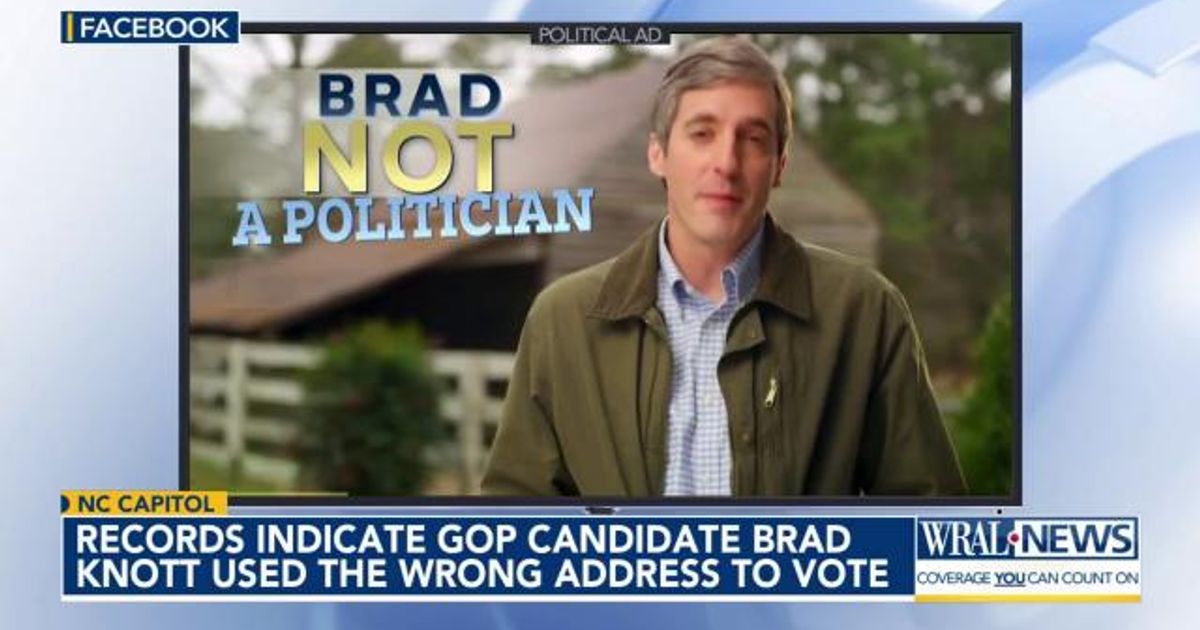
In February 2024, while he was running for Congress, WRAL's Paul Specht reported what the election records showed: Knott had been voting from an address where he didn't live.
Not once. Five general elections.
What the records show
Knott listed a property on Oberlin Road in Raleigh as his voting address from November 30, 2010 until November 30, 2023. That's his parents' house — the one he grew up in. He confirmed as much to WRAL in a phone interview.
But in April 2014, Knott bought a house on Allister Drive in Raleigh. He told WRAL it had been his residence since 2015 or 2016 — "somewhere in there."
He didn't update the registration. In his words, it "slipped my mind."
In the years between buying the Allister Drive house and finally changing his registration at the end of 2023, records show he voted in person in five general elections while registered at his parents' address.
What that means under North Carolina law
This is where a former prosecutor's explanation gets uncomfortable.
When North Carolinians vote in person, they give their address to a poll worker and sign a form testifying to their eligibility to vote in that precinct. WRAL quoted the disclaimer printed on the form:
"Fraudulently or falsely completing this form is a Class I felony under Chapter 163 of the NC General Statutes."
A Class I felony in North Carolina can carry up to two years in prison.
Knott's answer was that he didn't remember the address ever coming up:
"I can't remember specifically how the ballot exchange happened. It was just one of those things where, [the polling site] was where I'd always voted."
And his framing of the whole thing:
"It's a paperwork issue. I should have done it when I bought this place, when I moved in. But it's one of those things where I didn't do it."
He also told WRAL his votes didn't compromise the integrity of any election. WRAL asked his campaign to clarify whether he had knowingly misrepresented his address. The campaign didn't immediately comment.
Nobody came after him — and that's the point
Wake County District Attorney Lorrin Freeman didn't comment on Knott specifically, but she described to WRAL how her office handles this kind of case. Sometimes it's a verbal warning. Her explanation of why:
"It generally can be difficult to prove that the individual did not have some basis to believe they could be considered a resident of the address they used to vote."
If a board of elections found a voter had no basis to claim the residence "and the conduct was persistent, then a criminal investigation may be appropriate," she said.
Knott also told WRAL that even after buying the Allister Drive house he lived with his parents and his in-laws "for extended periods of time" — around his wedding, and while his own house was being renovated. "When I moved back with my parents during renovations, should I have filed it back? Maybe so. When I moved in with my in-laws after I got married for a few months, should I have filed it there? Maybe so," Knott said. "But, you know, we missed it. We will acknowledge that."
Neither the state nor the Wake County elections board had received any challenge to Knott's ballots.
So he got the benefit of the doubt. A system that assumes good faith, gives people room for an honest mistake, and doesn't treat a paperwork slip as a crime. That's the right way for it to work.
Hold onto that.
Then he got to Washington
On April 10, 2025 — his first spring in Congress — Knott voted for the SAVE Act. It passed 220 to 208, with 216 of the yes votes coming from Republicans.
The SAVE Act would require every American to show documentary proof of citizenship in person to register to vote or to update their registration information.
Think about what that means for someone in exactly Knott's situation. Under the SAVE Act, moving across town and updating your address isn't a form you mail in. It's a trip to an election office with a passport or a birth certificate in hand.
More than 21 million Americans of voting age don't have ready access to proof of citizenship. And 84% of women who marry change their surname, which means the name on their birth certificate no longer matches the name on their ID — a mismatch that can stop a registration cold. We laid out the full picture in our breakdown of the SAVE Act: a solution to a problem that barely exists, with a price paid by tens of millions of eligible citizens.
Knott would have been fine. He has the documents. He has a lawyer's comfort with paperwork. The people who wouldn't be fine are the ones without a filing cabinet and a spare weekday morning.
The two standards
Here is the whole thing in two sentences.
When Brad Knott spent nine years registered at his parents’ address after buying his own house, and voted five times that way, the correct response — and the one he got — was that people make mistakes and the system should absorb them.
When ordinary North Carolinians want to register or move, his vote says the system should assume they might be lying until they produce a birth certificate.
He's not the first Republican from North Carolina to campaign on election integrity with an awkward file behind him. Mark Harris — whose 2018 congressional election was thrown out over absentee ballot fraud by his own operative — took the House floor in February 2026 to demand proof of citizenship and photo ID. He's now Knott's colleague in the North Carolina delegation.
What he actually knows
Brad Knott isn't a man who stumbled into this. He prosecuted federal crime for a living. He now sits on the House Judiciary Committee, the Homeland Security Committee — and the House Ethics Committee. He knows the difference between an error and a fraud, and he knows how rare the second one is, which is why he could say with a straight face that his own five votes compromised nothing.
He was right about that.
He just voted to make sure nobody else gets the same benefit of the doubt.
Source
Paul Specht, "A Republican candidate voted from the wrong address. Will it affect his bid for Congress?" WRAL, February 28, 2024. Photo: WRAL.