In December 2023, WUNC ran a story about a strange thing happening in North Carolina's 13th Congressional District. A super PAC nobody had heard of was carpet-bombing the airwaves for a candidate nobody had heard of, months before anyone votes.
WUNC described Brad Knott as a "little-known Republican candidate" and a former federal prosecutor who "hasn't run for office before, and few people in political circles had heard of him." He was one of at least 11 Republicans in the race. And he had the advantage of being one of the first with regular TV ads, thanks to about $500,000 the group spent in November and early December of 2023 alone.
The group is called The American Foundations Committee.
Federal Election Commission records show where its money came from.
$1,960,000 of $2,587,500
Over the 2024 election cycle, The American Foundations Committee — registered with the FEC as an independent-expenditure-only super PAC, based in Louisburg, North Carolina — took in $2,587,500.
Money from people named Knott accounted for $1,960,000 of it. That's 76 cents of every dollar.
Here's the breakdown, straight from the FEC's Schedule A filings:
| Donor | Listed occupation | Total |
|---|---|---|
| Thomas R. Knott (New York) | Private equity | $1,735,000 (incl. a $500,000 loan) |
| J. Tucker Knott (Washington, DC) | Chief of staff | $75,000 |
| Sarah Tucker Knott (Raleigh) | Homemaker | $50,000 |
| Joe T. Knott III (Raleigh) | Attorney | $50,000 |
| Mary Garland Knott | Nurse | $25,000 |
| Sarah Katherine Knott Kane (Raleigh) | Event manager | $25,000 |
Thomas R. Knott by himself put in $1,735,000 — 67% of the PAC's entire haul — in seven payments between November 2023 and April 2024, including two of $500,000 each. The first, on November 14, 2023, was a straight contribution. The second, on April 10, 2024, the committee reported not as a contribution but as a loan — and its Schedule C filings show it has never been repaid: $500,000 borrowed, $0 paid back, $500,000 still carried as a debt on the committee's most recent report.
The Assembly, which covered the primary in detail, identified Thomas Knott as Brad's brother, a New York investor. It identified J. Tucker Knott as another brother — chief of staff to U.S. Senator Ted Budd, and before that chief of staff to former Rep. George Holding. Joseph Knott is their father, a Raleigh attorney who served on the UNC Board of Governors.
The only donor outside the family who gave six figures was Reynolds Services Company of Winston-Salem, at $200,000.
What the money bought
Super PACs are legally forbidden from coordinating with the candidate they support. What they can do is spend unlimited money on their own. The FEC requires them to report every dollar and say whether it supports or opposes a specific candidate.
Here is what The American Foundations Committee reported for the 2024 cycle, from its independent expenditure filings:
- $1,334,358 supporting Brad Knott
- $678,086 opposing Kelly Daughtry, his chief rival in the primary
- $381,905 opposing Fred von Canon, another Republican in the race
Read those numbers again. The family-funded super PAC spent $1,059,991 tearing down two other Republicans — 44 cents of every dollar it spent, and nearly as much as it spent promoting Knott himself.
Fourteen Republicans ran in the March 5, 2024 primary. Daughtry finished first and Knott second, forcing a runoff. Then Donald Trump endorsed Knott, posting that "Brad Knott is a strong patriot who is running for congress in North Carolina's 13th Congressional District against a RINO, Kelly Daughtry."
Daughtry quit the race on May 2, 2024, twelve days before the runoff:
"In light of President Trump's endorsement of Brad Knott for the Congressional seat in District 13, it has become clear that a pathway to victory is no longer feasible."
The runoff went ahead anyway on May 14 — early voting was already underway and it was too late to take her name off the ballot. Knott won it 90.8% to 9.2%, 19,632 votes to 1,998, and won the seat that November.
The scale of it
For comparison: Knott's own campaign committee reported $2,473,896 in receipts for the whole 2024 cycle — and $780,000 of that was loans.
So the super PAC took in slightly more than the actual campaign did — and 76% of it came from six people with the same last name.
Meanwhile, the contributions small enough that the FEC doesn't require them to be itemized — the $20 and $50 donations from ordinary people — came to $39,304. Out of $2.47 million. That's about one and a half cents on the dollar.
That imbalance didn't stop when he got to Washington. Today only about 2% of Knott's money comes from small grassroots donors, and Who Bought My Rep ranks him #244 out of 440 House members on grassroots funding. His top contributors now read like a Washington lobbying directory: the American Institute of CPAs, the Council of Insurance Agents & Brokers and the National Association of Realtors — all of it PAC money — plus the consulting giant Accenture and the drugmaker Novo Nordisk.
Why this matters past the gossip
There is nothing illegal here. A brother in private equity is allowed to write a $500,000 check to a super PAC, and then lend it another $500,000. That's what Citizens United means in practice.
But it's worth being clear-eyed about what happened in NC-13.
Fourteen Republicans ran. One of them had a family that could put nearly $2 million behind him before most voters knew his name. That money bought the earliest ads, spent over $1 million tearing down two rivals, and turned an unknown into a runoff finalist. In a district drawn to elect a Republican, the primary is the real election.
The voters of NC-13 got a choice. They just got it after the field had been narrowed by a checkbook.
And the man that checkbook sent to Congress now sits on the House Judiciary Committee, the Homeland Security Committee, and — per his own office — the House Ethics Committee.
The record since
Since arriving, Knott has voted the way the money that sent him would want. He has a 0% score from the League of Conservation Voters for 2025 and a 0% lifetime score. He voted for the SAVE Act, the bill requiring documentary proof of citizenship to register to vote — after having spent nine years voting from an address he didn't live at.
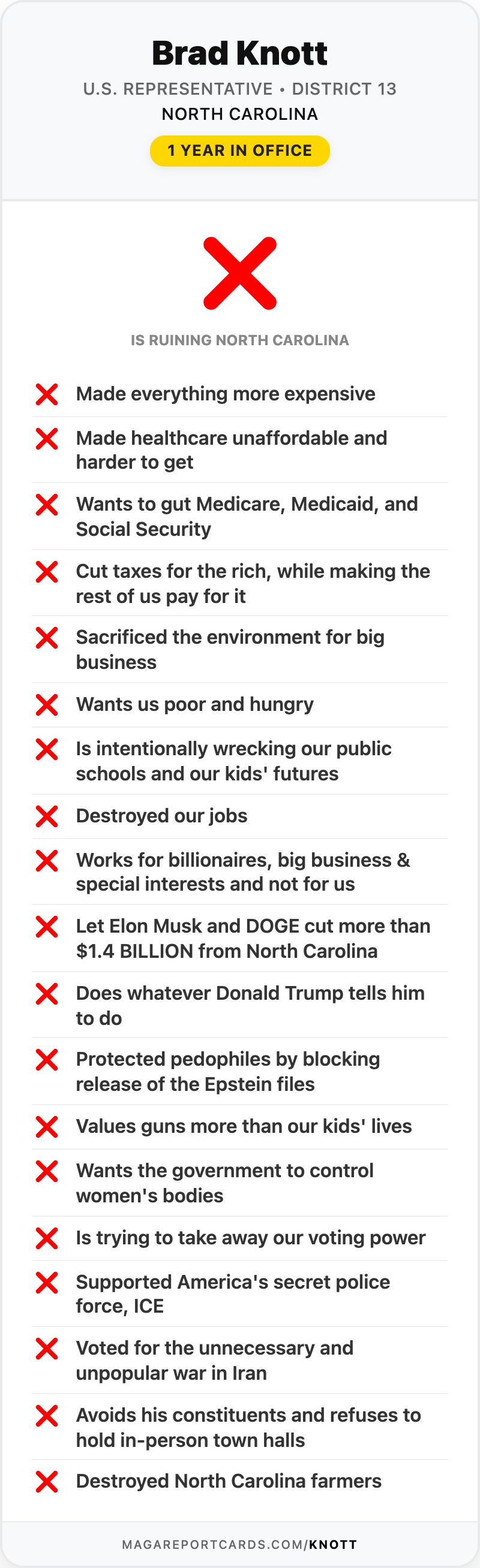
His district takes in Raleigh and seven surrounding counties — and North Carolina lost at least $714 million in federal grants to DOGE's cuts. We wrote up his first-year record in our earlier piece on Knott, and what his whole delegation's votes are doing to the state in what North Carolina's Republicans in Congress are costing you.
Sources
Colin Campbell, "Super PAC spends big on obscure Congressional candidate with early TV push," WUNC, December 14, 2023; "A Runoff Reveals A GOP Family Feud," The Assembly. Dollar figures verified against Federal Election Commission filings for committee C00514125. Photo: The Assembly.