In 2004, sisters Raechel and Jacqueline Houck — 24 and 20 years old — were killed while driving a rented car that was under an active safety recall. The recalled Chrysler PT Cruiser caught fire and crashed head-on into a semi. Their mother, Cally Houck, sued the rental company for negligence and wrongful death and won a unanimous jury verdict, then worked with the consumer group CARS to get a federal law passed making it illegal to rent out a car with an open safety recall.
By 2015 she was close. The Raechel and Jacqueline Houck Safe Rental Car Act was riding along inside a big federal transportation bill, and both chambers had a version.
Then, just before midnight on November 4, 2015, Roger Williams stood up on the House floor and offered an amendment to it.
What the amendment did
Williams's amendment was one word. It inserted "primarily" before "engaged" in the bill's definition of a rental company — limiting the new law to companies primarily in the rental business, which would have carved out auto dealerships entirely.
In practice, the Texas Tribune and the Center for Public Integrity explained, the amendment would allow a dealer to loan you a vehicle under active recall while your own car is in the shop being fixed for the same defect.
Williams did not hide his stake in the outcome. Introducing it on the floor, he said:
"I am a second-generation auto dealer. I have been in the industry for most of my life. I know it well."
He was, at the time, chairman of Chrysler Dodge Jeep RAM SRT in Weatherford, Texas, and he still runs the family dealership companies: his most recent financial disclosure lists him as sole director and president of Williams Chrysler, LP and Williams Chrysler Holding, LLC. His congressional biography told the story of trading a baseball uniform for a suit and tie and becoming a car dealer more than 40 years earlier.
The amendment passed on a voice vote. "It was the House floor, almost midnight, there was hardly anyone there," said Rosemary Shahan, president of Consumers for Auto Reliability and Safety.
Shahan's assessment of the substance was blunter:
"It seems to me that if it isn't illegal, if it isn't an ethics violation, it ought to be. His amendment benefits nobody but car dealers. And he's a car dealer."
His explanation, and the response to it
Williams argued the underlying bill was bad for small business. Vehicles, he said on the floor, "would be grounded for weeks or months for such minor compliance matters as an airbag warning sticker that might peel off the sun visor or an incorrect phone number printed in the owner's manual."
Rep. Lois Capps of California answered that directly:
"This is ridiculous. NHTSA does not issue frivolous recalls. All safety recalls pose serious safety risks and should be fixed as soon as possible."
Williams was not the only dealer working the floor that night. Rep. Mike Kelly, a Pennsylvania Republican who sells Chevrolets, Cadillacs, Hyundais and KIAs and co-chairs the House Automotive Caucus, spoke in favor: "There is not a single person in our business that would ever put one of our owners in a defective car or a car with a recall." Kelly later said weighing in with "my personal expertise" on relevant bills is part of the job. (Kelly turns up on this site for a separate exercise in personal expertise: taking $974,100 in taxpayer-backed pandemic loans and then voting to keep the recipient list secret.)
Calls to Williams's press aides went unreturned at the time.
Who actually wrote it
The House Ethics Committee's report — the same one that cleared him — lays out where the amendment came from, and it did not come from Roger Williams.
The National Automobile Dealers Association had already tried and failed to get this language into the Senate's bill. So the group went looking for a House sponsor, and Williams "immediately emerged as a likely candidate": a car dealer who, in the NADA official's words, "knows the business of automotive retailing" and would spot the problem straight away.
On October 29, 2015, that official emailed Williams's legislative director to say dealers "potentially have a major problem" with the bill. Before that email, the committee found, Williams had not contemplated amending the transportation bill at all — and neither he nor anyone on his staff knew it might reach the loaner cars dealerships hand out. He agreed to sponsor it the same afternoon. His deputy chief of staff's account of the decision: it "[s]ounds like a no-brainer."
NADA supplied the rest.
- The amendment itself. The group sent over the one-word text. Williams's office passed it to the House lawyers who check that an amendment is properly formatted, and "neither Representative Williams' staff nor the Office of the Legislative Counsel made any substantive changes to the amendment language." Asked whether he had checked independently whether the bill even applied to dealerships, the deputy chief of staff said he "just read the [bill] language and the language seemed pretty clear."
- The talking points, along with a list of "minor" safety recalls that would ground vehicles under the bill as written.
- The speech. NADA gave the staff "a draft floor speech for the Congressman to deliver in support of the amendment." On November 4 he delivered it, and "neither Representative Williams nor his staff appear to have made any substantive changes to its NADA-drafted language."
So the line the whole story turns on — I am a second-generation auto dealer, I have been in the industry for most of my life, I know it well — opened a speech the car dealers' lobby had drafted for him.
The amendment lost
Here is the part that matters most, and the reason this story has a decent ending.
The American Car Rental Association opposed the carve-out. So did senators in both parties, and the amendment was dropped from the final bill. The National Automobile Dealers Association and the National Independent Automobile Dealers Association had backed it; they lost.
On December 4, 2015, the Raechel and Jacqueline Houck Safe Rental Car Act was signed into law as part of the FAST Act — without Williams's dealer exemption.
The law took effect June 1, 2016. It is now a federal violation for a company with a fleet of 35 or more rental or loaner vehicles — including some car dealers — to rent, loan or sell a recalled car until the defect is repaired.
That protection exists because Williams's amendment failed, not because he changed his mind.
And Cally Houck was watching the exact gap he'd tried to widen. When the law took effect she said:
"I'm thrilled that the Safe Rental Car Act named for my beautiful, treasured daughters, Raechel and Jacqueline, is now the law of the land. But I'm worried about the loaner car loophole for car dealers and remain committed to closing that dangerous safety gap."
The loophole she wanted closed is the one Williams had gone to the floor at midnight to blow wide open.
The ethics investigation
The attempt did not pass without consequence.
- May 13, 2016 — the Office of Congressional Ethics transmitted the matter to the House Ethics Committee.
- June 27, 2016 — the Ethics Committee announced it had decided to extend its review, revealing publicly that it was examining whether Williams had improperly used his office to benefit his own financial interests.
- August 1, 2017 — the committee closed the matter without sanction.
Read the actual finding, though, because Williams's summary of it and the committee's language are not the same document.
The committee concluded that while the amendment "could have affected Representative Williams' personal financial interests," the circumstances "did not create a reasonable inference of improper conduct." And it criticized him for how he'd gone about it, stating that a member considering legislation that could affect their personal financial interests "should contact the Committee before doing so."
He hadn't.
Williams's public statement: "As I knew all along, the Committee found no violation of any law, rule or regulation." He described his work as bringing "sensible business solutions" to government overreach hurting small businesses.
"No violation" is true. It is also the narrowest possible reading of a finding that said, in the same breath, that the amendment could have affected his own money and that he should have asked first.
The pattern
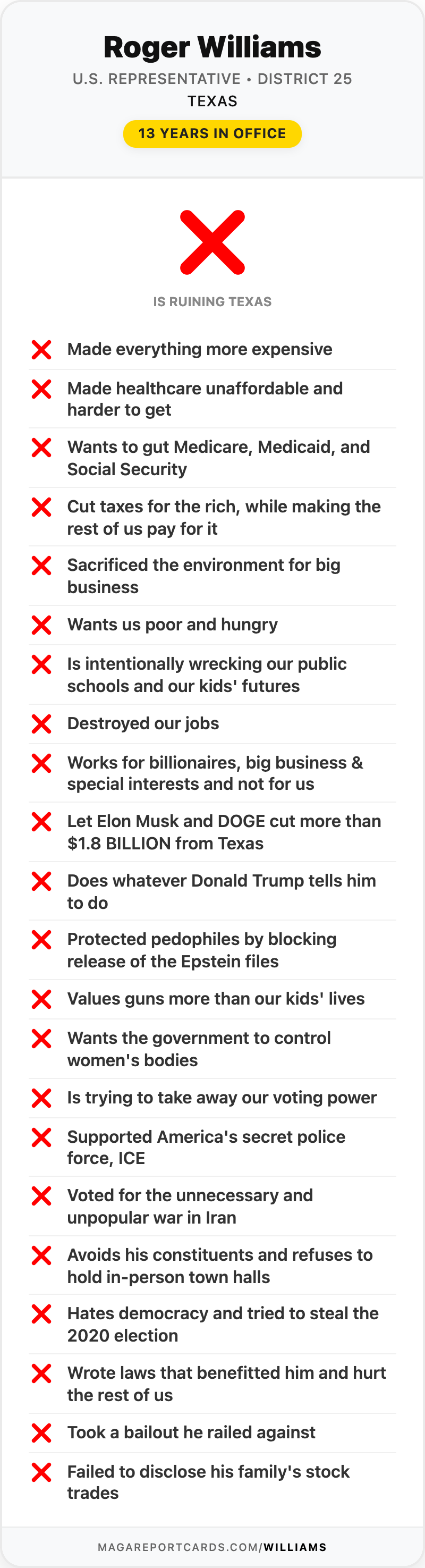
This is not an isolated episode in a long career. Roger Williams has represented Texas's 25th District since 2013 — 13 years — and the same shape keeps recurring: the seat gets used, and someone who has given him money or who shares his business is on the receiving end.
- In June 2020 he called a bank on behalf of a longtime donor about a pending bankruptcy case, mentioning — he testified he "might have," but couldn't recall — his seat on the committee that regulates banks. A watchdog asked federal ethics investigators to look at it.
- He is one of 45 Republicans on this site who broke the STOCK Act, the law requiring members to disclose their stock trades.
- The National Automobile Dealers Association — the group that wrote his 2015 amendment — remains one of his donors, at $35,000, alongside the banks, credit unions, insurance agents and accountants regulated by the Financial Services Committee he sits on. Only about 1% of his money comes from small donors; he ranks #432 out of 440 House members on grassroots funding.
The bottom line
A law named after two dead women was moving through Congress. It said: don't rent people cars you already know are dangerous.
A car dealer in Congress waited until nearly midnight, stood up, said out loud that he was a car dealer, and asked his colleagues to exempt car dealers.
The Senate stopped him. The House Ethics Committee told him he should have called first. And Cally Houck got the law named for her daughters anyway.
Texas's 25th District should ask what its congressman would have done if nobody had been watching that night — because almost nobody was.
Source
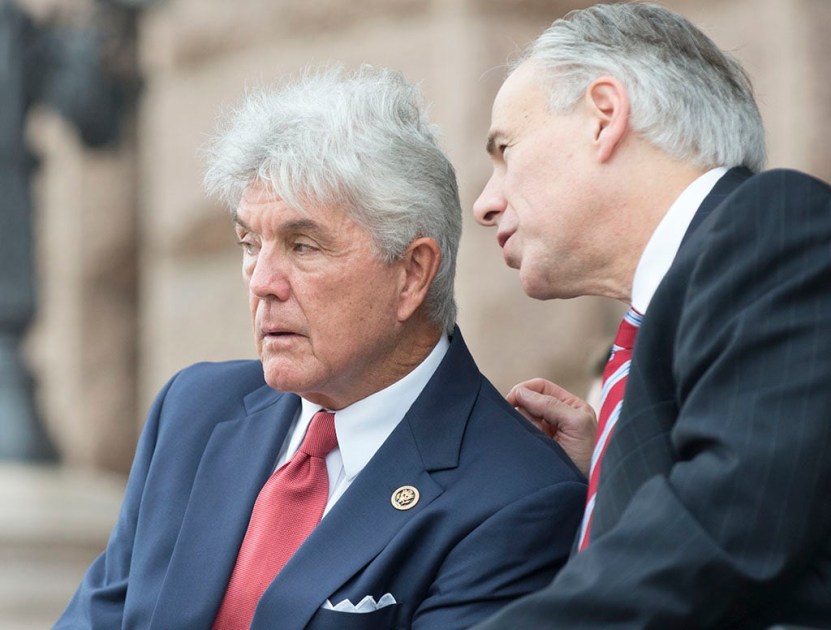
- Was Roger Williams' Auto Dealer Amendment a Conflict of Interest? — The Texas Tribune / The Center for Public Integrity, November 18, 2015. Photo: Bob Daemmrich.
- Car dealer-congressman subject of ethics probe — Center for Public Integrity
- U.S. Rep. Roger Williams cleared in ethics investigation — The Texas Tribune, August 1, 2017
- Safe Rental Car Act Passes as Part of Highway Bill — Auto Rental News
- In the Matter of Allegations Relating to Representative Roger Williams — Report of the Committee on Ethics, H. Rept. 115-271, August 1, 2017