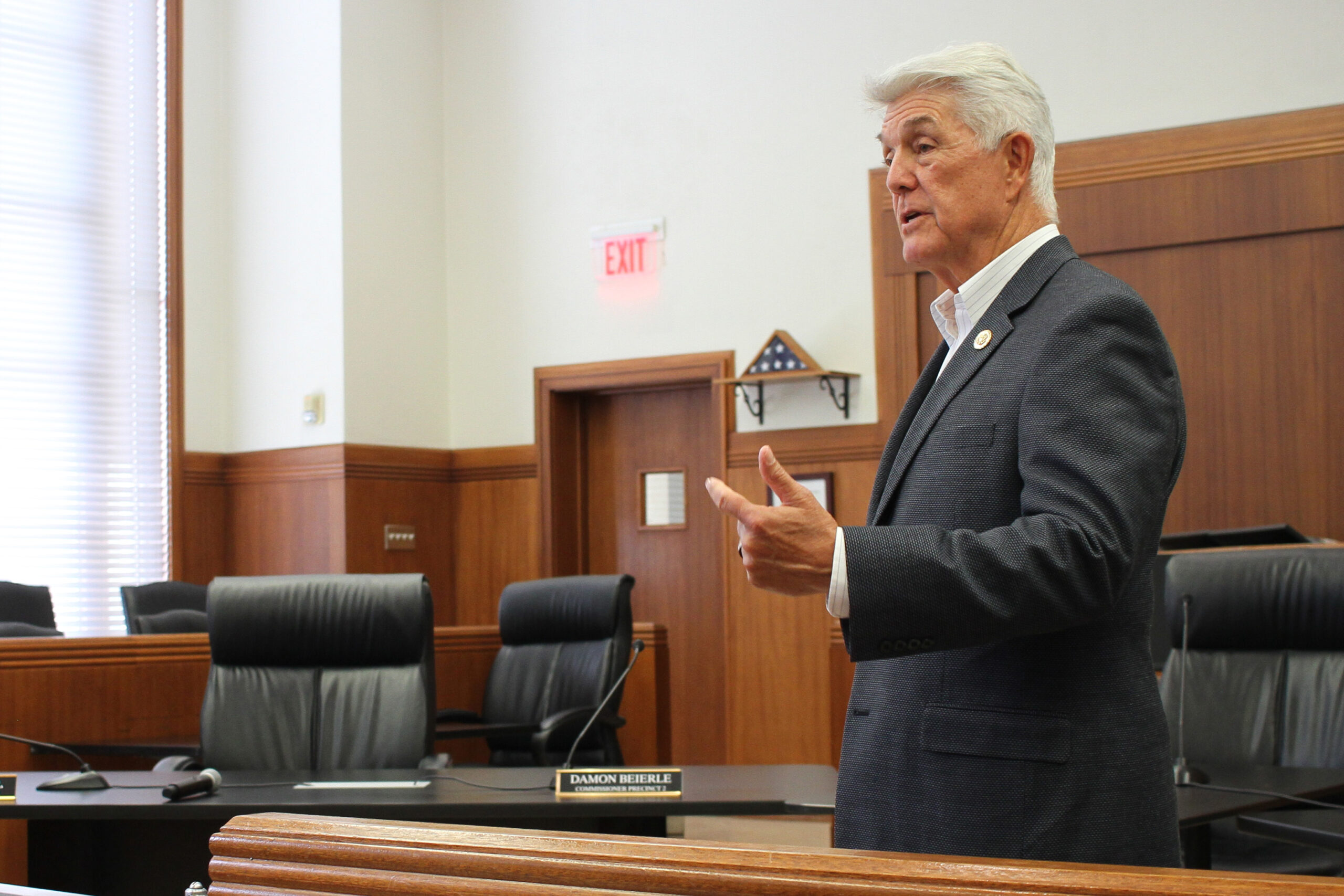
On June 11, 2020, Roger Williams picked up the phone and called a senior official at UMB Bank.
He was not calling about a constituent's lost Social Security check. He was calling to set up a meeting between the bank's chief executive and one of his campaign donors, an oil investor named Gary Martin — who was unhappy about a loan the bank had made to a company Martin's own business was fighting in court.
And according to the watchdog group that later asked federal ethics investigators to look at it, Williams introduced himself on that call not just as a member of Congress, but as a member of the House committee with regulatory authority over the bank.
What the fight was actually about
Martin, of Marble Falls, is a manager of Repeat Precision. Repeat Precision had been battling a company called Diamondback Industries in a patent case. Diamondback ended up in Chapter 11 bankruptcy, with both Repeat Precision and UMB among the creditors.
Martin's grievance was that UMB was preparing to finance Diamondback — a "multi-million dollar loan package" that Martin called proposed rescue financing for a company already owing Repeat Precision and its lawyers more than $40 million on a judgment Repeat had won against it. He wanted to talk to the top of the bank about it. And in a bankruptcy proceeding, "creditor wants a private word with another creditor's CEO" is not a neutral request — it is a party to a pending court case trying to move things outside the courtroom.
The bank official said no. He then reported the call to UMB's outside counsel, Kyle Hirsch, who brought it to the bankruptcy judge's attention. That triggered depositions aimed at working out whether Martin and Repeat Precision had tried to improperly interfere in the case.
Which is how a congressman's phone call ended up on the record, under oath.
"I didn't know what it was all about"
Williams's account was that he was doing something routine and knew nothing about the underlying dispute — not Martin's anger at the bank, not the bankruptcy. "All I wanted to do was set the meeting up," he said in his deposition. "I didn't know what it was all about."
The testimony and documents say otherwise.
Martin testified that before the call he sent Williams talking points and other documents — routed through Williams's congressional staff. He testified that he had sat down with Williams over lunch at his own ranch to share his frustrations about the bank.
And there were text messages between the two men. In one, the congressman directed Martin to send information to a congressional staffer's personal email address.
That last detail is the one worth sitting with. There is an official House email system, and it creates records. Routing a donor's materials to a staffer's personal inbox instead is a choice.
"Whenever I ask him to"
The complaint filed by Campaign for Accountability on June 3, 2021 argues this wasn't a one-off.
Martin testified under oath that Williams sets up meetings for him "whenever I ask him to […] on different deals that I do." He described other instances — including a call Williams made to the State Department to help Martin pursue a government contract to sell personal protective equipment.
In his own testimony, Williams denied ever making any other calls on Martin's behalf.
Both men were under oath. Their accounts don't match.
"Rep. Williams intervened in a pending court action at the request of his longtime donor," said CfA executive director Michelle Kuppersmith. "This goes well beyond typical constituent service and likely violates House rules."
The complaint asked the Office of Congressional Ethics to examine whether Williams violated the federal prohibition on members taking official actions for anyone's financial gain, and the rule against using congressional staff for purposes they weren't funded for.
What the bank's lawyers said — and the fair caveat
UMB's outside counsel, Kyle Hirsch, testified under oath that Williams's intervention exerted inappropriate pressure on the bank, and that unless the CEO agreed to meet his donor there could be problems for UMB in Congress. Those are the reporters' words, not a quotation from his deposition.
It's only fair to say what cuts the other way. Hirsch wasn't on the call. When he was pressed on how he concluded there was a threat in it, he said he couldn't answer without breaching attorney-client privilege. And Michael Garner, UMB's Texas-Oklahoma president and the man Williams actually called, said in his deposition that the request was "unusual" but that he didn't view the conversation with Williams as threatening.
Williams's spokesman at the time, Colby Hale, called Hirsch "a zealous swamp attorney, with no firsthand account of any conversation, trying to smear a congressman in order to score political points for his big bank client," and said the judge had admonished Hirsch for "unjustifiably dragging Congressman Williams into the conversation."
So: reasonable people can argue about whether the call carried an implied threat.
What isn't in dispute is the part Williams did himself. He testified that his attempt to broker the meeting was routine — and that he might have mentioned his post on the House Financial Services Committee, but couldn't recall.
A member of Congress who calls a bank on behalf of a donor and can't remember whether he invoked the committee that regulates banks has already told you the answer to the question that matters.
The donor relationship, in numbers
Federal Election Commission records show Gary H. Martin of Marble Falls — listed as the owner of RJ Machine Company — giving to Williams's campaign committee going back to 2012, cycle after cycle, most often at or near the legal maximum an individual may give.
Including in March 2021 — months after the phone call became public in sworn depositions, and two months before the ethics complaint was filed.
The committee is the whole point
Williams doesn't just sit on the House Financial Services Committee. He also chairs the House Small Business Committee. And the industry his Financial Services seat oversees is a large share of who funds him: the American Bankers Association, America's Credit Unions, the Independent Insurance Agents & Brokers, the American Institute of CPAs.
Only about 1% of his money comes from small grassroots donors — he ranks #432 out of 440 House members on that measure, near the very bottom of the chamber.
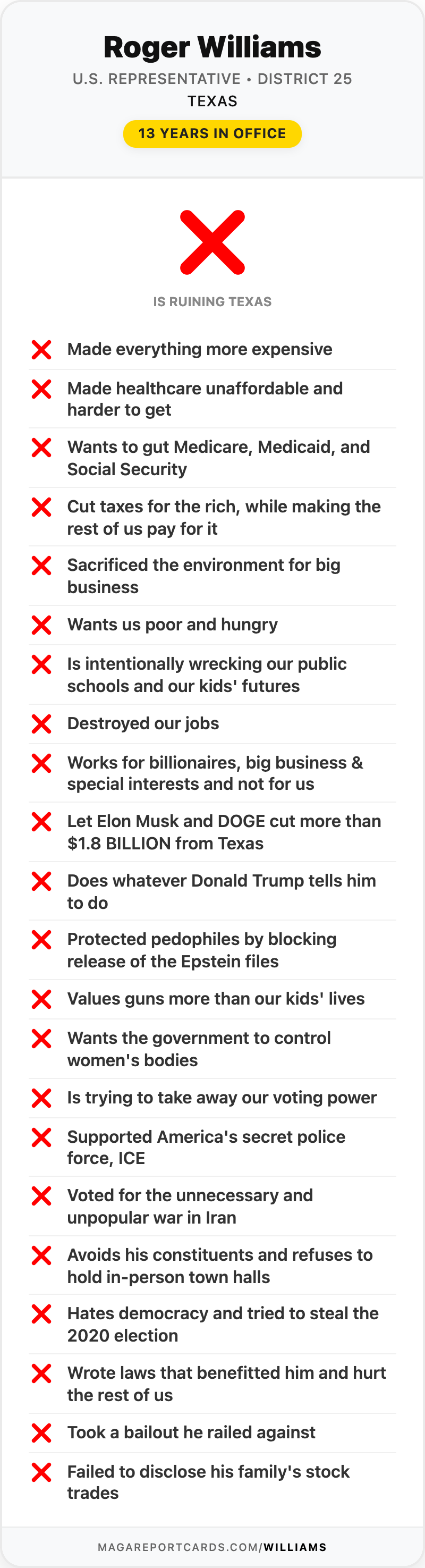
We've written before about what he does with the committee seat: pitching "Trump Accounts" on television as a fix for Social Security, a plan the people who designed it have openly described as a route to privatizing the program — while the banks and financial firms that would collect the fees write him checks.
This isn't his first ethics file
Williams has been here before. He is also one of 45 Republicans we cover who broke the STOCK Act, the law requiring members of Congress to disclose their stock trades — in his case, a 2021 Campaign Legal Center complaint over his wife's undisclosed sales of General Electric, Nvidia and Disney stock.
And he is not the only Texas Republican on this site with an ethics file open: Rep. Lance Gooden is under a House Ethics Committee investigation over his spending.
The bottom line
Constituent service is a real and good part of a congressman's job. Helping a small business untangle a problem with a federal agency is what the office is for.
This wasn't that. This was a call to a bank, on behalf of a donor who had been feeding the congressman talking points, about a fight that was already in front of a federal bankruptcy judge — placed by a member of the committee that writes the rules for banks, who couldn't quite recall whether he'd mentioned it.
Texas's 25th District has had Roger Williams for 13 years. This is what the seniority bought.
Source
- Watchdog Requests Investigation into Rep. Roger Williams for Abusing Position to Aid Long-Time Donor — Campaign for Accountability, June 3, 2021
- Congressman accused of pressuring bank on behalf of Marble Falls donor — Alex Copeland, DailyTrib.com, October 19, 2020, reporting on the Houston Chronicle's account. Photo: DailyTrib.com file photo.
- Texas Congressman Roger Williams pressured a bank to help out a top donor, records show — Jay Root, Houston Chronicle, October 15, 2020 (the original reporting; the live page has been taken down, so this is the Internet Archive's October 17, 2020 capture).