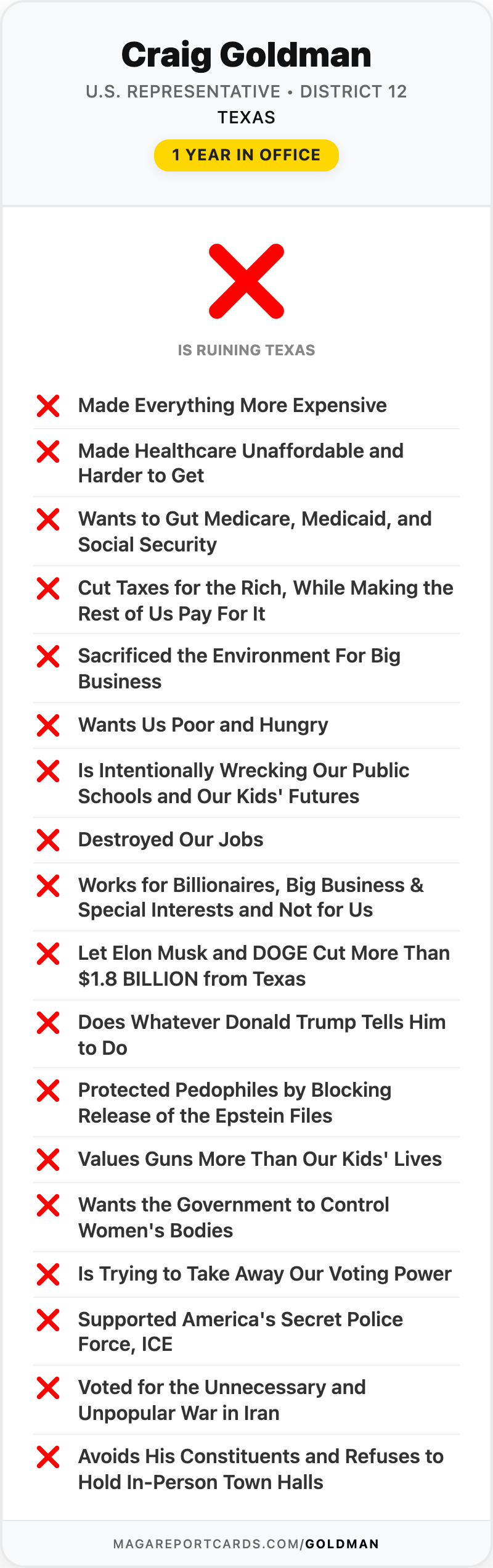
Craig Goldman has been in Congress since January 2025. In that time, exactly one thing he wrote has become law.
It is Public Law 119-9, signed by President Trump on May 9, 2025. It reads, in its entirety, that Congress disapproves a Department of Energy rule "relating to 'Energy Conservation Program: Energy Conservation Standards for Commercial Refrigerators, Freezers, and Refrigerator-Freezers'... and such rule shall have no force or effect."
Goldman's summary of why, from his own op-ed in The Hill three days after the House vote: "I led a resolution, H.J. Res. 75, to repeal burdensome standards on commercial refrigerators and freezers."
Here is what the Energy Department said the burdensome standards would do.
DOE's own numbers
The rule Goldman erased was published on January 21, 2025, at 90 Fed. Reg. 7464. Commercial refrigeration equipment is the reach-in display cases, chef bases and freezers in grocery stores, convenience stores, restaurants and bodegas. (Walk-in coolers are a separate category with their own standards, which this rule did not touch.) It runs 24 hours a day, and the electricity to run it is a standing cost for every one of those businesses.
Congress requires DOE to revisit these standards every six years and set them at the level that is technologically feasible and economically justified. DOE ran the analysis, considered six different stringency levels, and picked the third. From the rule's own summary of national benefits and costs:
- Lifetime energy savings for equipment bought over 30 years (2029–2058): 1.11 quadrillion Btu — a 6.5% cut in the energy this equipment uses.
- Net present value of consumer benefits: $1.32 billion at a 7% discount rate, $3.43 billion at 3%. That figure is future operating-cost savings minus the higher purchase price of the equipment. It is already net of the sticker shock.
- Emissions avoided: 19.7 million metric tons of CO₂, plus 6,000 tons of sulfur dioxide and 36,900 tons of nitrogen oxides — the pollutants that cause asthma attacks and heart attacks.
- Average life-cycle cost savings were positive for every single equipment class, with payback shorter than the equipment's 14-year average life.
And the cost side, in DOE's words: manufacturers would incur "total conversion costs of $117.7 million," with industry net present value falling between $51.3 million and $77.8 million against a baseline of $3.02 billion.
Line those up. Roughly $118 million in one-time retooling costs for the companies that build the equipment, against $1.32 billion to $3.43 billion in net savings for the businesses that buy it and pay to run it. Compliance wouldn't have started until January 22, 2029 — four years of lead time.
Goldman's resolution deleted it. It passed the House 214–193 on March 27, 2025, with all 209 Republicans who voted saying yes and only five Democrats joining them, then the Senate 52–45 on May 1.
"Shall have no force or effect" is not the whole of it
H.J.Res. 75 was a Congressional Review Act resolution, and the CRA does something ordinary repeals don't. Once Congress disapproves a rule this way, the agency is barred from issuing a rule in "substantially the same form" unless Congress passes a new law authorizing it.
So this is not a pause. Congress requires DOE to review these standards every six years; Goldman's law makes it very hard for DOE to do anything with that review. The convenience store owner in Fort Worth paying to run a 1990s-efficiency cooler will keep paying it, and the agency that calculated the savings is not allowed to try again.
The follow-up bill
Ten months later, Goldman brought the Homeowner Energy Freedom Act to the floor. It passed the House 210–199 on February 25, 2026, and is now in the Senate.
His pitch, from his own press release: "I'm proud to lead the Homeowner Energy Freedom Act, a bill that could reduce the costs of new homes by up to $31,000."
The operative text is a single section. It repeals three sections of the Inflation Reduction Act and rescinds the unobligated balances of two of them:
Section 50122 is the High-Efficiency Electric Home Rebate Program — $4.5 billion, and it is not a subsidy for builders or utilities. Under 42 U.S.C. 18795a, it pays rebates directly to low- and moderate-income households: up to $8,000 toward a heat pump, $1,750 for a heat pump water heater, $1,600 for insulation and air sealing, $2,500 for wiring, $4,000 for an electrical panel, $840 for a stove or dryer — capped at $14,000 per household. For a household under 80% of area median income, the rebate covers 100% of the cost. Between 80% and 150%, it covers half.
Section 50123 is $200 million in grants to train home energy efficiency contractors. Job training, in a trade with a labor shortage.
Section 50131 is $1 billion in grants to states and cities that choose to update their building energy codes.
Where the $31,000 comes from
Not from any of that.
The $31,000 figure comes from the National Association of Home Builders, which does not claim it as its own research: "Home Innovation Research Labs has found that compliance with the 2021 IECC can add more than $20,000 to the price of a new home, but in practice, home builders have estimated increased costs of up to $31,000." NAHB is the home builders' trade association, and it endorsed Goldman's bill.
Set aside whether the number is right. Goldman's bill does not repeal the 2021 IECC. It cannot — the IECC is a model code written by a private standards body and adopted, or not, by state legislatures and city councils. What Section 50131 does is offer states a billion dollars if they choose to adopt it. Deleting the grant deletes the money. It does not delete a single line of code from a single jurisdiction, and it does not lower the price of a single house by a single dollar in any state that has already adopted the code — or in Texas, which hasn't.
What the bill unambiguously does do is take up to $14,000 off the table for a family under 150% of area median income that wanted a working heat pump, and claw back whatever is unspent.
Goldman represents Texas's 12th District, in a state where summer heat is a public health emergency and the grid has failed people in living memory. His answer to home energy costs is to cancel the program that pays low-income families to make their homes cheaper to cool.
What ties it together
Goldman sits on the Energy and Commerce Committee, which writes these rules. He has a 0% lifetime score from the League of Conservation Voters — 0% in 2025, 0% for his career. In February 2026 he also introduced the Zero-Based Regulatory Budgeting to Unleash American Energy Act, which would put expiration dates on the energy regulations of the Energy Department, four Interior bureaus and FERC — one year for every rule already on the books, five years for new ones. "Texas leads the nation in passing prudent energy deregulation policies," he said. "It's time for the federal government to follow Texas' example."
Every one of these is sold as lowering costs. The refrigerator rule was cost savings, calculated by the agency, in dollars: $1.32 billion net, minimum. The home rebates are cost savings that arrive as a check to a household that needs one. Goldman has spent his first term deleting both.
And he has been hard to ask about it. In September 2025, when constituents who said they had repeatedly and unsuccessfully tried to reach his office to arrange a town hall protested outside a Fort Worth Chamber of Commerce breakfast, Goldman said it was not clear to him what the demonstration was aimed at.
We deserve better.
Source
Energy Conservation Program: Energy Conservation Standards for Commercial Refrigerators, Freezers, and Refrigerator-Freezers, U.S. Department of Energy final rule, 90 Fed. Reg. 7464, January 21, 2025; H.J.Res. 75, Public Law 119-9; H.R. 4758, Homeowner Energy Freedom Act, as passed the House. Roll call from the Office of the Clerk. Photo: official congressional portrait via Wikimedia Commons.