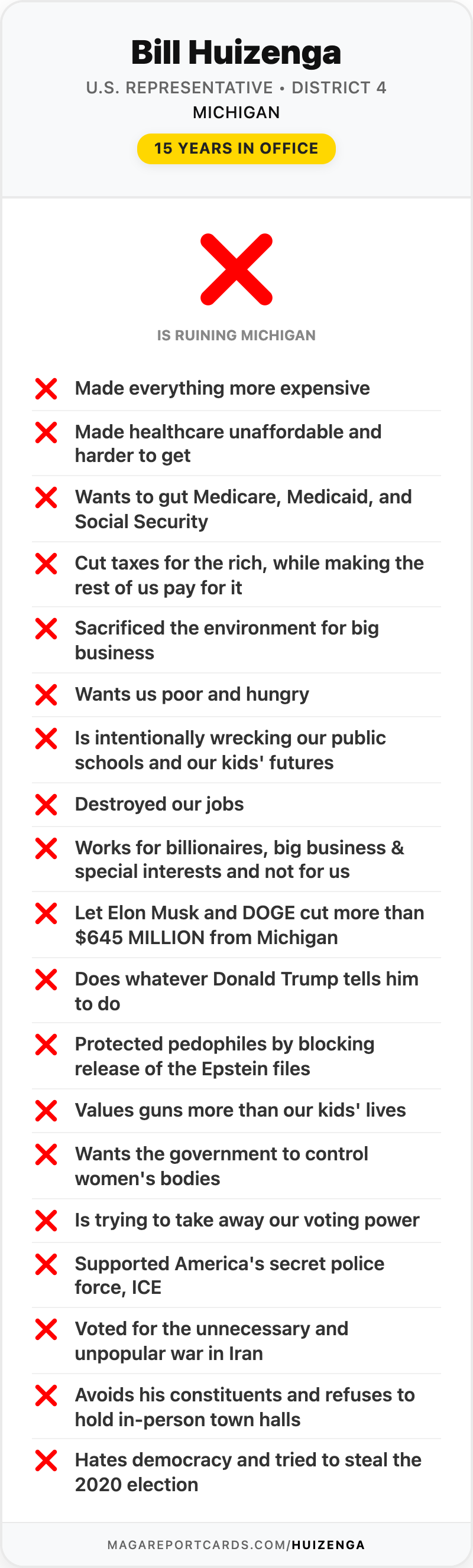
The J.H. Campbell coal plant sits in Bill Huizenga's district. It was supposed to close in May 2025. The Trump administration used emergency powers to keep it burning coal for more than a year after that.
When the Detroit News asked Huizenga where he stood, he defended keeping plants like it open and blamed Michigan Democrats. On September 11, a federal appeals court threw out the order, saying the administration had stretched the meaning of "emergency" beyond what the law allows.
A closure the company planned
The Campbell plant is in West Olive, just west of Grand Rapids, in Michigan's 4th Congressional District. Its owner, Consumers Energy, planned to close it in May 2025, a move it negotiated with state officials and advocacy groups. It had worked to replace the plant with cleaner energy, with closure plans approved by state officials and grid authorities.
Instead, Energy Secretary Chris Wright ordered it to keep running. He used a short-term emergency power in federal law that lasts 90 days at a time, and then kept renewing it. By the time of the ruling, the department had re-issued the order six times. Wright has said the plant's power is needed to protect against electricity shortages.
What Huizenga said
In August, Huizenga's Democratic opponent, state Sen. Sean McCann, made the plant an issue in the race. Asked about his position, Huizenga sent the Detroit News a statement:
"forcing the premature closure of cheap, reliable power plants is punishing hardworking Michiganders who just want to keep their lights on without going broke."
He went on:
"We wouldn't be in this mess if it wasn't for (Gov.) Gretchen Whitmer and her Green New Deal cronies in the state Legislature like Sean McCann."
He also said Michigan families are "watching their utility bills go through the roof."
What keeping it open actually cost
Here's what his statement left out.
The plant's closure wasn't "forced" on anyone. The company that owns it planned it and negotiated it. What was forced was keeping it open, by the Trump administration, over the objections of the state.
And that has a price. Consumers Energy's own filing with federal securities regulators put the cost of keeping Campbell running through June 30, 2026, at $259 million, after subtracting $239 million the plant earned selling power. Earthjustice, which challenged the order, put the running cost at about $642,000 a day. Opponents of the order say that bill lands on families and businesses in the Midwest.
If Huizenga is worried about utility bills that "go through the roof," the $259 million spent keeping a plant open that its own owner meant to close is a strange thing to leave out.
What the court ruled
A unanimous three-judge panel of the U.S. Court of Appeals for the D.C. Circuit threw out the order. Judge Cornelia Pillard wrote that these emergency powers are "essentially a narrow, last-resort backstop," the Associated Press reported.
The court was blunt:
"The Department's reading of 'emergency' invites frequent federal interventions that are unsupported by the statute and threaten the stability of the energy market."
It said it is the states, informed by federal and regional assessments, that "bear the responsibility to plan for and avert reliability risks on an ongoing basis." Michigan did that planning. The administration overrode it.
The Energy Department defended its orders, saying they "prevented blackouts and likely saved hundreds of lives during peak capacity events." Michigan, Minnesota and Illinois were among the challengers.
Not the first time
This isn't the only time Huizenga has sided with power plants on pollution. In 2025 he was one of the House Republicans who voted to let an energy board block clean-air rules for coal and gas plants.
The bottom line
The J.H. Campbell coal plant in Bill Huizenga's district was scheduled to close in May 2025 under a plan its owner negotiated with the state. Trump's Energy Department re-issued emergency orders six times to keep it running, at a cost Consumers Energy put at $259 million through June 2026. Asked about the plant, Huizenga blamed Gov. Whitmer's "Green New Deal cronies." On September 11, 2026, a unanimous federal appeals court threw out the order.
Source
Orders to keep coal plant open fuel Michigan political fight: Insider — Craig Mauger, Beth LeBlanc, Melissa Nann Burke and Grant Schwab, The Detroit News, August 30, 2026 (archived). Also: Judge Knocks Down Trump's Order to Keep a Michigan Coal Plant Open — The Washington Sun; Court rejects DOE 'emergency' order delaying coal plant retirement as overstep — Utility Dive. Photo: Annabelle Gordon / Sipa via AP Images.