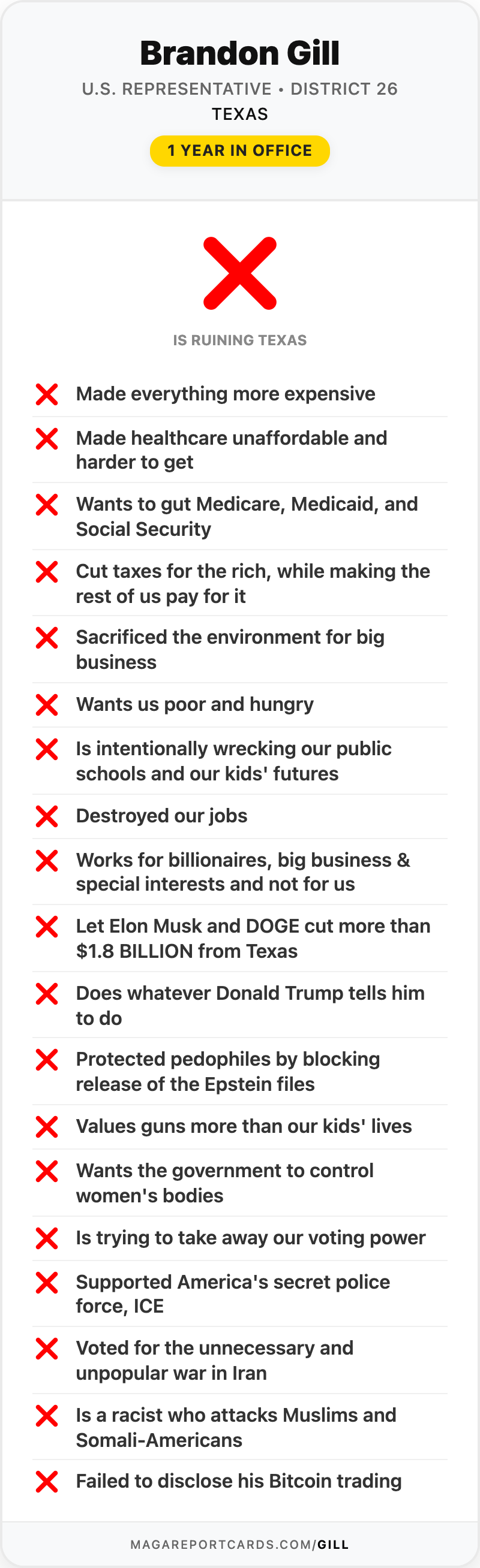
On September 3, 2026, Brandon Gill introduced the Ending Restaurant Purchases with SNAP Act of 2026. It would bar people on food assistance from using their benefits at a restaurant.
Here is how he described the thing he is ending:
"Taxpayers are footing the bill for fast food through SNAP. More than $524 MILLION was spent at restaurants through this loophole in just two years. Today, I introduced legislation to end the fast-food loophole and refocus SNAP on nutritious groceries for struggling Americans."
The word doing the work in that sentence is "loophole." A loophole is a gap somebody slipped through. This isn't one.
It has a name, and it was built on purpose
The thing Gill is describing is the Restaurant Meals Program. It is a state option under federal law, written into the rules deliberately, and it exists for a specific reason that Gill's statement does not mention.
It is for SNAP recipients who cannot cook or store food. The U.S. Department of Agriculture limits it to people who are elderly, who have a disability, or who are homeless — plus their spouses.
That is the entire population of the program. Someone who is housed, able-bodied and under 60 cannot use their benefits at a restaurant in any state. There is no loophole for them to slip through, because the rule already excludes them.
So what the bill actually does is take prepared meals away from a person in a wheelchair who cannot stand at a stove, an 80-year-old whose kitchen is a hot plate, and someone sleeping in a car with nowhere to keep a bag of groceries. Nine states run the program: Arizona, California, Illinois, Maryland, Massachusetts, Michigan, New York, Rhode Island and Virginia. Texas, which Gill represents, is not one of them.
The $524 million, in context
The number comes from Sen. Joni Ernst's office, which told Fox News that "from June 2023 to May 2025, more than $475 million in taxpayer dollars funded Restaurant Meals Program meals at fast-food establishments" and that "$524 million in taxpayer funds were spent through the Restaurant Meals Program overall" in the same window. Two years, nine states.
Now put it next to a vote he cast.
On July 3, 2025, Gill voted "Aye" on the One Big Beautiful Bill Act, Trump's budget bill. The Congressional Budget Office scores that law as cutting food assistance by nearly $187 billion — the largest cut to food assistance in American history. Four million people are no longer receiving food aid.
The cut he voted for is roughly 350 times the spending he is now filing legislation to stop. He was not worried about the food budget fourteen months ago. He is worried about it now that the target is disabled people ordering lunch.
"Do the American people need Coca-Cola to survive?"
The line is not from this week. Gill said it on June 25, 2026, at a hearing his own Oversight subcommittee held on "Combating Waste, Fraud, and Abuse in SNAP", pressing the Democrats' witness — Gina Plata-Nino, the Director of SNAP Policy and Advocacy at the Food Research and Action Center. "Do the American people need Coca-Cola to survive?" he asked her. When she did not answer it the way he wanted, he answered it himself: "I think most people can rationally say that you don't need Coca-Cola to survive."
Nobody claims otherwise. The question is not whether a soda is necessary. The question is what a homeless person is supposed to do with a package of raw chicken. A month after that hearing Gill signed a letter led by Sen. Joni Ernst objecting to SNAP benefits being spent on fast food. The bill came in September.
This is the shape these bills always take. A rule that sounds like common sense to a person with a kitchen becomes a wall for a person without one. We saw the mirror image of it earlier this year, when Rick Crawford — who voted for the same $187 billion cut — won a 384-35 bipartisan vote for an amendment letting SNAP recipients buy a rotisserie chicken while it was still warm. One party takes the food away in the budget and then legislates, loudly, about the temperature of what's left.
Gill has now filed a bill that would take the warm meal back.
The pattern in his district
Gill represents Texas's 26th District. He has spent a lot of his first term on hearings and task forces about other places and other people's programs — he held a hearing about Ohio's Medicaid and blocked every Ohio Democrat who asked to speak, and he runs a task force on "DEI" while his own district waits.
The Restaurant Meals Program is the same move. It does not operate in Texas. Not one of his constituents uses it. The bill costs him nothing at home and takes a hot meal from disabled and homeless people in nine states he does not represent.
What the record shows
Brandon Gill introduced a bill to end SNAP purchases at restaurants, calling it a "fast-food loophole." The program is the Restaurant Meals Program, a deliberate federal option limited to SNAP recipients who are elderly, disabled or homeless and cannot cook or store food, and it runs in nine states that do not include his own. Sen. Joni Ernst's office puts its spending at $524 million over two years. Gill voted in July 2025 for a budget bill that cut food assistance by nearly $187 billion — about 350 times as much.
Source
Brandon Gill introduces bill to ban SNAP benefits at restaurants — David Zimmermann, Washington Examiner, September 3, 2026.