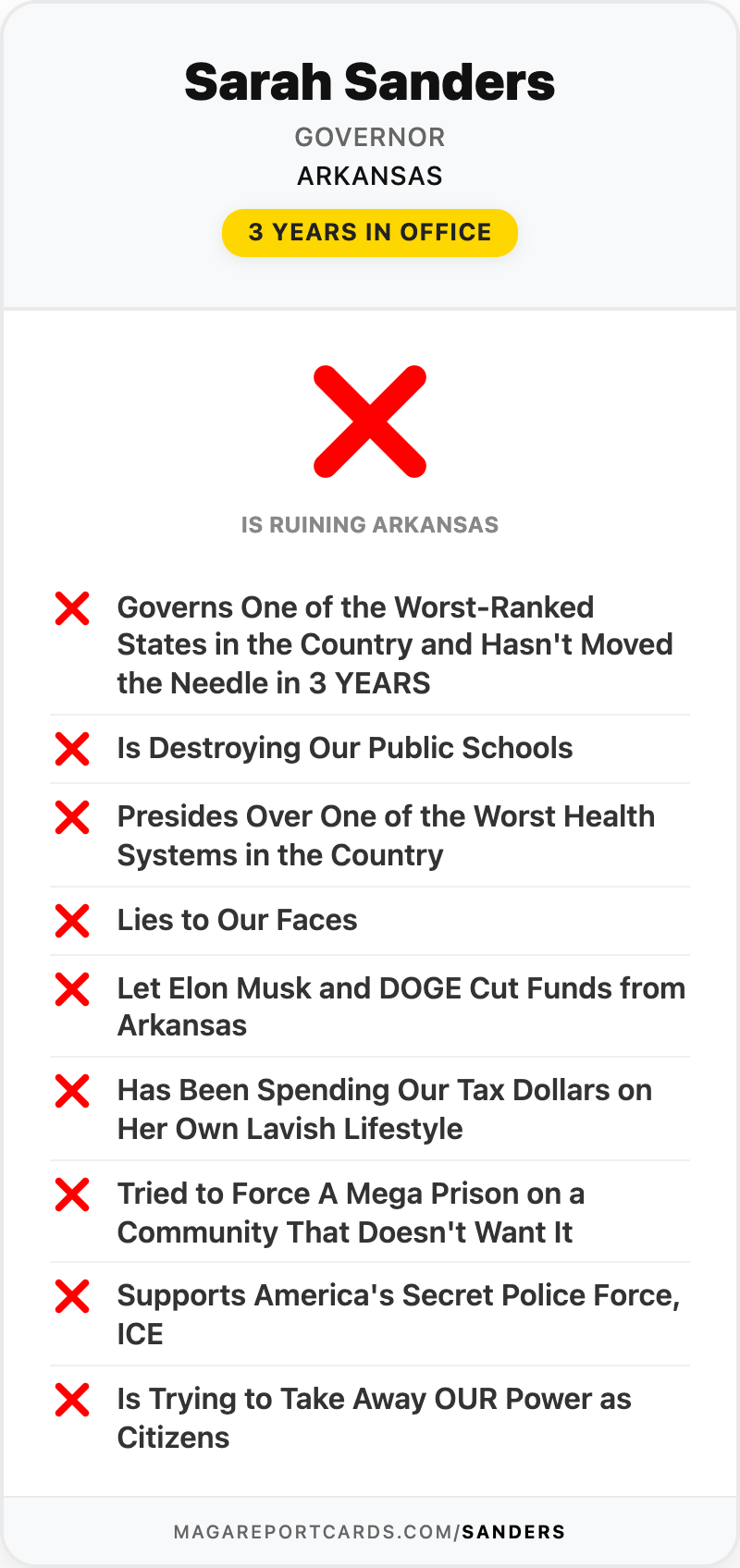
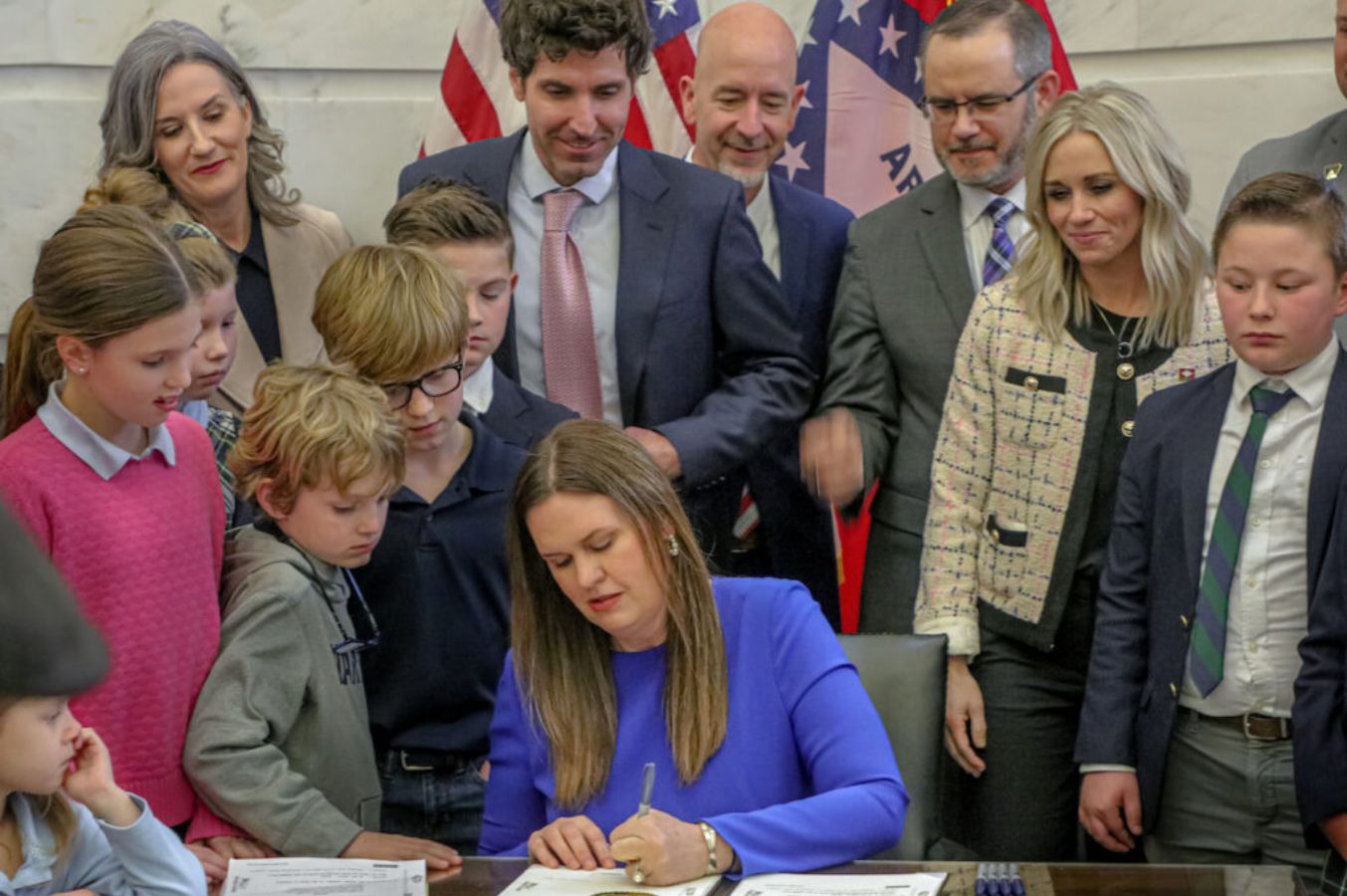
Arkansas will spend up to $379 million on school vouchers this school year. That is $309 million for the students already enrolled, plus $70 million that Gov. Sarah Sanders asked lawmakers to set aside from the state surplus for the students still coming.
For that money, the state does not ask a family whether it could have paid the tuition anyway. It does not ask whether the child ever sat in an Arkansas public school. And in three years, it has never once permanently barred a school from cashing the checks.
That last one is not a talking point. It is what ProPublica and the Arkansas Times found in the state's own records: in three years of the Educational Freedom Account program, Arkansas has stepped in at exactly two schools, and it has "never permanently blocked a school from taking public money."
Keith M. Ingram, who served in the Arkansas Senate from 2013 to 2023 and was its minority leader, laid the whole thing out this week in a column in the Arkansas Democrat-Gazette. He is not calling for repeal. He says he'd like it, but he's "practical enough to temper expectations." What he wants is for the program to be watched.
Here is why that is such a low bar.
What Arkansas actually requires
A private school that wants to take voucher money in Arkansas has to have accreditation or be seeking it, has to have been open for a year, and has to promise it will run background checks and fingerprint its employees. It has to teach English, math, science and social studies. It has to give a standardized test once a year — one the school picks for itself.
Past that, the list is: conduct regular fire drills, keep immunization records, and have an American flag and a flagpole.
That is close to the whole rulebook. Here is what is not on it:
- The state does not review the curriculum.
- The state does not review the background or the capability of the person running the school.
- Schools promise background checks — but nothing in the rules says those checks have to come back clean. There is no requirement that an employee have no criminal history.
- Test results go to the state, but they are pooled into one aggregate number. No parent can look up how a particular voucher school did. There is no requirement to report students' individual test scores to the state or to parents at all.
Meanwhile, a public school down the road reports test scores, attendance, discipline, finances and teacher credentials — and gets graded on every one of them. Same dollar. Same taxpayer. One of them grades itself.
What that bought
Since 2023, Arkansas has gone from about 100 private schools to about 220, plus roughly 100 microschools when that reporting was published — a category the state didn't track or fund before LEARNS existed, and one that has since grown to 142 registered schools. We wrote about it this week, after one of them collapsed three weeks before classes started.
Among the schools that got in was the Delta Institute for the Developing Brain, outside Jonesboro. Its owner made a 10-year-old with autism scrub floors and walls. She put a 13-year-old in a circle of his classmates, invited them to take turns hitting him, and joined in herself with a footlong plastic cylinder that resembled a pipe. It went on for nearly 40 minutes. Three employees were in the room.
Nearly half that school's students were on vouchers. It had collected more than $300,000 in public money. We covered the case and the guilty plea that followed.
Now the part that has not been said enough. The Education Department stopped the checks the day news of the owner's arrest broke, in April 2025.
It restarted them two days later. An assistant education commissioner who oversees the program told a colleague he was satisfied the school had put "appropriate safeguards" in place.
Asked to tighten the rules, the state changed the shopping list
This spring, the Education Department was asked to strengthen oversight of the program.
What it did instead was adjust what parents are allowed to buy with the money. Travel sports teams were banned.
Horseback riding lessons stayed on the approved vendor list.
"Choice" that mostly isn't
The pitch for vouchers was rescue: get children out of schools that are failing them. So Ingram's proposal is to hold the program to its own pitch — require that a child actually attended a public school the year before.
That isn't a new idea in Arkansas. It's the old one. The Succeed Scholarship, the program LEARNS absorbed, was built for students with disabilities and children in foster care, and it required a student to have spent the prior full year in a public school.
Under LEARNS, 12% of voucher participants reported previously attending a public school. The other 88% were already in private school, already homeschooled, or starting kindergarten — a number we've written about before as the program passed 50,000 students.
As Ingram puts it: that isn't choice. That's reimbursement.
And there is no income limit anywhere in the process. None. Since the program went universal there is no ceiling and no question about household income on the application. Ten of the program's private schools took in more than $60 million last school year. The top five are in Springdale, Little Rock, North Little Rock and Searcy — which are not communities short on options.
Means-testing a public benefit is not an attack on school choice. It is how nearly every other public benefit in Arkansas already works.
The teacher pay gap inside the same program
One school approved to take voucher money this fall plans to pay a first-year teacher $25,000.
The state minimum for a public school teacher in Arkansas is $50,000.
The same public dollar, paying half as much to the person standing in front of the kids, at a school whose curriculum and operator the state never reviews.
What $22 million would do instead
Arkansas closed the fiscal year with a $655 million surplus.
Arkansas Advocates for Children and Families calculated that $22 million of it would clear 1,500 children off the Arkansas Better Chance waiting list and raise what the state pays pre-K providers to three-quarters of the market rate.
The Arkansas Better Chance budget has not moved since 2011. Fifteen years flat, while the voucher line went from nothing to $379 million.
Twenty-two million dollars is under 6% of what the state is putting into vouchers this year. It would put 1,500 children in a pre-K classroom instead of reimbursing families for tuition they were already paying.
Nobody in charge wants a ceiling
In April, at a Little Rock luncheon, Senate President Pro Tempore Bart Hester was asked whether there was any cap on what this program should cost.
"We never talk about whether we spent too much for K-12. I will never talk about whether we spent too much for EFAs," Hester said.
Asked whether there was political will to add hundreds of millions more if enrollment kept climbing, he said he would never agree to capping it.
"If it goes up $100 million a year, so it does," Hester said.
That is the Republican leader of the Arkansas Senate, saying out loud that there is no number at which he would stop. And the governor whose law created the program is pointing at test scores from an exam Arkansas built for itself as proof it's working, while a legislative panel studies a third program to subsidize private education on top of this one.
The bottom line
Arkansas will spend up to $379 million this year on a voucher program Sarah Sanders created, with no income limit, no requirement that a child ever attended a public school, and no state review of a school's curriculum or of who is running it. In three years the state has intervened at two schools and permanently barred none — including the one where the owner had a 13-year-old's classmates take turns hitting him and joined in with a plastic cylinder that resembled a pipe, and where public money resumed two days after her arrest. Meanwhile $22 million, about 6% of the voucher bill, would clear 1,500 Arkansas children off a pre-K waiting list funded at 2011 levels.
Source
This post is based on "How to fix LEARNS", a column in the Arkansas Democrat-Gazette by Keith M. Ingram of West Memphis, who served in the Arkansas Senate from 2013 to 2023, including as Senate minority leader, and previously served in the Arkansas House and as mayor of West Memphis.