On August 3, the Arkansas House and Senate education committees met at the state Capitol. The next day, the news out of that meeting was that a legislative panel had approved a request to study a new $100 million tax credit for private school and homeschool families.
That would be Arkansas's third program for subsidizing private education costs.
The state already runs Educational Freedom Accounts, the voucher program Sarah Sanders created with the LEARNS Act in 2023. Arkansas has also opted into the new federal private school voucher that starts January 1. Now a Republican state representative wants to add a third — and his argument for it is worth reading closely, because he is not hiding what it's for.
What's being proposed
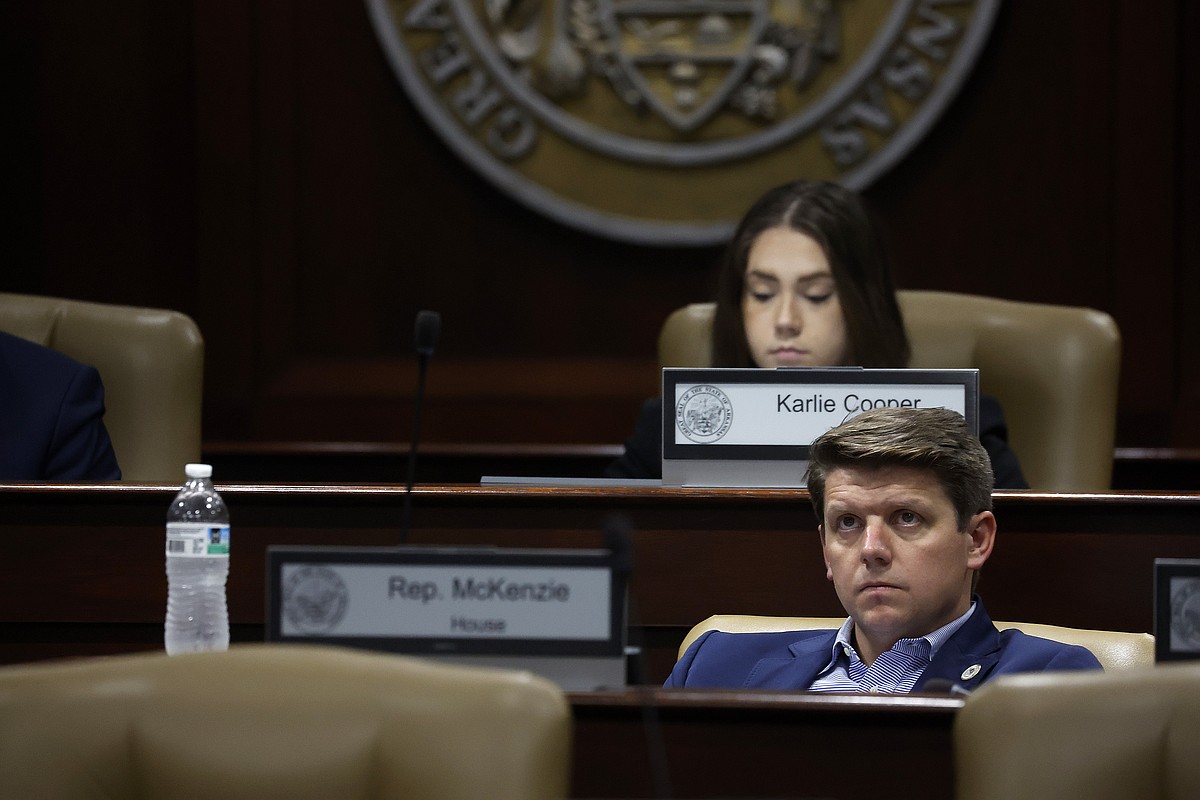
Rep. Brit McKenzie of Rogers asked for the interim study. The proposal outlines:
- A tax credit worth up to $3,000 per child for education expenses — tuition, fees, textbooks, curriculum, tutoring, educational therapies, transportation, and technology.
- A $100 million program starting in 2027.
- Expansion to "uncapped universal availability" in 2029.
- The credit would be refundable — meaning, per the study proposal, families could claim it even if they have no income tax liability at all, and get the balance as a payment.
McKenzie has not written a bill. "I would love (lawmakers) to consider" it, he said, but added: "I have no bills drafted for next session." What he has is a study, approved, with a mandate to gather input from state agencies, education providers, parent advocacy groups, and other states.
The pitch is that it skips the paperwork
Here is McKenzie's stated reason for wanting a second state program alongside the one Arkansas already has:
"Basically, this would be for anyone interested in school choice and not in EFA."
He said lawmakers have heard from homeschool families reluctant to apply for Educational Freedom Accounts because the program "did create regulation whereas they didn't have it before."
That is the sales pitch: a version with fewer rules attached.
It's worth knowing how few rules we're talking about. Educational Freedom Account families do have to take a norm-referenced test each year — but they get to choose which test. In June, lawmakers tightened things slightly: no using the money on sports that "limit participation based on tryouts or ability," and pre-approval now required to be reimbursed for anything the Arkansas Department of Education doesn't count as a "core educational expense."
Those are the "regulatory hurdles" the new program is designed to route around.
McKenzie's own framing was blunt: "My main thing is, I want a buffet of education freedom in Arkansas."
Meanwhile, the first program keeps growing
Arkansas is not short on ways to spend money on private education right now.
Educational Freedom Accounts opened to every K-12 student in the state last year. Lawmakers have approved up to $379 million for 2026-27, with most participants getting $7,208 each, and more than 54,000 students have applied.
Getting there took three separate votes. As the Arkansas Advocate laid out, lawmakers budgeted more than $187 million for the program in April 2025 — then had to add $90 million that June and another $32 million in January 2026 when that wasn't enough. Final cost for the year: more than $309 million. The governor's budget then asked for at least $309 million again, plus $70 million more set aside from surplus for "anticipated program growth."
The Advocate reports bipartisan worry about this. Democrats and rural Republicans have raised concerns about what else in the state budget gets squeezed, and the paper notes a similar program has contributed to budget problems in Arizona.
Into that, a proposal for $100 million more — heading for "uncapped."
Who the money has actually been going to
The case for vouchers is that they rescue kids from bad public schools. Arkansas's own numbers say otherwise.
According to the state Department of Education, 95% of participants in the voucher program's first year had never attended a public school before receiving a voucher. The state's most recent annual report says 12% of 2024-25 participants had previously attended a public school. The program is not moving children out of struggling schools. It is paying tuition bills for families who had already chosen private school.
And oversight of where that money lands has been thin. A private school in the Delta collected more than $300,000 in voucher money while its founder directed students to attack a 13-year-old and made kids scrub floors as punishment — she pleaded guilty to criminal charges, and the state has no record of ever visiting the school or investigating it.
That is the program a new proposal would sit beside, with fewer requirements.
Even a conservative school choice group says no
The most interesting opposition isn't from the left.
Opportunity Arkansas, a conservative advocacy group that supports school choice, came out against the idea. CEO Nic Horton said the group stands "in full support of protecting and preserving" the Educational Freedom Account program, and added: "We see no reason to change course now."
Horton's other objection is about money. He argues state leaders should stay focused on eliminating the Arkansas income tax — and that a new personal education tax credit would slow that down. Sanders has approved four income tax cuts since taking office in 2023 and has pledged to phase the income tax out.
That is the collision at the center of this. You cannot promise to phase out the income tax, run a voucher program that has already needed two emergency funding votes on top of its budget in a single year, and bolt on a $100 million refundable credit headed for "uncapped," all at once. Something gives.
From the other direction, Rep. Jessie McGruder, a Democrat from Marion who sits on the Education Committee, put it simply:
"I can't understand why we need another tax credit."
He also went after the premise directly. Money going to private schools and homeschools should face more scrutiny, not less: "I do not think we need fewer hoops to jump through. I think we need more hoops to jump through, because when we're spending taxpayers dollars, we need to have accountability in place."
Where the governor stands
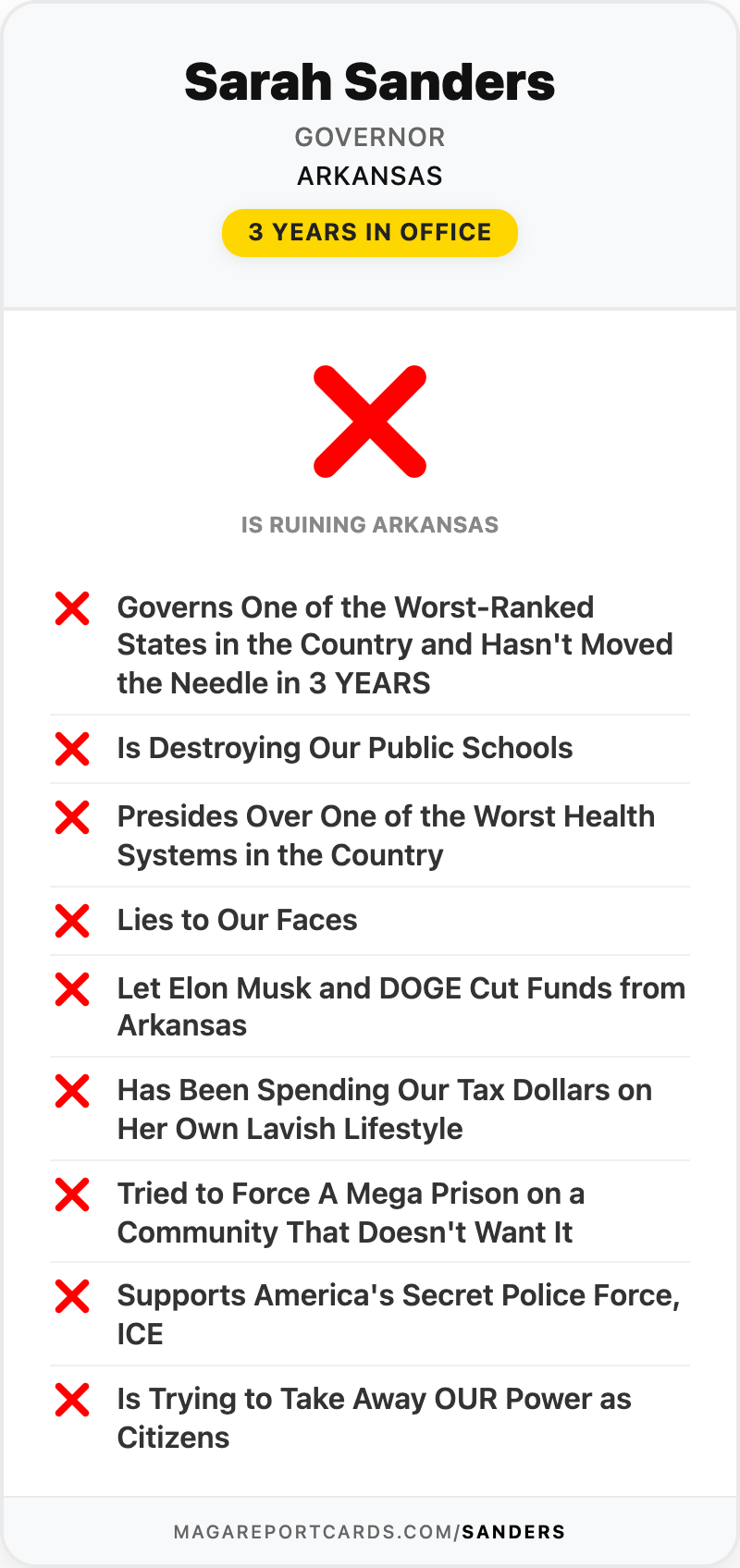
Sanders has not endorsed this. Her spokesman, Sam Dubke, said she is interested in the study's findings, and declined to say whether she'd support the program. His full statement was a résumé:
"Governor Sanders has supported education freedom by establishing the EFA program, now used by nearly 50,000 students to attend the school of their choice, and by opting Arkansas into President Trump's federal tax credit scholarship program for school choice, and looks forward to reviewing this study's results when it is complete."
Read that again. It is not a position on the proposal. It is a list of the two reasons this proposal exists.
Sanders built the first program. She opted Arkansas into the second in January, saying she was "excited to see that with President Trump back in office, he's taking the education freedom movement nationwide." That federal credit — the first national private school voucher in American history, with no cap on what it can drain from the Treasury — starts in Arkansas on January 1.
A third program is now a live idea in the legislature because the first two made it one. "Looks forward to reviewing this study's results" is what a governor says when the answer is probably yes and the price tag isn't public yet.
Nine out of ten American children go to a public school, and Arkansas is no exception. Their families have spent three years watching the state build program after program for the other one in ten — each one bigger than the last, each one carrying fewer requirements than the state program that came first, and each one drawing on the same budget that pays for their kids' classrooms. We deserve better.
Source
Reporting by Josh Snyder for the Arkansas Democrat-Gazette: "Arkansas legislative panel approves study of proposed $100 million school choice tax credit." Photo: Arkansas Democrat-Gazette/Thomas Metthe.