In less than five months, a brand new federal program starts handing out money. Twenty-seven states have already signed up for it. It is the first national private school voucher in American history.
Most people have never heard of it.
That is not an accident. It was not passed as an education bill. It was slipped into the tax section of the "One Big Beautiful Bill Act," the giant budget bill Trump signed on July 4, 2025. If you were following the news that summer, you were hearing about Medicaid cuts and food aid. This was in the same bill, on a different page.
Here is what it does, in plain English — and what it takes out of all our pockets.
How it works
Starting January 1, 2027, you can give up to $1,700 to a nonprofit called a "Scholarship Granting Organization." That group hands out scholarships — vouchers — that families use for private school tuition and other school costs.
Then the federal government gives you the entire $1,700 back on your taxes.
Not a deduction. Not a percentage. The whole thing. It is a dollar-for-dollar credit worth 100% of what you gave, and it comes straight off your tax bill. You are not richer than before — you gave away $1,700 and got $1,700 back. But the donation cost you nothing. The government paid for it.
There is no other charity in America that works this way. As the Institute on Taxation and Economic Policy put it, there is no other cause — "not children's hospitals, veterans' groups, or disaster relief" — where the federal government picks up the entire tab for your gift.
A few details that matter:
- The $1,700 is per person, regardless of filing status. A married couple filing jointly gets $1,700, not $3,400.
- It is nonrefundable. You need to owe federal income tax to use it. If you owe little or nothing, this tax break is not for you.
- Contributions have to be cash. An earlier version let people donate stock, which would have let wealthy donors dodge capital gains taxes on top of everything else. That part got cut.
- You claim it when you file your 2027 return, in 2028.
This is not like the state voucher programs you've heard about
A lot of states run vouchers. Arizona started the first tax-credit scholarship program back in 1997, and by August 2025 there were 22 such programs operating across 18 states.
But every one of those is a state program, paid for out of a state budget, on terms a state legislature wrote. Most cap the total credits they hand out in a year, and those caps run from under $2 million up to $540 million; some states set no cap either. Lawmakers argue about that number every session, and voters can throw them out over it.
The new federal program has no cap at all.
Not a small cap. Not a generous cap. None. Each person is limited to $1,700, but there is no limit on how many people can do it, and no limit on the total amount of money it pulls out of the U.S. Treasury. The more people who claim it, the more it costs — forever, with no vote required.
That was a choice, and it was made late. The version the House passed had a safeguard: total payouts capped at roughly $5 billion a year. The bill's own author had written a $10 billion annual cap into his original version. Then the Senate parliamentarian ruled the provision broke the chamber's budget rules, and senators rewrote it to survive — a rewrite that threw the cap out entirely.
The House version would also have expired after a few years. The final one is permanent.
What it costs all of us
Congress's own scorekeeper, the Joint Committee on Taxation, estimates the program will drain about $26 billion from federal revenue over ten years. That is the official number.
Outside analysts think it could be far bigger, because with no ceiling, the cost depends entirely on how many people sign up — and there is a large, well-funded movement whose whole job is getting people to sign up. ITEP ran the math. If roughly 59 million taxpayers who like the idea of vouchers all claimed the credit, it would cost $101 billion a year. If only half of them do, it is nearly $51 billion a year. Even if just 5 million people participate — roughly the number of children already in private school — it runs past $8 billion a year.
Put the high end next to what the federal government actually spends on schools:
| Program | Annual federal spending |
|---|---|
| Title I, for schools serving low-income kids | $18.4 billion |
| IDEA state grants, for kids with disabilities | $14.6 billion |
| The new voucher credit (high estimate) | up to $51 billion |
One uncapped tax credit for private schools could cost more than the two biggest federal K-12 programs combined — the money for poor districts and the money for children with disabilities.
And here is the part that reaches everyone: your state does not have to opt in for you to pay for this. States choose whether to participate. But a taxpayer in a state that opted out can still donate to a scholarship group in a state that opted in, claim the credit, and shrink the federal Treasury by $1,700. The families in the non-participating state get nothing. The bill still comes to everybody.
"Low-income" can mean half a million dollars
The program is sold as help for low-income families. Read the definition.
A student qualifies if the household earns up to 300% of the area median gross income. Not 300% of the poverty line, which is what most state programs use. Three times the median — the middle — for wherever you live.
The Congressional Research Service spells out what that means. If the median income in your area is $60,000, a household making $180,000 qualifies. If the median is $100,000, a household making $300,000 qualifies. In 2025, the highest area median income in the country was $195,200, in Santa Clara County, California. Three times that is more than $585,000.
One more wrinkle: area median income does not change based on how many people are in your household. A single adult and a family of six face the same cutoff.
Nobody has to answer for the money
State voucher programs usually come with strings. Private schools taking the money might have to be accredited, run background checks, or give students the state test.
The federal program has none of that. The Congressional Research Service notes that the law does not place any "requirements on private schools that enroll scholarship recipients." No accreditation. No state tests. No background checks. And a private school does not have to take a scholarship student at all — it can say no and keep taking everyone else's money.
The scholarship groups themselves face a thin set of rules: be a 501(c)(3), keep the money in a separate account, serve at least 10 students at more than one school, and spend at least 90% of the money on scholarships. They keep up to 10% for overhead.
And they must give priority to students who got a scholarship the year before, then to those students' siblings — before any new family is considered. Whoever gets in first stays in first.
We have written about what happens when nobody is watching. An Arkansas private school taking state voucher money had students attack a 13-year-old and made kids scrub floors as punishment — and the state has no record of ever visiting or investigating it. The Wichita school Iowa candidate Zach Lahn co-founded never sought accreditation, which left it free of state regulation, state tests and any duty to hire licensed teachers.
Where the money actually goes
Every state that has opened vouchers to everyone gets the same result. The money goes to families who were already paying private tuition.
- In Arkansas, 95% of voucher users in the program's first year had never attended a public school.
- In Florida's first universal year, 69% of new recipients were already in private school. Only 13% had ever attended a public one.
- In Iowa, about two-thirds were already in private school.
- In Ohio, the share of voucher students who had been in private school the year before jumped from 7% in 2019 to nearly 55% in 2023 — and in Cleveland, the share of voucher users who were low-income fell from 35% to 7%.
For the kids who do switch, the research is not kind. Josh Cowen, a Michigan State professor who spent years evaluating these programs before turning against them, says studies of vouchers in Washington D.C., Indiana, Louisiana, and Ohio found some of the largest test score drops "ever seen in the research record" — on par, he writes, with what the pandemic did to test scores.
Who wrote it
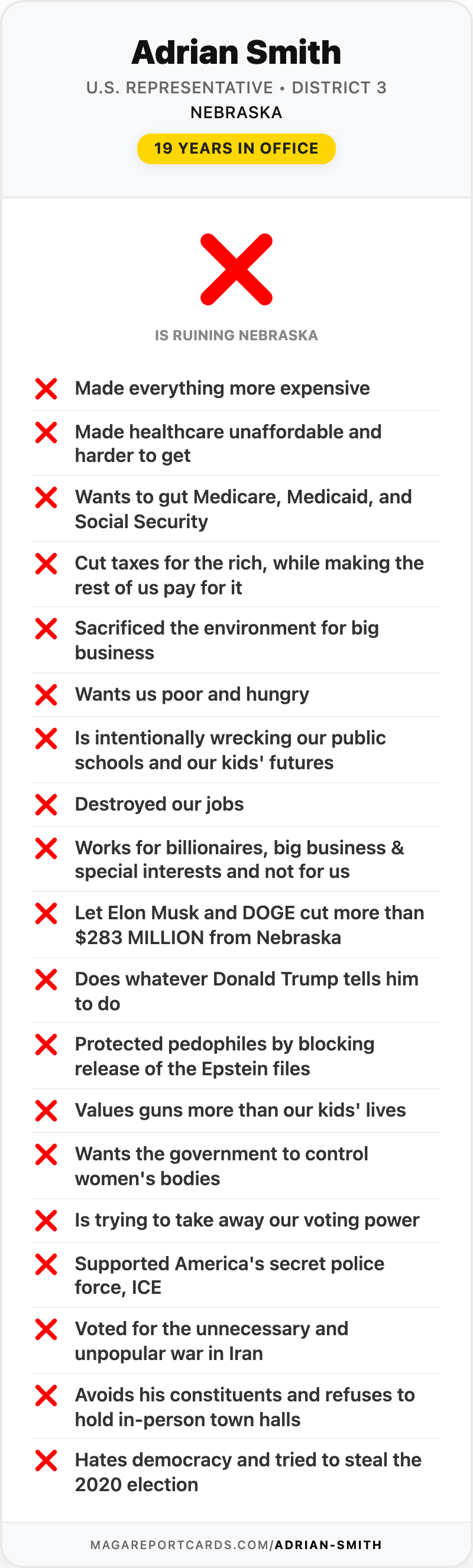
The House bill behind all this is H.R. 833, the Educational Choice for Children Act. Its author is Adrian Smith, who represents Nebraska's 3rd District.
When he reintroduced it in January 2025, Smith said it was about giving students "a brighter future, no matter their background or address." His press release listed 30 House cosponsors and endorsements from former Education Secretary Betsy DeVos, former Attorney General Bill Barr, and more than 150 national and state groups. It also described his bill as providing "$10 billion in annual tax credits" — a number, a ceiling, a limit.
The law that passed has no such number.
Nebraska voters had already weighed in. In November 2024, they voted to repeal their own state's private school scholarship program, killing its $10 million a year. Colorado and Kentucky voters turned down voucher measures the same night; Nebraska's margin was the widest of the three, 65% to 35%. Nebraska has since opted into the federal program anyway.
The vote, and what happens next
The final bill cleared the House on July 3, 2025 by 218 to 214. Republicans voted 218–2 for it. The Senate had split 50–50 two days earlier, and Vice President JD Vance broke the tie.
The Treasury Department is still writing the rules; officials said in June that full guidance is expected by the end of September. Democrats have introduced a repeal bill in both chambers — the Keep Public Funds in Public Schools Act, S.4297 and H.R.9289. Both were referred to committee on the day they were filed and have not moved since.
Meanwhile the state-by-state fight is live. Pennsylvania Treasurer Stacy Garrity, running for governor, was asked whether her state should join and answered "I would a hundred percent". In Tennessee, Marsha Blackburn's push to expand vouchers drew $3 million from Club for Growth and billionaire Jeff Yass. This program is the quiet half of a much louder campaign to take apart the Department of Education.
About 49.6 million American kids go to a public school — around nine in ten. Those schools have to take every child who walks in the door: rich or poor, disabled or not, any faith or none. They are the only schools that do.
Congress just built an unlimited pipeline out of the Treasury and pointed it somewhere else, and it never had to say out loud what it was doing. We deserve better.
Source
Details of the program from the Congressional Research Service report on P.L. 119-21 and The Hechinger Report's explainer, "10 things to know about Trump's new school voucher program." Photo: Alex Brandon/Getty Images.