On August 10, Baker Kurrus published what he said may be his last article about Arkansas public schools. He is an attorney in Little Rock, and he was superintendent of the Little Rock School District in 2015 and 2016. He has spent about two years writing long, careful, fact-heavy pieces about what the LEARNS Act would do to the state.
He ended this one like this:
"I am reduced to watching the state I love so deeply commit educational and economic suicide, and all I can say is that I told you so."
The "I told you so" is the part worth sitting with. Kurrus wrote down his predictions in advance. Nearly every one of them came true.
The scoreboard the state built for itself
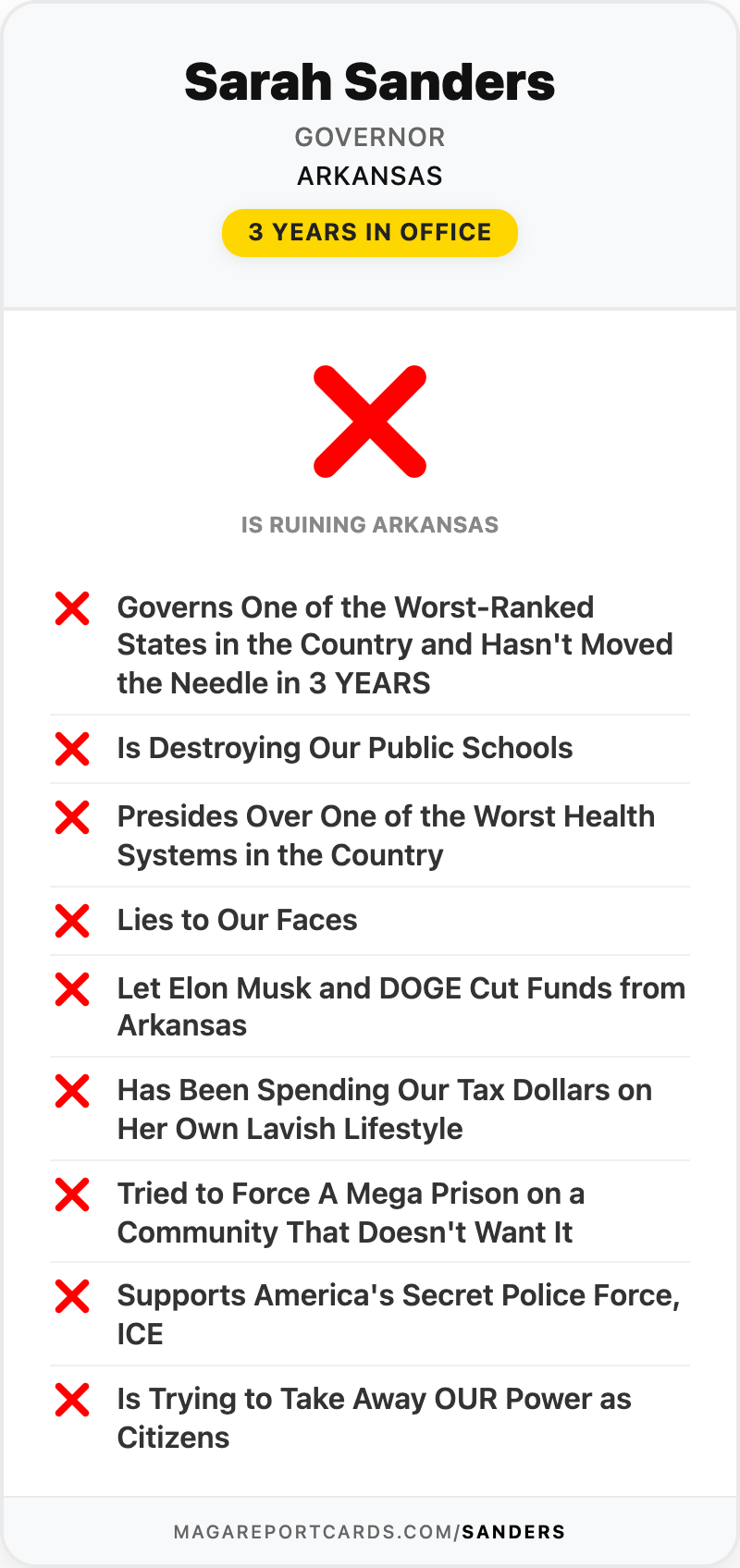
Two months ago, Sarah Sanders put out a press release with a headline that could not be clearer: "LEARNS is Working: Student Test Scores Rise Across the Board."
The numbers in it are real. Since 2024, math proficiency went from 36.4% to 44.2%. Science went from 35.6% to 44.0%. English went from 33.8% to 39.5%. Overall proficiency went from 35% to 42%.
"Arkansas LEARNS is working and students across Arkansas are doing better because of it," Sanders said.
Two things about that.
First, "proficiency has risen by more than 20%" is doing some work. Going from 35% to 42% is a gain of seven percentage points. Calling that "more than 20%" is technically true, and it sounds twice as big as it is.
Second, and this is Kurrus's actual point: every one of those numbers comes from ATLAS — the Arkansas Teaching, Learning, and Assessment System. Arkansas wrote that test. Arkansas set the standards it measures. Kurrus explains what that means:
"The trick there is to keep the standards simple and keep the test at a level that is easy to master."
He is not saying anyone cheated. He is saying that when the state that wants the good news also gets to write the exam and decide what counts as passing, the good news is not worth much on its own. He predicted the ATLAS scores would keep climbing. He also predicted what the national test would show.
The national test says Arkansas is falling behind
The National Assessment of Educational Progress is the one test given the same way in every state. People call it the nation's report card. It's the clearest way to compare Arkansas to anywhere else.
By that measure, Arkansas has been going backwards — and not slowly. The Arkansas Times walked through the numbers from a state Department of Education presentation:
- 4th grade math, 2013: Arkansas was one point behind the national average. 2024: seven points behind. The nation dropped four points over that decade. Arkansas dropped ten.
- 4th grade reading, 2013: Arkansas was two points behind. 2024: four points behind.
Scores fell almost everywhere in the country. Arkansas fell faster. And this isn't a critic's spin on the data — it's what Sanders' own education secretary told lawmakers. Jacob Oliva said Arkansas had been following the national decline "if not at the same level, a more rapid level."
That is the same Jacob Oliva who said in June that "the plan is working."
So: on the test Arkansas built, Arkansas is improving. On the test everyone takes, Arkansas is losing ground faster than the rest of the country. The governor's press release reports results from only one of them. Its single reference to the national test is a line at the bottom noting that the next NAEP results are not expected until late 2026 or early 2027.
Half of LEARNS isn't even on the scoreboard
Here's the part that should bother everybody, whatever you think about vouchers.
The centerpiece of LEARNS is the voucher program — Educational Freedom Accounts. Lawmakers approved up to $379 million for it this year, and Kurrus puts the real cost at close to $400 million. And the private schools cashing those checks don't have to give ATLAS. They don't have to give any one test. They don't report results to the state the way public schools do.
Read that against the press release again. "LEARNS is working" is a claim about the whole law. The evidence offered is a test score from the public school students — the part of the system LEARNS is drawing money away from. The voucher half, the expensive half, the part that is actually new, contributes nothing to that number at all.
When the state did try to report on voucher students, the result was a mess. A mandated annual report released in October 2025 said EFA students outperformed 57% of students nationally in math and 59% in English. But as KATV reported, those students took 17 different tests. April Reisma of the Arkansas Education Association put it plainly: "You're comparing apples to oranges."
The same report claimed potential savings to the state of $12 million to $22 million. Its own data showed only 12% of voucher students were known to have switched out of public school. At least 42% were already in private school or homeschooled.
The people grading the program are paid by the people who wanted it
Kurrus raises the funding question directly, and he names names:
"The University of Arkansas Office for Education Policy has lots of positive things to say about LEARNS. That's not surprising. The office is partially funded through grants from voucher proponents – think the Walton Family Foundation – and it certainly seems to find ways to keep getting those large grants."
That checks out. In June 2024, the Office for Education Policy announced it had been awarded $1.175 million from the Walton Family Foundation over three years.
And the new three-year evaluation of the voucher program itself? Also funded by the Walton Family Foundation, announced in July 2026, run out of the same University of Arkansas department, with support from that same office. The state's mandated annual report on vouchers is co-produced with that department too.
None of that proves any researcher is bending a finding. But it means the state's official evidence that vouchers work is largely produced by an operation kept running by the foundation that spent years pushing for vouchers. If you would find that arrangement suspicious coming from a union or an environmental group, it should read the same way here.
Kurrus asked the researchers a question that doesn't need a grant to answer:
"I want the folks there to explain how students who were already in private schools or already home schooled will attain higher academic achievement simply because public tax dollars are now used to pay the costs that their parents paid before."
$400 million to change nothing
That question lands because of what Kurrus laid out in part one of this series in June.
There are 54,442 voucher applications pending for this school year. About $320 million of the money, he calculates, goes to families who are doing exactly what they were already doing and planned to keep doing — just with the state paying now.
The homeschool numbers make the case by themselves. Homeschool vouchers went from 3,422 to 11,286 in one year. Over that same stretch, the total number of homeschoolers in Arkansas went down by roughly 2,000. Eight thousand more checks. Two thousand fewer homeschoolers.
Meanwhile the promise — rescuing kids from failing schools — barely happened. The last official LEARNS report showed 3% of voucher students had left public schools graded D or F.
And the schools taking the money answer to almost nobody. Private schools don't have to follow the Individuals with Disabilities Education Act. Their teachers don't have to be certified. They can turn down any child for any reason. That last one is what Kurrus can't get past:
"School choice is not parental choice. Parents apply, then private schools make the choice of the students they want and don't want, getting paid for the number of students they accept."
We've seen where thin oversight goes. A private school in the Delta collected more than $300,000 in voucher money while its founder had students attack a 13-year-old and made kids scrub floors as punishment. She pleaded guilty. The checks kept coming.
Her father saw it the exact opposite way
The sharpest thing in Kurrus's two columns is the family history.
In 2002, the Arkansas Supreme Court ruled in Lake View School District v. Huckabee that the state must provide an adequate and equitable education to every child — and that the state can hand the job to school districts but can never hand off the responsibility.
The Huckabee in that case name is Mike Huckabee, Sanders' father. He didn't fight the ruling. In his 2003 State of the State address, he proposed consolidating districts with fewer than 1,500 students, because small schools couldn't offer a full curriculum. In 2004 he signed a bill forcing districts that stayed under 350 students two years running to consolidate.
Arkansas had gone from 4,711 school districts in 1927 down to 240 by 2010. That was a century of deliberate work, and Mike Huckabee pushed it forward.
His daughter's law runs it in reverse. By Kurrus's count, the state will soon fund at least 228 more schools and districts than it did before LEARNS — including about 100 microschools that average around 15 students each, the exact kind of tiny, thinly-staffed school the consolidation era existed to end.
The lawsuit he sees coming
Kurrus closes with a warning that isn't rhetorical:
"Some day, some child who comes out of a micro school, a private school or even a home school might just sue this state because it failed to provide an adequate education. The constitution requires it, Gov. Mike Huckabee acknowledged it, and Lake View confirmed it."
The state can delegate the teaching. It cannot delegate the accountability. And Arkansas is now writing checks to hundreds of schools it openly does not have the staff to inspect.
That's the trajectory. A second state voucher program is already being studied at the Capitol — a $3,000 refundable tax credit that Kurrus calls "a wasteful example of political grandstanding." A federal voucher with no cap on its cost starts in Arkansas on January 1. And in Washington, 37 House Republicans have signed on to a one-sentence bill to abolish the Department of Education entirely.
Nine out of ten American children go to a public school, and Arkansas is no exception. Those parents are being handed a rising number from a test the state wrote itself, while the national scorecard says their kids are falling further behind — and while hundreds of millions a year go to schools that are not required to report a comparable score at all.
The man who ran Little Rock's schools called it two years ago, in writing, and got it right. We deserve better.
Source
Baker Kurrus, "State committing educational, economic suicide, former Supt. Baker Kurrus says," Arkansas Times, August 10, 2026 — part two of a two-part series. Photo: Arkansas Times.