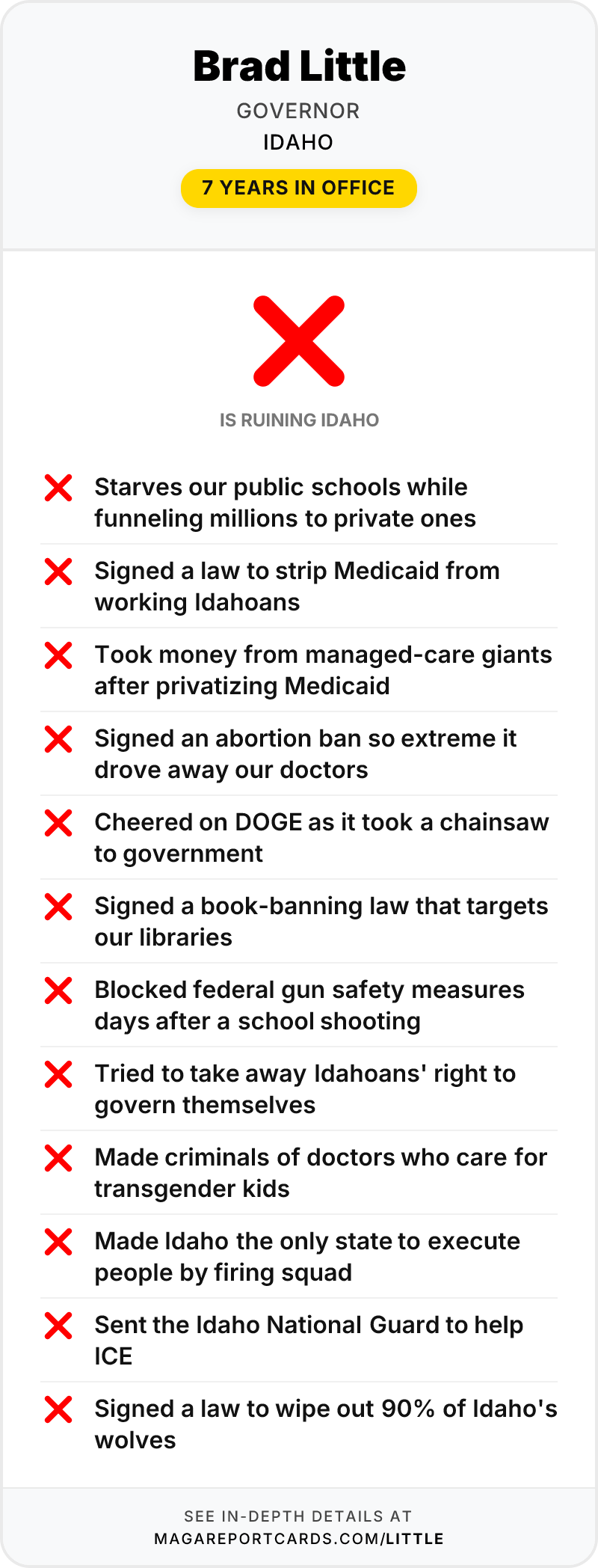
Brad Little signed Idaho's $50 million private-school tax credit into law in February 2025. Now the state has added up who got the money. The answer is mostly families who were already paying for private school, and who make more than twice what a typical Idaho household does.
On November 13, the Idaho State Tax Commission released its first full report on the Parental Choice Tax Credit. The Idaho Capital Sun went through it. Here is what it found.
Who got the money
- The average parent who got the credit had an income of $178,000 a year. Idaho's median household income is $84,234, according to the Census Bureau.
- 6,875 parents got a credit, covering 12,216 students.
- Only 25.3% of those students had ever attended a public school. Just 4.3% had been in public school for the entire 2025 school year.
- More than 93.5% of the money went to private-school tuition.
- Almost a quarter of the tuition money — about $10.9 million — went to just five private schools, in Meridian, Boise, Nampa and Moscow.
- Two-thirds of the parents who applied live in Idaho's three biggest counties: Ada, Canyon and Kootenai. Bingham County in eastern Idaho had 48 applications. Cassia County in southern Idaho had 31.
- About 600 of the students — roughly 5% — had a declared disability, according to the Tax Commission's report.
So the program did not mostly move kids out of public schools. By their parents' own answers, three out of four of the children it paid for had never been in one. It mostly helped families who were already paying private-school tuition get some of that money back from the state.
The families it was supposed to put first
When lawmakers wrote the bill, they said low- and middle-income families would get first priority. Families under 300% of the federal poverty level — $96,450 for a family of four — were supposed to go to the front of the line.
They ended up as the minority. According to the report, 55% of the parents who got a credit made more than 300% of the poverty level. Only 45% were at or below it.
And the priority doesn't even last. Starting in 2027, first place in line shifts to parents who got the credit the year before. That means the families who got in first, most of them better off, get to keep their spot.
"Idahoans were sold a lie about this voucher scheme," said House Minority Leader Ilana Rubel. "We were told this program would help low-income children leave public schools for supposedly better-performing private schools. Instead, more than half of the families awarded tax credits are above the income threshold Republicans promised to prioritize, and nearly three-quarters of students have never attended an Idaho public school."
Little knew it wasn't ready, and signed it anyway
This was not a bill Brad Little was forced into. It was one he said, out loud, did not meet his own test.
In his January 2025 State of the State, Little said any private-school subsidy had to be "fair, responsible, transparent, and accountable." On February 25, 2025, he told reporters the bill met only one of his five conditions — the $50 million price tag. "There's not enough accountability in it," he said.
Two days later, he signed it.
His signing statement promised that "Idaho can have it all – strong public schools AND education freedom." It did not say anything about who would get the money.
Idahoans told him what they thought. Public testimony submitted to the House committee ran 10 to 1 against the bill, Idaho Education News found, Boise State Public Radio reported. Little's office said it got "thousands" of messages, then said it needed "more time to compile the numbers" on how many were for or against.
What it costs everyone else
The program hands out up to $50 million a year in state tax credits. More than half of the parents who got it were above the income line lawmakers promised to put first, two-thirds of the applicants came from three counties, and more than one dollar in five landed at five private schools.
"I want someone to explain to a rural parent why their child's school can't afford another teacher, but the state can afford to help a well-off family pay private school tuition," said state Sen. Janie Ward-Engelking, a retired teacher. "That's a pretty lousy deal for rural Idaho."
This is the same governor who cut Idaho's budget to make room for Trump's tax bill. The pattern is the same: the state finds money for tax breaks and asks everyone else to make do.
Little's response to the report on Friday was to praise the transparency of it. "Transparency and accountability are important to ensuring the Parental Choice Tax Credit works as intended and serves Idaho families well," he said. He did not say whether a program where three out of four children it paid for had never been in a public school is working as intended.
Idaho isn't the only state where this is happening. In Arkansas, Republicans who already passed two voucher programs are studying a third one — and its selling point is fewer rules.
The bottom line
Brad Little signed Idaho's $50 million private-school tax credit two days after saying it had "not enough accountability." The state's first report on it shows the average family that got the money earns $178,000 a year — more than twice Idaho's median household income. Only about one in four of the 12,216 children it paid for had ever attended a public school, and most of the parents who got it earned more than the income level lawmakers had promised to put first.