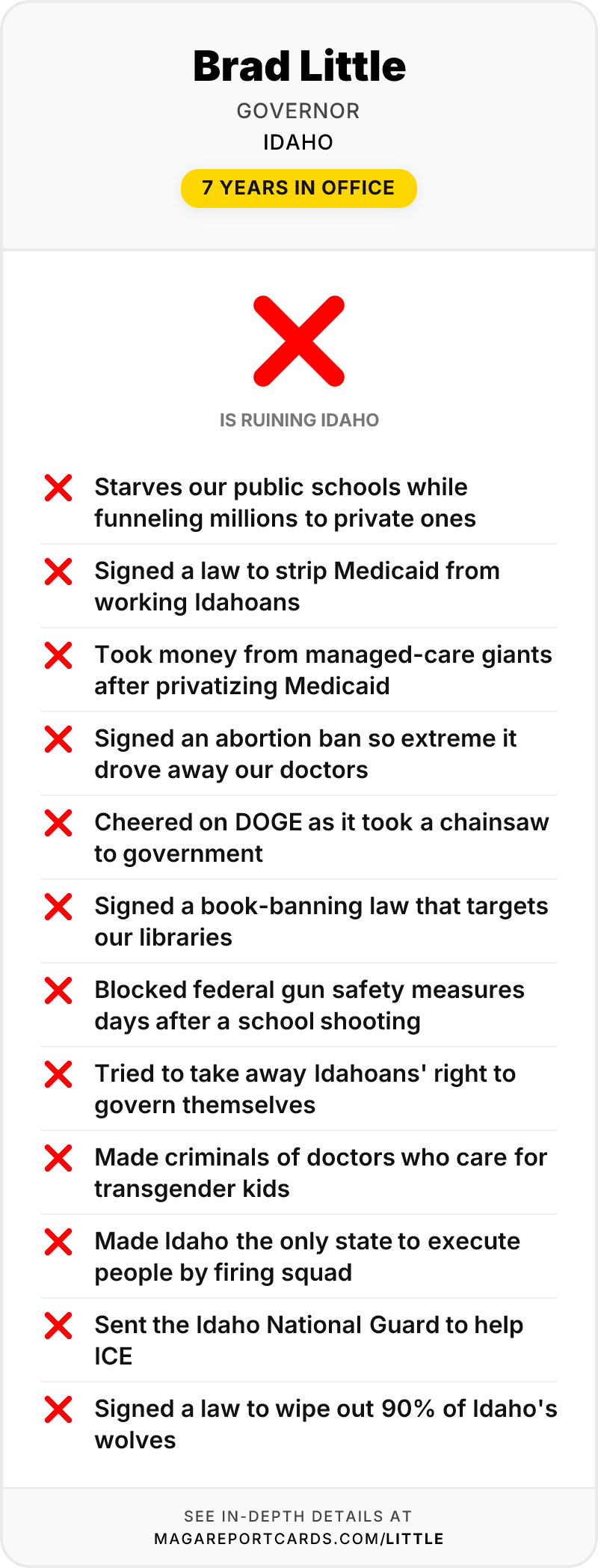
Here is a straightforward story about where money goes.
In 2026, Idaho matched its state tax code to the federal tax cuts in Trump's budget bill. That's called conformity, and it isn't automatic — the Legislature has to vote for it. Idaho did, through House Bill 559, and made it retroactive to 2025. The cost to the state budget: an estimated $155 million reduction.
That money had to come from somewhere. It came out of Idaho.
The cuts
On March 16, 2026, Brad Little signed Senate Bill 1331, the 2026 Idaho Rescissions Act. It cut 4% from most state agencies in the current fiscal year, and the Legislature's budgets for the next one cut 5%. Medicaid, the Idaho State Police, and the Department of Correction got a smaller 3% cut instead of the full 4%, and K-12 public schools were exempt from this year's cuts.
The stated reason was exactly what you'd expect: conforming with the federal tax cuts in Trump's One Big Beautiful Bill Act, plus revenue uncertainty.
It barely passed. The Senate approved it 18–17 on March 2 — a single vote. The House followed 48–22 on March 6.
House Majority Leader Jason Monks, a Republican, described the bill he was asking his own members to vote for:
"a crappy bill that we have to vote on, but it's a necessary bill"
Senate Minority Leader Melissa Wintrow put the responsibility where it belonged:
"Gov. Little knows these cuts will hurt Idaho families because his own administration warned they would."
Little's own statement on signing it was about efficiency:
"Idahoans expect their state government to operate efficiently and effectively, and the balanced budget we approved for the current fiscal year delivers on both fronts."
Who actually absorbed it
"Most state agencies" is a phrase that hides the specifics. Here's what got hit, according to Idaho Education News:
- Idaho's public colleges and universities took it worst. A 4% cut this year, then 5% for four-year universities and 3% for two-year schools next year. A $9.5 million line item meant to cover enrollment growth was zeroed out entirely.
- Students got the bill. Tuition and fees at Idaho's public four-year schools went up $350 to $425 — the largest increase in three years. That's a state cut converted directly into a household cost.
- Idaho Launch, the program that helps Idaho kids pay for training and college after high school, was cut $10 million this year and $10 million next year.
- The Idaho Digital Learning Alliance had its budget cut roughly in half, a $13.4 million reduction that eliminated elementary programs and state funding for driver's education.
- K-12 was flat-funded at $2.75 billion for fiscal 2027 — the second consecutive session with no discretionary increase, which with inflation is a cut in everything but name. Some districts were also left with a $9 million shortfall in employee insurance funding.
Remember where Idaho was starting from. It already spends less per K-12 student than any other state in America, and ranks 48th of 50 for public education. This is the state that decided it had room to trim.
Then he showed everyone the leftovers
Now the part that makes this a story about Brad Little's priorities rather than Idaho's finances.
On July 17, 2026, Little announced that Idaho closed the fiscal year with a cash balance of approximately $250 million. He called it discipline:
"Some decisions were not easy but they were the right ones. We stayed disciplined, and as a result Idaho protected its priorities, maintained healthy reserves, and finished the year in an even stronger financial position than anticipated."
Three days later, in a guest opinion, he told Idahoans not to get any ideas about that money:
"Some may look at the year-end cash balance and conclude that Idaho should restore spending reductions or significantly expand government. We won't."
Read those two quotes together. The state cut driver's ed, cut Idaho Launch by $10 million, zeroed out enrollment funding, saw tuition and fees at four-year schools rise by up to $425 a student, and left some school districts $9 million short on employee insurance — and then finished the year with a quarter of a billion dollars in the bank and announced that none of it is coming back.
That's not a state that ran out of money. That's a state whose governor decided the cuts were the goal.
He knew how to intervene when he wanted to
Little wasn't powerless here. He proved it in the same session.
When the Legislature tried to cut $478,600 from medical residencies, Little issued a line-item veto, writing that defunding eight residents mid-residency would signal "that the state may not honor its commitments" while Idaho faces "one of the most severe physician shortages in the nation."
He was right about that. He simply chose not to apply the same reasoning to the college students, the high school kids losing Idaho Launch money, or the districts carrying an insurance shortfall.
And this is not the first time Little has taken money out of Idaho's classrooms by choice. In February 2025 he signed House Bill 93, a $50 million program handing private- and home-schooling families up to $5,000 per student in taxpayer money — two days after telling reporters the bill didn't meet his own accountability standard: "There's not enough accountability in it." He signed it anyway. In 2026 the Legislature cleaned that tax credit up and expanded who qualifies.
So in the space of about a year: $50 million out the door to private schooling, $155 million out the door to match federal tax cuts, and 4-to-5% off the top of nearly everything the state does.
The trade
The federal law Idaho chose to match, the One Big Beautiful Bill Act, gives the top 1 percent of earners tax cuts worth approximately $1 trillion over the next decade. Idaho conformed to it, took a $155 million hit doing so, and then made college students, school districts, and state agencies cover the difference.
Brad Little is asking Idahoans for a third term this November. This is what the last one bought them.
A governor who cuts your kid's school to match a tax cut written in Washington, then sits on $250 million and says the cuts are staying, is not being disciplined. He's choosing. We deserve better.
Sources
- Idaho governor signs additional budget cuts for current fiscal year 2026 into law — Clark Corbin, Idaho Capital Sun, via KMVT, March 17, 2026. Photo: Kyle Pfannenstiel/Idaho Capital Sun.
- Little lauds Idaho's bottom line — but downplays how Idaho got there — Kevin Richert, Idaho Education News, July 23, 2026
- UPDATED: Find out what passed and what didn't. A look back to the 2026 legislative session — Ryan Suppe and Kevin Richert, Idaho Education News, April 9, 2026