On Tuesday, voters across America handed Democrats control of the U.S. House and Senate. In Michigan, the wave reached almost every major race.
Republicans lost the governor's race, the Senate race, three U.S. House seats and the state House. The four Republicans on this site who did win kept their seats with smaller shares than two years ago. And the man Republicans ran for Senate lost by about 7 points after a campaign that kept coming back to his opponent's religion.
Here's the good, the bad and the ugly.
The good: three House seats and the state House
Going into Tuesday, Republicans held 7 of Michigan's 13 seats in the U.S. House. Starting in January, Democrats will hold 9 and Republicans 4, according to the Michigan Advance. All the vote shares below are from NBC News' count as of Saturday morning.
- Bill Huizenga lost his southwest Michigan seat to state Sen. Sean McCann, 48.3% to 50.1%. Two years ago, Huizenga won with 55.1%. He was first elected to Congress in 2010. In the race's final weeks, protesters were still gathering outside his Holland office every Friday, as they had for 20 months, because he had held only phone town halls since early 2025.
- Tom Barrett lost the mid-Michigan 7th District to organizer William Lawrence, 47.7% to 51.0%. Barrett led most of the night, then left his watch party at 2:39 a.m. without speaking to reporters, the Advance reported. Lawrence said his campaign found common ground "in opposition to war and data centers." Barrett had run an ad saying he stood up to his own party on data centers. The vote in it was from 2015, and since then he had voted for tax breaks that handed six companies $83 billion.
- The 10th District, the seat John James gave up to run for governor, went to former prosecutor Christina Hines. She beat Republican Michael Bouchard Jr. 52.4% to 45.3%.
Democrats also took back the Michigan House. Republicans lost 11 seats there, according to the Michigan Advance. Even Republican House Speaker Matt Hall barely held on, winning his own seat by 3.2 points. His caucus picked a new leader two days later.
The seat that made the majority came from Holland, Huizenga's home turf. There, 29-year-old Democrat Joseph McClusky beat Republican Rep. Nancy DeBoer in an area that has elected Republican representatives for decades, Michigan Public reported. "I got the call from the next speaker of the House that this was the 56th seat — the majority-making seat," McClusky told supporters.
Democrats kept the state Senate and won the races for governor, attorney general and secretary of state. John James lost the governor's race to Secretary of State Jocelyn Benson, 43.7% to 54.6%. That's a hair worse than Republican Tudor Dixon did against Gretchen Whitmer four years ago, when she got 43.9%. It also happened despite a late money surge: in October, James's campaign took $1.8 million in party-paid TV ads funded by two DeVos brothers, more than twice what Michigan law lets a party give a candidate for governor.
Why it matters. Starting in January, Democrats will control the governor's office and both chambers of the Legislature. They last had that in 2023 and 2024. The incoming House speaker, Ranjeev Puri, said that for the last two years he "watched healthcare be ripped away from our sick" and "food and benefits taken away from our needy." The worst of it is still coming. The Trump budget bill's Medicaid work requirements start January 1, 2027, a date Republicans set to land after this election. Michigan will now meet them with a Democratic Legislature instead of a Republican House.
Voters also passed Proposal 2 with 81.2% of the vote when the AP called it. It bans campaign spending by the state's regulated gas and electric utilities and by companies with more than $250,000 a year in government contracts. Republican leaders in the state House had tried to keep it off the ballot by passing their own version as a regular law, which Democrats said could have made it easier to change or overturn later.
The bad: they won, by less
Four Republicans on this site won Tuesday. All four are House members, and all four got a smaller share than they did two years ago.
- Jack Bergman won a sixth term in the Upper Peninsula and northern Michigan with 53.8%, against 59.2% two years ago. It was a rematch with Democrat Callie Barr. He beat her by more than 21 points in 2024 and by fewer than 10 this time. Late in the campaign, he faced criticism over the Capitol Hill house he lives in. For years it belonged to an entity run by one of his biggest donors. This year she sold it to his daughter and lent her the money to buy it. Two constituents have asked the House Ethics Committee to investigate.
- John Moolenaar won a seventh term in west and northern Michigan with 61.5%, down from 65.1%. Two hospitals in his district were named among the rural hospitals most at risk of closing, and three weeks later he voted for the budget bill that cuts about $1 trillion from Medicaid.
- Tim Walberg won again in southern Michigan with 59.1%, down from 65.7%. His opponent was an educator, Christian Vukasovich. Walberg chairs the House education committee, and he is leading the effort to break up the Department of Education, which helps pay for special education and runs the federal student loan program.
- Lisa McClain won a fourth term in the Thumb with 62.6%, down from 66.8%. She is the fourth-ranking Republican in the House. In July, asked on Newsmax about democratic socialists' momentum, she told "the people in our country who want to turn this country into a communist country" to leave: "Go to Europe where they're experiencing this heat wave and they don't have any air condition."
On election night, Bergman said Americans "are rightly frustrated with inflation." All four of them voted in February to keep Trump's tariffs, which work out to the equivalent of $5,619 per Michigan household, the highest of any state.
The ugly: Mike Rogers and the campaign against a Muslim candidate
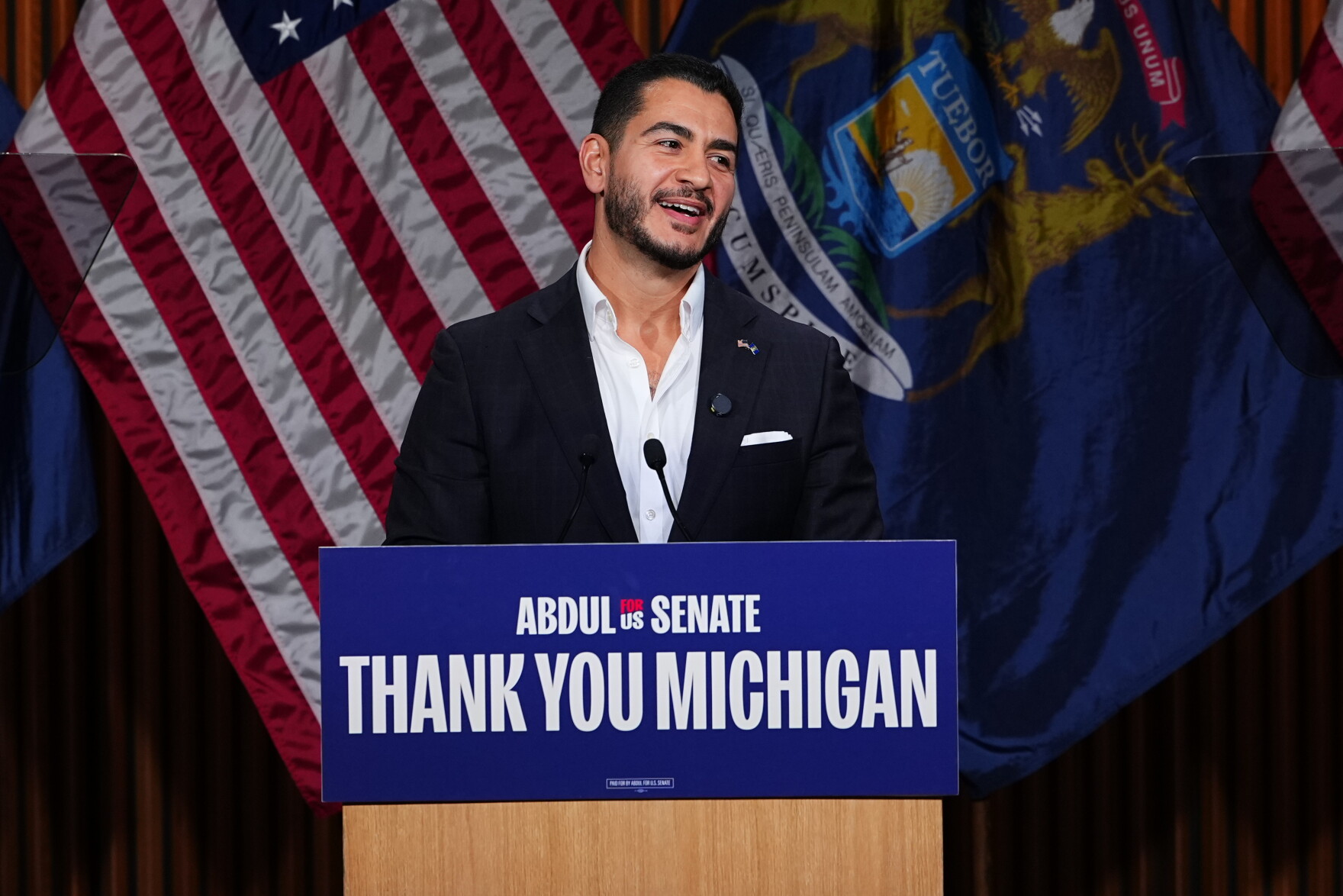
Mike Rogers (MI) lost Michigan's open Senate seat to Democrat Abdul El-Sayed, 45.5% to 52.5%. El-Sayed, the son of Egyptian immigrants and a former public health official, will become the first Muslim U.S. senator.
It was Rogers's second Senate loss in two years. In 2024 he lost to Elissa Slotkin 48.3% to 48.6%, by about 19,000 votes. This time he lost by about 7 points.
What Rogers's campaign said
Rogers said again and again that his attacks were not about El-Sayed's faith. "This is not about Islam. It's not about how he prays," he said on Meet the Press on October 25. Here is what happened on his campaign trail in the last four weeks before the election:
- October 9. At a Rogers event, Louisiana Sen. John Kennedy told reporters that El-Sayed sleeps "in a Bin Laden jersey." Rogers, standing beside him, laughed.
- October 10. Barstool founder Dave Portnoy wrote that El-Sayed "really is a terrorist." Rogers reposted it and said Portnoy was "exactly right." The Senate Republicans' campaign arm shared it again. The clip was El-Sayed joking about Michigan football.
- October 18. On CNN, Rogers said El-Sayed "didn't disavow" the Muslim Brotherhood. Host Dana Bash had just played tape of El-Sayed answering that exact question: "Sure. Yes, absolutely." Rogers said, "No, that's not true."
- October 25. The same day as Meet the Press, Trump opened a rally for Rogers and James in Port Huron by saying he was there "to keep a jihadist … Muslim Brotherhood member from becoming a United States senator." Rogers spoke from the same stage. The next day, Health Secretary Robert F. Kennedy Jr. told a Rogers event in Grand Rapids that "500 million Arabs" in the world "don't produce science." By the next day, Rogers still hadn't condemned it.
What it was worth on Tuesday
It didn't work. Even after Democratic Rep. Haley Stevens, who lost the Senate primary to El-Sayed, endorsed Rogers days before the election, Rogers did nearly 3 points worse than he did two years ago.
Jon King, who covered Rogers's whole career in Congress, wrote in a Michigan Advance column that Rogers "helped unleash a wave of outright Islamophobia that was not only disgusting, but also a profoundly misguided political strategy." He added that Rogers treated Michigan "as though it were another safely Republican congressional district", where attacking the other side might be enough. As King noted, Republicans haven't won a Senate race in Michigan since the last century.
El-Sayed answered the attacks in his victory speech. "My name and faith are not the reason you can't afford gas," he said, Michigan Public reported.
The rest of the ugly
- Federal monitors questioned poll workers. The Justice Department sent 71 election monitors to polling places in Detroit, Dearborn, Hamtramck, East Lansing, Grand Rapids, Flint and Warren. On Election Day, the state said monitors in Dearborn and Flint had questioned poll workers about their training, which Michigan law doesn't allow. The department's own coordinator agreed it wasn't how the monitors were trained. Weeks earlier, James had bragged that his "friend Kash Patel" promised an FBI "presence" in Michigan before Election Day.
- The utilities sued over the vote. By Friday, three days after more than 80% of voters passed Proposal 2, DTE, Consumers Energy and its parent company CMS Energy had gone to federal court arguing it violates the First Amendment. So did the Mackinac Center, a free-market think tank. The law takes effect by December 3 unless a court blocks it. The utilities' lawyers wrote that there is "no evidence of such corruption by Michigan's utilities." Those same utilities and their employees had given James about $48,529 over his campaigns while asking regulators to raise Michigan families' rates.
What the results show
Michigan Republicans lost three of their seven U.S. House seats, including Bill Huizenga's and Tom Barrett's, and lost the state House by dropping 11 seats. John James got 43.7% for governor, less than his party's 2022 nominee. The four Republicans on this site who won all got smaller shares than in 2024, and Jack Bergman's lead over the same opponent fell from more than 21 points to under 10. Mike Rogers, who agreed with a post calling his Muslim opponent a terrorist and shared a stage with Trump as Trump called him a jihadist, lost by about 7 points after losing by 0.3 two years ago.
Source
Blue wave washes over Michigan as Dems flip key congressional battlegrounds — Kyle Davidson, Michigan Advance, November 4, 2026.