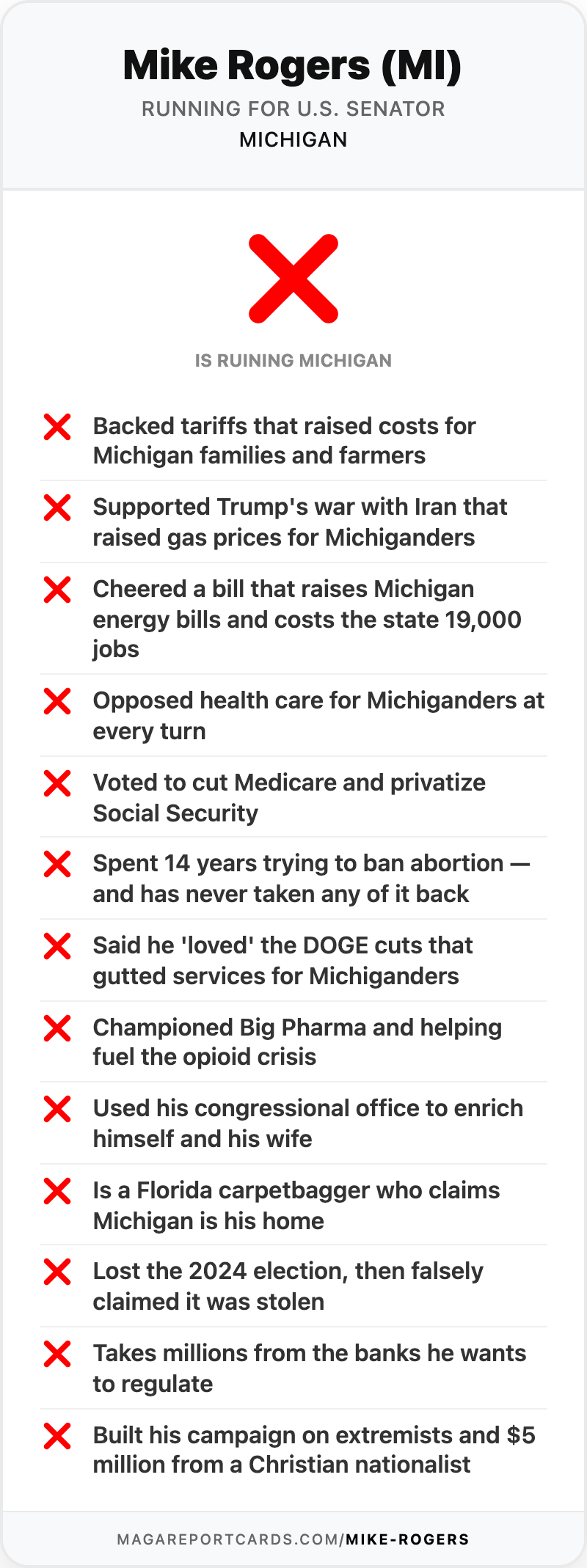
Mike Rogers (MI) went on Meet the Press on Sunday, October 25, and said his attacks on his Democratic opponent, Abdul El-Sayed, have nothing to do with El-Sayed's religion.
"This is not about Islam. It's not about how he prays," Rogers said, according to a Sinclair national report. "It is about his adherence to this radical Islamic agenda."
That same day, Rogers shared a stage with Donald Trump in Port Huron. And the next day, the Trump administration's health secretary came to campaign for him in Grand Rapids. Here is what they said.
Port Huron: 'a jihadist'
Trump opened his Port Huron rally for Rogers and John James by announcing why he was there.
"I'm here today to keep a jihadist … Muslim Brotherhood member from becoming a United States senator," Trump said, the Michigan Advance reported.
El-Sayed was born in Michigan. Trump went on:
"If Abdul and the Democrats win, they will open the floodgates and invite hoards of jihadists to our shores, creating a nightmare of violence … We're not going to let this guy become a senator of the United States."
He told the crowd that anyone with El-Sayed's record "would be screened and unable to get a seat on an airplane," and that "any Jewish person that supports this guy should be ashamed of themselves." Some people in the crowd yelled "traitor."
Then Trump turned to Rogers. "This guy, he's like Central Casting," Trump said. "He's a fantastic man." Rogers spoke from the same stage.
Grand Rapids: '500 million Arabs'
On Monday, Health and Human Services Secretary Robert F. Kennedy Jr. spoke at a Rogers campaign event in Grand Rapids. In a clip that circulated that night, reported by Common Dreams, Kennedy said:
"There's five hundred million Arabs in the world. And yet they don't produce science. They don't win the Nobel Prize. They don't win the Fields Prize. They don't win the Wolf Prize. They don't produce literature."
It isn't true. Just last year, Jordanian-born chemist Omar Yaghi, the son of Palestinian refugees, won the Nobel Prize in Chemistry. He had already won the Wolf Prize in 2018. Egyptian-American chemist Ahmed Zewail won the Nobel in 1999.
Michigan has the highest share of Arab Americans of any state. Kennedy said this there, a week before Election Day, to help elect Rogers.
The Council on American-Islamic Relations called the remarks "a textbook display of unvarnished racism and bigotry" and demanded Kennedy's removal. Protect Our Care's Brad Woodhouse said it was "an indictment" of both Rogers and John James "that they haven't condemned the remarks."
Rogers' own words
Rogers can say it's "not about Islam." His own campaign record says otherwise, and we've been documenting it for months:
- He claimed El-Sayed "believes America deserved 9/11." PolitiFact rated it Pants on Fire — El-Sayed had said the opposite.
- He reposted Barstool's Dave Portnoy calling El-Sayed "a terrorist" and said Portnoy was "exactly right."
- On CNN on October 18, he denied El-Sayed had disavowed the Muslim Brotherhood seconds after the host played video of El-Sayed doing exactly that — and wouldn't say whether he wished Trump hadn't called El-Sayed a "jihadist."
The Michigan Advance reports that Rogers has emphasized El-Sayed's full Arabic name, questioned his loyalty to the Constitution, and claimed ties to the Muslim Brotherhood — though there is no evidence that any of his immediate family were directly involved in the Muslim Brotherhood or international terror networks.
A week after that CNN interview, Trump used the "jihadist" line again with Rogers on the same stage — and Rogers went on national television the same day to insist his campaign is "not about Islam."
What it adds up to
On October 25, Mike Rogers (MI) told Meet the Press his campaign against Abdul El-Sayed is "not about Islam." That day, Trump called El-Sayed — a Michigan-born doctor — a "jihadist" at a rally for Rogers, and the next day RFK Jr. told a Rogers event that 500 million Arabs "don't produce science" or literature, a claim disproved by Arab Nobel winners as recent as last year. As of Tuesday Rogers had not condemned Kennedy's remarks, after months of his own attacks tying El-Sayed to terrorism.