There is a new ad running in Michigan's 7th District. A man sits at a bar and talks about how "Michigan water, Michigan land, and Michigan's future belong to Michiganders."
"So while politicians are cozying up with Big Tech billionaires to force data centers on our communities," he says, "I stood up to my own party and voted against giving your tax dollars to data centers."
That is Tom Barrett, the Republican congressman who represents the district. If you didn't know the race, you couldn't tell from the ad which party he's in.
There's a line of small print on screen citing the vote. It's from 2015.
What the 2015 Vote Actually Was
Barrett was a state legislator then, and the bill he voted against was Senate Bill 616 — a sales tax exemption on data center equipment, anywhere in Michigan, running through 2035. The American Prospect describes it as incentives for one internet data center in Grand Rapids, which is the project that drove it. The Senate's own fiscal analysts expected at least 43 Michigan firms to qualify.
It had nothing to do with the AI build-out that is currently upsetting people in Michigan and across the country. In 2015 "AI" was mostly the title of a Steven Spielberg movie.
Eleven years later, Barrett is running that vote as his qualification on the issue dominating his district.
What He's Done Since
Here is Barrett's record on data centers in Congress — the part the ad doesn't mention.
He voted for the tax breaks. He voted for Trump's budget bill, like nearly every Republican did. The Institute on Taxation and Economic Policy estimates that six companies tied to the AI build-out — Microsoft, Google, Amazon, Meta and Nvidia among them — collected $83 billion in tax breaks last year from the corporate tax provisions that bill extended. That's money those companies then had available to build data centers.
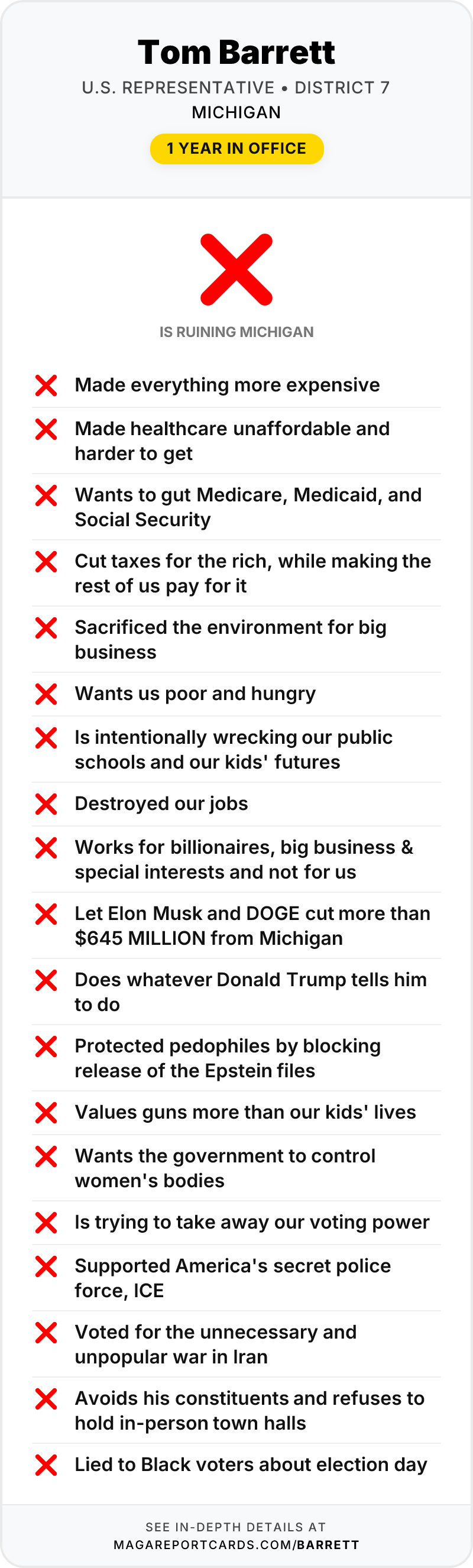
He voted for that same bill knowing what else it did to Michigan. Barrett was one of the members who voted for it, and 130,000 fewer Michiganders were enrolled in Obamacare coverage a year later.
He voted to stop states from regulating AI at all. An early version of the budget bill contained a ten-year ban on any state-level AI rules. Barrett voted for that version. A bipartisan group stripped the ban out before final passage. Had it survived, it would likely have wiped out state restrictions on data centers — the exact local control Barrett's ad now says he believes in.
He backed a bill to weaken environmental reviews. Barrett supported the SPEED Act, a permitting bill the House passed mostly along party lines last December. It shrinks federal environmental review, including for data centers.
He voted against limiting Flock cameras. In May, a bipartisan amendment would have barred anyone taking federal highway money from using automated license plate readers — the Flock cameras his Democratic opponent says are being rolled out across the district — for anything except toll collection. It failed 20–44 in the committee Barrett sits on. Barrett voted no.
Who Pays for His Campaigns
The ad warns about "politicians cozying up with Big Tech billionaires."
- Elon Musk's super PAC spent more than $869,000 in Michigan's 7th District to get Barrett elected two years ago.
- Peter Thiel gave Barrett the legal maximum this cycle.
- Stephen Schwarzman, CEO of Blackstone — which holds $150 billion in data center investments worldwide — gave Barrett the maximum in 2024 and again in 2026.
- The corporate PACs of Google, Amazon, Microsoft and Oracle have all given to Barrett. Oracle is the company behind the contested data center project in Saline, Michigan.
"Tom Barrett wants to reinvent himself as a data center fighter, but his record says the opposite," said Ravi Mangla of the Working Families Party. "He voted to give data center developers billions in tax breaks and left Michiganders holding the bag."
Barrett's campaign did not respond to a request for comment.
This Is Becoming a Habit
Barrett's ads have a pattern of saying things his own record doesn't support.
His campaign store sold "Made in USA" T-shirts whose tags said Haiti. His campaign ran a full-page ad in a Black-owned newspaper telling readers to vote the day after Election Day. And he described the 2020 election as "an unknowable thing" fifteen months after his own party's investigation found nothing wrong with it.
Now an eleven-year-old vote, cast before anyone was building for AI, is doing the work of a data center platform.
The Bigger Picture
Barrett isn't alone, and that's the point.
The same week this ad went up, Axios reported that Republicans' Senate campaign arm privately warned AI companies that their data center push was costing Republicans votes and could become "a sleeper issue for the entire election cycle." In Ohio, that memo named Senator Jon Husted's data center record as the "anchor" around his campaign. In Michigan's Senate race, Mike Rogers called for a one-year moratorium days after a reporter published what he personally owns.
Barrett's answer is to talk about "nationalization" — the idea that Washington will force data centers on unwilling towns. As the Prospect notes, the only person in Washington trying to do that is Donald Trump, who has moved to exclude data centers from environmental review and to put them on public land. Trump has endorsed Barrett and held a rally in the district a few weeks ago. Data center protesters interrupted it.
His opponent, Will Lawrence, won the Democratic primary by double digits running against data centers, and has spent the campaign at town halls opposing specific projects in the district. A House Majority PAC poll released Thursday put Lawrence ahead 49–47, with Barrett at 35 percent favorable and 47 percent unfavorable.
Barrett is not leading this argument. He's chasing it.
Michiganders in the 7th District are worried about their water, their power bills and who gets to decide what goes up down the road. Barrett voted for the tax breaks, voted to take away their state's ability to write rules, backed weaker environmental reviews, and took the industry's money.
Then he made an ad about 2015.
Source
David Dayen, "MI-07: Tom Barrett Scrambles to Bury His Data Center Past", The American Prospect, August 20, 2026.