For most of this year, Mike Rogers (MI) was for data centers.
In March, he endorsed Trump's national AI plan, which speeds up federal permitting for data centers. He told Michigan reporters he wanted to make permitting easier for AI companies. In July, he told Detroit's WXYZ that communities willing "to put up with one of these things" should get something out of it.
Then, on Thursday, August 20, he stood at a news conference and was asked about his policy on data centers.
"I think we need to take a pause, probably," he said.
He told the Detroit News he wants a one-year moratorium on new data centers in Michigan. Michigan, he said, "needs stronger guardrails to protect community control, prevent utility price hikes, protect our water and stop pay-to-play schemes."
That is a complete reversal. Politico called it "a massive shift" that "separates him from most of the Republican Party and even many Democrats."
Here is what happened in between.
Days Earlier, a Reporter Went Through His Financial Disclosure
The Lever, a reader-funded outlet that follows money in politics, published an investigation into what Rogers personally owns. What reporter Freddy Brewster found:
- Between $1.7 million and $2.6 million in companies that stand to gain from tech-friendly policy and faster permitting for AI construction.
- Between $100,001 and $250,000 in the Blackstone Real Estate Income Trust. Data centers are now 29 percent of that trust's holdings, up from 1 percent in 2020.
- Blackstone is helping build a 1.6 million square-foot data center near Ann Arbor worth $16 billion.
- Stock, held with his wife, in cybersecurity firms Qualys, NowSecure and Constella Intelligence, and in the quantum computing firm D-Wave — all companies building their businesses on AI.
- Stock in the venture capital firm Forgepoint Capital, where Rogers is a board adviser and his wife sits on the advisory council. Forgepoint is invested in at least 49 companies that use AI. Rogers is invested in two Forgepoint funds.
Days after that story ran, Rogers wanted a pause.
His campaign would not say whether the new position means he is going to sell any of it.
The Donors, Too
Rogers has raised roughly $148,000 from people invested in AI and data centers.
Cameron and Tyler Winklevoss gave $14,000 between them. Seven Blackstone executives gave $34,500. Paul Singer, who runs the private equity firm Elliott Investment Management — an investor in the data center company Equinix — gave $7,000. Executives at the venture firm Paradigm gave $17,615. Forgepoint's cofounder gave $6,950.
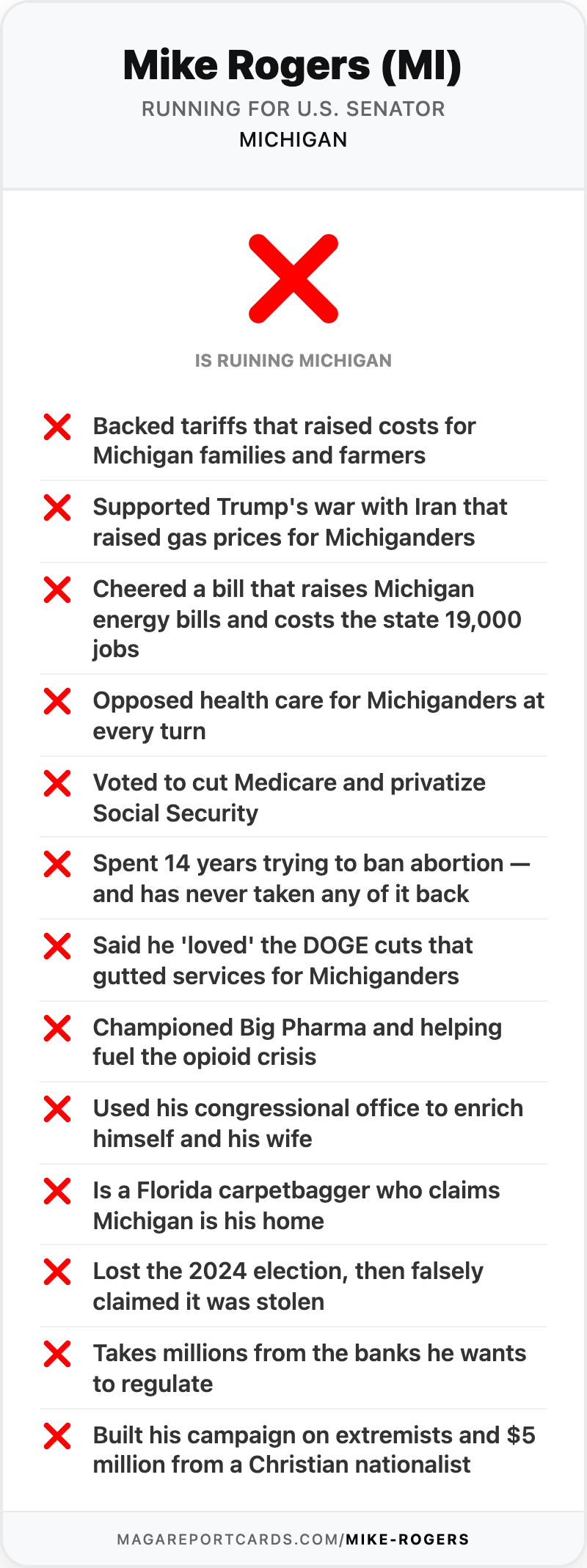
This is a familiar shape for Rogers. He has already been on this site for taking $95,000 from phone companies and then writing the bill that would have let them hand your data to the government, for voting against a gas price-gouging bill after nearly $700,000 from oil and gas, and for promising to root out "every waste, every fraud" while taking $234,000 from donors with fraud cases of their own.
The pattern is not that Rogers takes money. Everyone takes money. The pattern is that the policy keeps arriving after it.
Why Michiganders Care About This
Data centers are giant warehouses of computers that run AI. They need enormous amounts of electricity and enormous amounts of water, and somebody pays to build the power plants that feed them.
There are 79 data centers operating in Michigan right now, and 26 more proposed. Polling in May found 55 percent of Michiganders opposed building one within 25 miles of their home, though that opposition softened when the question added electricity-cost limits and other safeguards.
Water is the part that is specific to Michigan. Nearly half the state's residents rely on groundwater, and a lot of them draw it from private wells. A March report from the Alliance for the Great Lakes warned that if water-hungry industries pull out more groundwater than nature puts back, aquifers can be drained — and only 1 percent of the Great Lakes' water is naturally replaced each year.
A separate report in April found that data centers and their suppliers could push more forever chemicals — PFAS — into drinking water. The EPA has linked PFAS to cancer risk and pregnancy complications. Federal scientists found that up to 95 million Americans were already drinking groundwater with PFAS in it. Trump then cut 25 U.S. Geological Survey science centers in 2025 — the agency that did that measuring.
And communities often can't even find out what's coming. Andrea Densham of the Alliance for the Great Lakes told The Lever that developers show up "with an NDA in hand," requiring the county, the city and the water system to sign a silence agreement before work even begins.
The Politics Caught Up First
Rogers didn't discover any of this in August. The voters did, and they got there first.
On August 4, at least 14 Michigan candidates who campaigned against data centers won their primaries — including Abdul El-Sayed, the Democrat Rogers faces in November, and William Lawrence, who won the Democratic primary in Michigan's 7th District.
The same week Rogers flipped, his own party's Senate campaign arm sent a memo to the tech industry warning that data centers are turning toxic in the midterms — a memo that named Ohio Senator Jon Husted's data center record as the "anchor" around his campaign.
El-Sayed's response to Rogers' conversion was a raised-eyebrow emoji.
What He Still Hasn't Answered
A moratorium is a good idea. That isn't the problem.
The problem is that Rogers is asking to be trusted to write the rules for an industry he is personally invested in — after spending the year helping it, and after changing his mind within days of that investment becoming public.
Three questions his campaign has not answered:
- Will he sell the holdings? He hasn't said. Politico asked. The Lever asked. No response.
- What changed his mind? In July he wanted communities to be able to say yes. In August he wants the state to say no for a year. Nothing about the water, the power bills or the NDAs was new in between. The Lever story was.
- Does the moratorium apply to the $16 billion Ann Arbor project that Blackstone — whose real estate trust he holds a stake in — is helping build?
He also asked for guardrails to "stop pay-to-play schemes." He is the one holding $1.7 million to $2.6 million in the industry and $148,000 from its investors.
Michigan gets the electric bills, the groundwater risk and the NDAs. Rogers gets the portfolio. In November, Michiganders get one vote about which of those matters more.
Source
Freddy Brewster, "After data center investments revealed, Rogers backs statewide moratorium", The Lever / Michigan Advance, August 20, 2026. Photo by Ben Solis / Michigan Advance.
Timothy Cama, "Republican Mike Rogers backs Michigan data center moratorium", Politico, August 20, 2026.