There is a version of this story where a congressman writes a surveillance bill because he honestly believes it keeps us safe. Then there is the version where you look at who was paying him.
Mike Rogers (MI), the Republican running for Michigan's open U.S. Senate seat, collected nearly $95,000 from the phone and wireless industry while he was in Congress and while he has been running for the Senate, according to federal campaign finance records reviewed by the Michigan Advance. The money came from AT&T, Verizon, and CTIA — the trade group for the wireless companies.
During the same years, Rogers wrote and pushed a bill that would have let those exact companies hand your private information to the federal government without a warrant. After he left Congress, one of them hired him.
The money
The Advance went through two decades of Federal Election Commission filings, covering 2006 through 2025. It found at least 21 separate contributions to Rogers for Congress, Rogers for Senate, and his own leadership PAC, Securing America's Future.
- AT&T — $56,000
- Verizon — $28,500, across 17 contributions between 2007 and 2014
- CTIA, the wireless trade association — $10,000, starting in 2008
That's the industry. Now here's what he did for it.
The bill
As chairman of the House Intelligence Committee, Rogers introduced the Cyber Intelligence Sharing and Protection Act in November 2011. Everyone called it CISPA.
The bill would have let phone companies and internet providers legally hand over large amounts of private customer data — including information that identifies you personally — to federal agencies like the National Security Agency. No judge had to sign off. And the companies got broad protection from being sued for doing it.
Civil liberties groups hated it. So did consumer groups. So did a number of conservative and libertarian organizations, who argued the bill's language was so vague that the government could vacuum up enormous amounts of personal information without a warrant.
The phone companies loved it. AT&T publicly backed the bill in a November 2011 statement posted by Rogers' committee, saying it looked forward to "continuing to work with Chairman Rogers." By that November, AT&T had already given Rogers $27,000. Verizon, which lobbied for the bill alongside AT&T, had given him $23,000 by the time he reintroduced it in 2013.
CISPA passed the House and died in the Senate. Rogers brought it back in 2013. It cleared the House a second time that April and stalled again. When he reintroduced it, CTIA and US Telecom supplied supportive quotes for his own press releases. CTIA had given him $6,000 by then.
Rogers also cosponsored two resolutions, in 2010 and 2011, to stop the Federal Communications Commission from regulating broadband — the rules that keep internet providers from deciding which websites load fast and which load slow.
What he said while he was doing it
Rogers didn't just wave off the privacy objections. He made an argument that is genuinely hard to read twice.
"You can't have your privacy violated if you don't know your privacy is violated."
That was Rogers in 2013, defending warrantless government surveillance of Americans.
The same year, pushing for CISPA, he told the public the NSA wasn't watching Americans online at all:
"Our NSA is not monitoring the Internet here in the United States. I can guarantee you that."
He could not guarantee that. Two years later, The New York Times and ProPublica reported, using documents from Edward Snowden, that the NSA's ability to monitor internet traffic rested on a decades-long partnership with a single company — AT&T. The agency's files gave the program the codename "Fairview," dated it to 1985, and described AT&T's "extreme willingness to help." AT&T had installed surveillance equipment in at least 17 of its internet hubs on U.S. soil, far more than Verizon.
The company Rogers was legislating for, and taking money from, was the company doing the thing he guaranteed wasn't happening.
Then he went to work for them
Rogers left Congress in 2015. In 2016 — one year later — AT&T hired him as its chief security adviser, a job the Detroit News confirmed in 2024 while reporting on his industry ties. He advised the company on the same issues that had come before his committee.
That was one of several industry jobs. From 2018 to 2024 he sat on the advisory board of Telefónica, a giant international phone company. One of its subsidiaries operates in Venezuela — and Telefónica's own 2022 transparency report disclosed that it had intercepted the private communications of large numbers of its Venezuelan customers at the request of the authoritarian government of Nicolás Maduro.
Business Insider reported in 2024 that Rogers' post-Congress work in telecom and cybersecurity earned him $2 million in income, and that his assets had grown to $17.5 million.
The revolving door didn't stop the checks, either. When Rogers ran for Senate in 2024 and lost, AT&T's PAC gave him $10,000. In his current race, AT&T's corporate PAC has given him another $5,000.
This is the pattern, not the exception
If this were the only industry that had paid Rogers and then gotten what it wanted, you could call it a coincidence. It isn't.
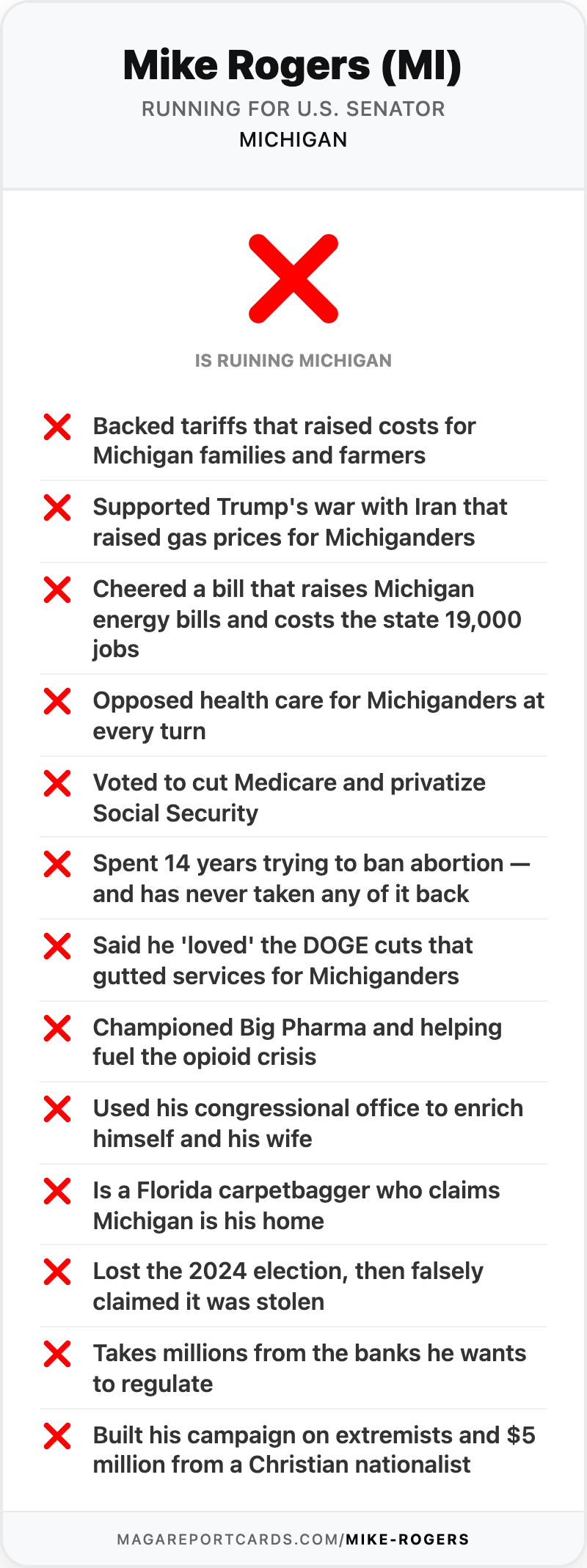
We've already documented that Rogers voted against a bill to stop gas price gouging after taking nearly $700,000 from oil and gas. We've documented that he promises to root out "every waste, every fraud" while taking $234,000 from donors with fraud cases of their own. His own report card lays out three decades of banking money and a stated desire to sit on the committee that regulates banks.
His campaign's answer to all of this is that the money follows the man, not the other way around. Spokesperson Alyssa Brouillet told the Advance that Rogers "has protected the national security interests of the United States his entire career, and nothing is going to change that."
His opponent's campaign puts the career total at $5.2 million in corporate PAC money.
What it means for Michigan
A U.S. senator votes on who gets to see your text messages, your emails, and your browsing history. They vote on whether the companies that carry those messages can be sued when they hand them over. They vote on whether your internet provider gets to throttle the websites it doesn't like.
Rogers has a record on every one of those questions. He wrote the bill to make the handover legal. He cosponsored the resolutions to strip the FCC of its authority. He told the public the surveillance wasn't happening while the company paying him was helping run it. And when he left office, that company put him on the payroll.
Michigan deserves a senator who works for the people whose data is being handed over — not for the companies handing it over.
Source
Telecom industry gave Mike Rogers nearly $100K while he pushed to deepen government data sharing — Ben Solis, Michigan Advance, August 19, 2026. Photo by Win McNamee/Getty Images.