Ohio's electric bills are going up. A report this summer projected the average Ohio household could pay close to $800 just for the summer months.
Here is how Jon Husted explained it in a July interview:
"We, the people, have created the demand for these data centers because we use all of these digital products that it processes. So, understand, like, when we look in the mirror, we are the problem."
We are the problem. Not the six years he spent as lieutenant governor recruiting the industry to Ohio. Not the tax break the state handed it. You, for having a phone.
Now his own party has put in writing what it actually thinks of that record.
The memo
Axios obtained an internal memo from the National Republican Senatorial Committee — the group whose entire job is electing Republican senators. It calls data centers an "anchor" around Husted's campaign.
The memo says Democrat Sherrod Brown has made data centers his "de facto opponent," and it is blunt about why:
"Brown has made his opposition to them the centerpiece of his campaign against Husted. Brown is using it because it works."
It goes further. The NRSC's own polling found the attack lands harder than normal campaign messaging, calling it "a sleeper issue for the entire election cycle." And it warns the tech industry what a loss would mean:
"If he loses and data centers get the blame, politicians across the country will take notice."
Read that again. This is not an attack ad. This is Husted's own side, in private, telling Big Tech that his record is a liability — and asking those companies to fix how Ohioans see them so he can survive November.
An Ohio Republican strategist, Terry Casey, called the memo "a surprisingly frank and honest analysis."
What the tax break actually cost
The reason Ohioans are angry isn't a messaging problem. It's a bill.
Ohio gives data center operators an exemption from sales tax. Husted didn't create it — it predates him. But as lieutenant governor from 2019 to 2025, he became one of the administration's most visible salesmen for bringing those projects in. At a 2019 groundbreaking for a Google data center, he said he could see Ohio becoming the "tech hub of the Midwest."
Then the bill came due. According to Ohio Department of Taxation figures reported by TiffinOhio.net, that exemption cost the state nearly $1.57 billion in 2025. The earlier projection was $136 million.
That is more than eleven times what the state thought it was giving away.
State records show Ohio has now committed at least $2.3 billion in long-term sales tax exemptions to data center operators, including Google, Meta and Amazon. Governor Mike DeWine paused consideration of new exemptions in May while the state figures out what it has done.
What it looks like from the sidewalk
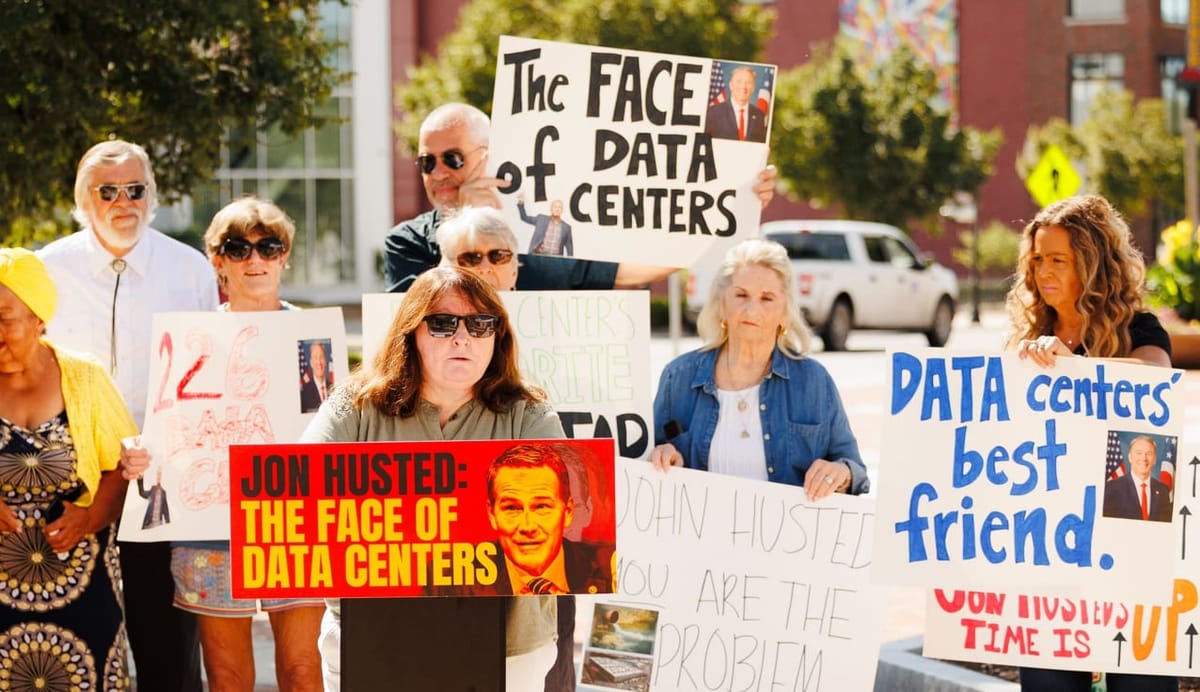
The day before the memo leaked, about a dozen people stood in downtown Lima with signs calling Husted the "face of data centers" in Ohio.
Lima City Councilwoman Jeannine Jordan spoke at the rally:
"Jon Husted is blaming you and I for using the tools modern life requires, while ignoring the fact that he helped flood the state with massive, power-hungry data centers without a coherent plan, without including citizens in the planning, without considering the costs that the people and the environment would pay."
Chris Gibbs, a Shelby County farmer and chairman of the county Democratic Party, talked about his own operation. He said his rates from AES have gone up 26% in twelve months, and 37% over two years.
Data centers are not the only reason bills are climbing — the regional grid is straining under aging power plants and transmission limits too. But they are a big and growing part of the demand, and PJM, the operator that runs the grid for Ohio and twelve other states plus Washington, D.C., has been writing new rules specifically to keep giant electricity users from shoving their costs onto everybody else's bill.
His answer is a bill that can't make anyone do anything
Husted's response to all of this was the Ratepayer Protection Act, which he introduced in July. He said it would make big power users cover the infrastructure their facilities need "without passing the costs on to working families and small businesses."
We've already gone through that bill line by line. It works through a 1978 law that only requires state regulators to consider federal standards — it can't compel a single state to do anything. When we looked, it had no cosponsors at all, and it sat in a committee whose chairman had said data center legislation wasn't a priority. The same post laid out the roughly $69,750 his campaign had taken from the tech and utility companies on the other side of that fight.
So the record is: six years selling the industry, a tax break that blew past its own estimate by $1.4 billion, a "we are the problem" explanation aimed at voters, and a bill with no teeth and no cosponsors.
The part that should bother Ohioans most
Husted's campaign says Brown "did nothing" on this for three decades and is "suddenly pretending to care."
Maybe. But Brown isn't the one whose own party wrote a private memo calling his record an anchor. Brown isn't the one whose strategists are asking AI companies to clean up the issue before voters get a say.
Ohio is not alone in this fight — Republicans in Pennsylvania and Tennessee are having the same argument with their own constituents. What makes Ohio different is that the people running the Republican Senate campaign have now admitted, in writing, that the voters are right and the politics are bad.
They just don't think Husted should have to change. They think the advertising should.
Sources
Anna Staver, "GOP memo calls data centers a political liability for Ohio Sen. Jon Husted", cleveland.com, August 19, 2026.
Dave Miller, "Northwest Ohio rally targets Jon Husted over Ohio data center boom, rising electric costs", TiffinOhio.net, August 19, 2026. Rally photo provided via TiffinOhio.net.