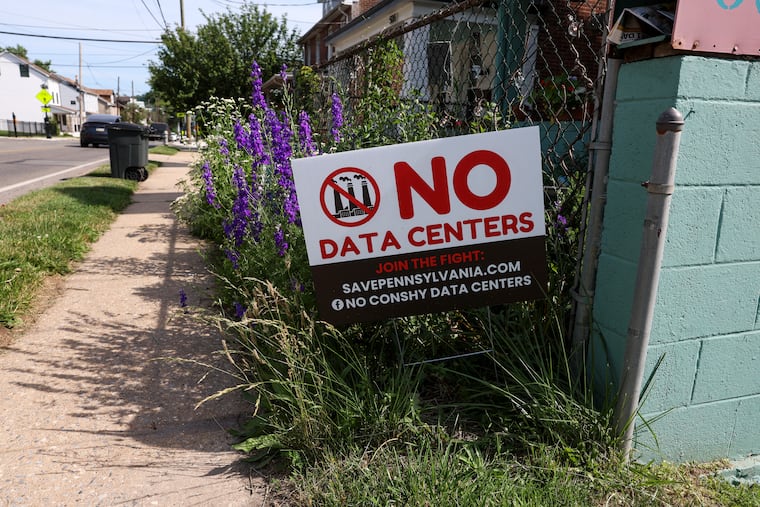
Data centers are giant warehouses full of computers that run AI. They use enormous amounts of electricity and enormous amounts of water, and somebody has to pay to build the power plants that feed them.
In Pennsylvania, that somebody is you.
A California Democrat, Rep. Ro Khanna, just toured 15 Pennsylvania counties. He was there to talk about lost manufacturing jobs. That is not what people wanted to talk about.
"I was surprised by the anger about it in Pennsylvania. In other states, people are sometimes opposed in local communities, local pockets. But not this widespread anger."
Data centers came up more than any other issue. Five have been proposed close together in King of Prussia. A two-million-square-foot project is proposed in Conshohocken. So on August 3 he introduced a "Data Center Bill of Rights" — a declaration that communities have the right to reject a data center through a transparent local process, or to allow one only with real protections: no higher electricity rates, disclosed water use, renewable power, and taxes actually paid.
Here is the honest part. Khanna's answer is House Resolution 1471, a "sense of the House" resolution. It is non-binding. It changes no law. And as of this writing it has zero cosponsors — not one member of Pennsylvania's congressional delegation has signed it.
So set the resolution aside and ask the harder question. When Pennsylvania's Republicans actually had votes to cast on who gets to make these decisions and who pays the bill, how did they vote?
First, what this is costing you right now
Pennsylvania's grid is run by PJM Interconnection, based in Valley Forge. Every year PJM holds an auction to pay power plants to be available on the hottest and coldest days. That auction price flows into your bill.
In July 2026 it hit the ceiling again. The price for 2028 and 2029 landed at $325 per megawatt-day — the maximum allowed under a cap negotiated by the Shapiro administration after the 2024 auction closed at a then-record $269.92.
The auction also came up 6,831 megawatts short of what PJM wanted. And PJM's peak demand forecast has risen by 66,000 megawatts through 2036 — a mix of retiring fossil fuel plants, electrification, and proposed data centers. That increase alone is nearly 80 times the output of Three Mile Island, which is reopening next year for the sole purpose of powering data centers.
Robert Routh of the Natural Resources Defense Council put it plainly:
"Data center load growth is degrading grid reliability, and it's raising prices to the Governor Shapiro-negotiated cap."
Patrick Cicero, Pennsylvania's former consumer advocate, said the last two auctions have added roughly $16 billion to the cost of keeping the lights on. Some Pennsylvania utilities have raised the rate they charge customers who don't shop around by as much as 20%. His estimate of what that means for a household:
"This has cost the average residential consumer in Pennsylvania somewhere in the neighborhood of $220 to $320 per year in additional costs on their bill."
That is the bill. Now here is who signed for it.
The senator who threw the party
On July 15, 2025, Sen. Dave McCormick brought President Trump to Carnegie Mellon University for his Pennsylvania Energy and Innovation Summit and announced more than $90 billion in private investment in data centers and power plants.
Seven months later, Technical.ly went looking for the money. What it found was that "some of the headline-grabbing announcements at the summit didn't match what companies actually pledged." McCormick's office named figures the companies themselves would not confirm — a $2.4 billion commitment from Constellation Energy among them. Some of the investments announced that day had been made years earlier, "as far back as the Biden administration." McCormick's office did not immediately return Technical.ly's request for comment on the discrepancies.
Now that the townships are angry, McCormick's language has softened. On a telephone town hall in late July 2026 he allowed that "data centers in Pennsylvania have raised legitimate concerns," and said developers should show up with commitments to protect energy costs and water, use local labor, invest in the community, and pay taxes.
"That should be part of the deal up front. With all those facts, then the local community can decide whether they want the data center or not. And if they choose not to, that's their choice."
Read that again. A sitting United States senator is describing what developers should voluntarily offer. He is one of a hundred people in the country who can write a law requiring it. He has not.
The vote that answered the question
Pennsylvania sends ten Republicans to the U.S. House. On May 22, 2025, they got a real vote on exactly the question Khanna's resolution asks — who decides — and every one of them answered the same way.
The version of Trump's budget bill that passed the House that day by a single vote, 215-214, contained a ten-year ban on states enforcing their own artificial intelligence laws. Brian Fitzpatrick, Dan Meuser, Glenn Thompson, Guy Reschenthaler, John Joyce, Lloyd Smucker, Mike Kelly, Rob Bresnahan, Ryan Mackenzie, and Scott Perry all voted yes.
Be precise about what that provision did and didn't do: it targeted state and local AI rules, not township zoning. It would not by itself have stopped a borough council in Conshohocken from voting a project down. But it is the clearest statement any of them has made about where they think this power belongs — a decade-long freeze on Harrisburg's ability to enforce its own AI rules, inside a bill the House passed at 6:54 in the morning.
The Senate killed it six weeks later. On July 1, 2025, senators voted 99-1 to strike the moratorium, Republicans and Democrats alike voting to protect their own states' authority. Only one senator in the entire chamber voted to keep it, and it wasn't McCormick — he voted with the 99.
House Republican leadership tried again anyway. In November 2025, Majority Leader Steve Scalise went looking for a way to attach a state AI preemption ban to the defense bill. That effort collapsed too, and the language was dropped in December after bipartisan blowback. Twice in one year, House Republican leadership went after the right of states to write their own rules for this industry. Twice they lost.
Then they made the power supply worse
Two days after the moratorium was stripped out, the same bill came back and passed for real. On July 3, 2025, nine of Pennsylvania's ten Republicans voted for final passage. Fitzpatrick was the only one who voted no — which he talks about a great deal more than the yes vote he cast in May that kept the bill alive by a single vote.
That law moved up the expiration of the two largest federal clean-energy tax credits — one for building clean energy projects, one for generating power with low emissions — to the end of 2027, from nearly a decade later. Spotlight PA reported one projection of an added $130 a year per Pennsylvania household by 2030.
Put the two halves together and you have the whole story of your electric bill. Demand is exploding because of an industry Pennsylvania Republicans courted and celebrated. Supply is tighter because of a law they voted for. PJM's auction is pinned at its cap. And the difference shows up on your statement every month.
Meanwhile, in Harrisburg: $2 billion still on the table
Pennsylvania hands data centers a sales tax exemption on their computer equipment. It is projected to cost the state nearly $2 billion in lost revenue over the next five years.
Almost nobody in Harrisburg publicly defends it. In the state House, 197 of 202 members voted for a bill repealing it. In the state Senate, 44 of 50 voted for a bill that included eliminating it. And then lawmakers went home for the summer without sending anything to the governor's desk.
Senate Majority Leader Joe Pittman, a Republican, said Democrats had "shredded" the Republican bill into "something that nobody could recognize." House Majority Leader Matt Bradford said he was "obviously unbelievably disappointed by the Republican leader in the Senate stating that he has no interest in doing anything on data centers." The only data center measure that survived into the budget was a disclosure rule: facilities using more than 10 megawatts have to report their energy and water use.
Two chambers, near-unanimous agreement, and the tax break is still there.
And the candidate for governor who found a poll
Stacy Garrity, the state treasurer running for governor, is reported in the same piece to have called for a pause but not an extended moratorium. That is the softest possible version of the position, and it arrived late. For a year Garrity's public line on data centers was that Pennsylvania needed to deregulate to attract more of them — "Ohio is kicking our butt" — until polling showed 64% of Pennsylvania adults calling data centers a crisis or a problem. We laid out the whole timeline in her own words.
There is one more Pennsylvania detail worth remembering. In northeastern Pennsylvania — where his Democratic opponent, Scranton Mayor Paige Cognetti, calls data centers a "big" and "very much cross-partisan" issue — Rob Bresnahan bought stock in a data center supplier while advocating for data centers on Capitol Hill.
This is not a Pennsylvania problem
The pattern repeats everywhere the boom has landed. In Ohio, Republican Sen. Jon Husted introduced something called the Ratepayer Protection Act — a bill with no cosponsors, from a senator whose campaign took about $69,750 from the tech and utility companies on the other side of that fight.
The shape is always the same. Court the developers during the boom. Discover the language of protection when the polling turns. Offer something voluntary, non-binding, or unenforceable. Never cast a vote that costs the industry anything.
What we deserve
The Pennsylvanians fighting proposed data centers in King of Prussia and Conshohocken are asking for three simple things: to know how much water and power a project will take, to have rules that are actually binding, and to not eat the cost on their utility bill.
Their senator says developers should offer that. Their governor's challenger wants a pause of unspecified length. All ten of their Republican House members voted for a ten-year freeze on states enforcing their own AI rules, and nine of them voted for the law projected to push their constituents' power bills higher.
Khanna is right about one thing, whatever you think of a non-binding resolution:
"At least they were offering royalty checks in the cases of fracking. [Data center developers are] not even giving the communities checks. It's just kind of like, 'OK, we're going to build.' What does the community get out of it? I literally don't understand it."
Neither do we. Pennsylvanians are paying for this industry twice — on their electric bills and in lost tax revenue — while the Republicans who represent them offer voluntary suggestions and votes that go the other way. We deserve better.
Source
Ro Khanna's tour through Pennsylvania influenced new federal data center legislation — Sam Janesch, The Philadelphia Inquirer, August 9, 2026. Photo: a yard sign protesting a proposed data center near the closed Cleveland-Cliffs steel mill in Conshohocken, by Monica Herndon / Philadelphia Inquirer staff photographer.


