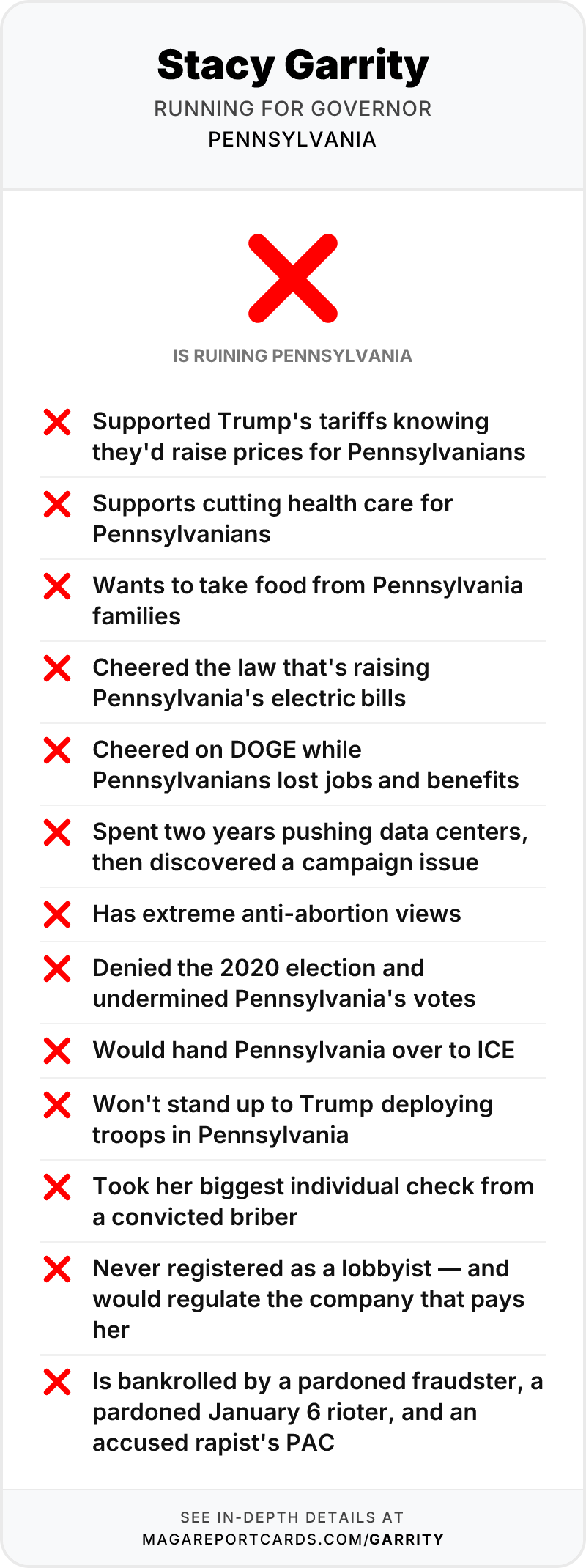
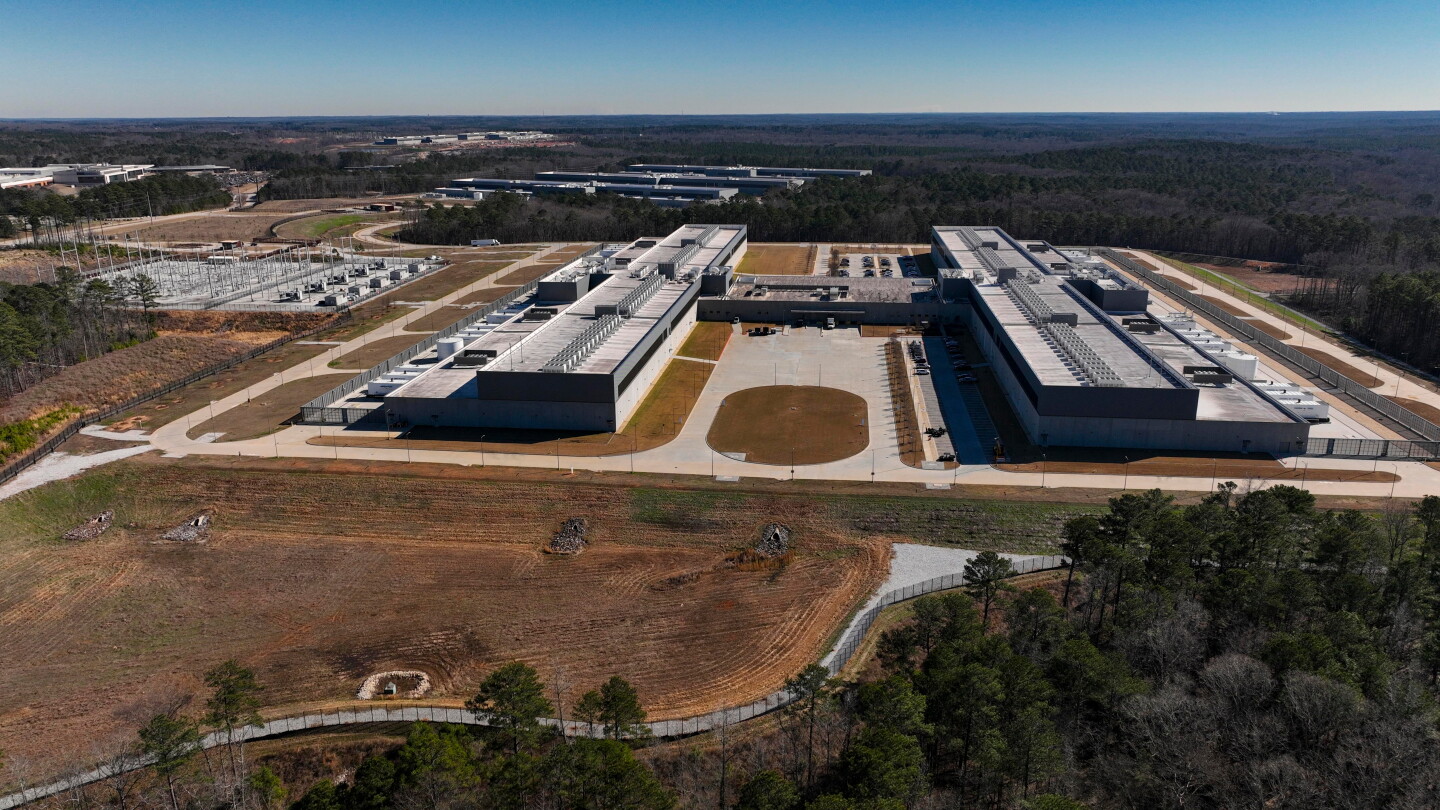
Data centers are giant warehouses full of computers that run AI. They drink enormous amounts of water, they need enormous amounts of electricity, and somebody has to pay to build the power plants that feed them. Across Pennsylvania, people are fighting them — including a project proposed for East Whiteland Township in Chester County.
Stacy Garrity has decided this is her issue. At an event in Cumberland County in June 2026, she told reporters that Gov. Josh Shapiro "was the biggest cheerleader of data center development in Pennsylvania until he wasn't."
"It is a huge, massive flip-flop, and nobody should be fooled," she added.
Fair enough. Let's not be fooled. Here's Garrity's own record on data centers, in her own words, in order.
What she said before it was a campaign issue
In June 2025, Amazon announced it would spend at least $20 billion building data center campuses in Pennsylvania. Garrity called it "great news" on X. "This will not only bring historic investment into our commonwealth," she wrote, "but also create thousands of jobs for Pennsylvanians."
That summer she went on KDKA's Big K Morning Show and complained that Pennsylvania was "playing around the fringes" compared to other states.
"We need to deregulate. Pennsylvania is not an easy state to do business in and our neighbors are kind of eating our lunch."
In July 2025 she told Breitbart the state needed to produce more energy to fuel "a rebirth of Pennsylvania as a national AI and tech hub."
That August, on a radio show, she said Pennsylvania should be building more of them, faster:
"We have 88 data centers. Ohio is kicking our butt. They have over 192. And so, you know, we could just be doing so much more in that space."
Not a word about water. Not a word about electric bills. Not a word about the townships. Her complaint was that Pennsylvania wasn't deregulating fast enough to get more.
Then the polling came in
By spring 2026, a Muhlenberg College poll found 64% of Pennsylvania adults called data centers a crisis or a problem. An Emerson College survey taken in December 2025 found 71% were worried about how much power the centers use.
Chris Borick, who directs the Muhlenberg College Institute of Public Opinion, told Spotlight PA why he thinks the issue suddenly matters so much to her:
"Given [Garrity's] standing in this race, the polling, the financial disparity between the candidates, I think she has latched on to data centers as a potential place to get a boost for her campaign and tap into what we're seeing."
Garrity started holding "listening sessions" around the state in June 2026. And she insists, flatly, that nothing about her position has changed.
"I know there was some headline and you guys want to infer that my position has 'evolved,' but it hasn't. I've always said you can't jam these things down the throats of communities. I've said that from day one."
That is not what she said from day one. What she said from day one was "we need to deregulate."
Pressed on the contradiction, Garrity offered a second answer that quietly contradicts the first one: she said she's learned a lot since then, and that back when she was strictly acting as treasurer, her goal was shrinking the state's deficit. So her position hasn't changed — except that she's learned a lot and had different priorities. Both can't be true.
The "pause" is not a plan
Here is the core of what Garrity has committed to. She says she'd call for a pause on new data center development so townships can update their zoning. She won't say how long. She won't say how she'd do it. As she put it to reporters:
"We pause for as long as we need the pause."
She has also said she would not support a moratorium of three years or more; the difference, she says, is that "a moratorium is a definitive period of time" — which is a distinction, not a policy. The Capital-Star reported it's unclear whether she could institute a pause at all without legislative approval, though she says she believes it's within her power. Her campaign did not answer Spotlight PA's questions about the specifics of what she'd do.
To be fair to her, she has taken one concrete position: she supports repealing the state sales tax break data centers get on computer equipment, a break Shapiro's budget projections estimate will have cost Pennsylvania $2 billion by 2031. "No more sweetheart tax deals," she says. That's a real answer to a real question.
But the questions Pennsylvanians fighting these projects are actually asking are about water, power, and their electric bills. On those, her answer is a pause of unspecified length that she may not have the authority to order.
Her energy plan is the part she doesn't want you to connect
Shapiro's data center proposal, called GRID, would require developers to get about a third of their power from clean energy by 2035 and to pay for the power infrastructure they need, in exchange for tax breaks. Garrity's criticism of it is that the standards are voluntary — she says developers "absolutely have to" follow rules.
But she also says she won't accept the clean energy piece. In a statement to Spotlight PA she rejected the "clean energy mandate," saying instead:
"We need to be utilizing the abundant natural gas resources under our feet that currently accounts for 60% of Commonwealth's electricity generation."
That is the heart of her plan. In June 2026 she stood in front of the Marcellus Shale Coalition, a natural gas industry group, and laid it out: an executive order on "day one" lifting what she calls a ban on new drilling sites, a special session of the legislature to fast-track gas permits, and a promise to "reform or potentially eliminate renewable energy and efficiency mandates."
Two things about that speech are worth sitting with.
First, the reporter checked. There is no statewide ban on new drilling sites in Pennsylvania. There's a moratorium on drilling in state parks and new leases in state forests, and a fracking ban in the Delaware River Watershed enforced by a multi-state commission. Her campaign didn't respond to the Capital-Star's request to clarify. Weeks later, a spokesperson told Spotlight PA she meant the moratorium on drilling in state parks and new leases in state forests.
Second, the very mandates she promises to "reform or potentially eliminate" are the mandates she's attacking Shapiro for not making mandatory. She wants binding rules on data centers and no binding rules on the energy that powers them.
She has also already helped make Pennsylvania's electricity problem worse. Garrity cheered Trump's budget bill as a "historic plan" delivering "real relief and real results for everyday Pennsylvanians." That law moved the expiration of two of the largest federal clean-energy tax credits — for building clean energy projects and generating low-emission power — up to the end of 2027, from nearly a decade later. One report projected an annual increase of $130 per Pennsylvania household by 2030. The head of a trade group for utility-scale renewable developers told Spotlight PA the added costs to developers would be "baked in" to consumer electricity prices for "several years to come."
So: demand is forecast to spike because of the data centers she spent a year asking for, supply is expected to tighten because of the federal law she cheered, and her fix is to drill more gas.
Who actually benefits
Garrity leases the mineral rights under one of her properties in Sayre to the fracking industry. Capital & Main went through her property records and financial disclosure filings and found she has earned at least $15,600 since 2020 from two fracking wells that run underground beneath her land — income from Chesapeake Energy (now Expand Energy) and the Norwegian firm Equinor, reported every year since she took office in 2021.
The real number could be higher. Pennsylvania only requires officials to disclose that outside income exists above $1,300 a year, not how much it is. Garrity's campaign told the Philadelphia Inquirer she receives modest royalties, declined to give a figure, and said she'd keep collecting them as governor, "as it is part of her private property."
The industry is funding her campaign, too. In March 2026 the Expand Energy Corp. Employee PAC — the company that absorbed her mineral rights — gave her $500. So did the Pennsylvania Coal PAC. The Pennsylvania Grade Crude Oil Coalition gave $4,000.
And the state agency a governor oversees, the Department of Environmental Protection, is right now weighing a proposal from environmental groups that would push new fracking wells farther from homes, schools, and hospitals. Garrity has attacked the proposed setbacks as an attack on fracking. The proposal wouldn't touch existing wells — but it could cut into profits for mineral rights owners. People like her.
Davina Hurt, who directs government ethics at Santa Clara University's Markkula Center, told Capital & Main that disclosure alone isn't enough for an office of this size, and recommended officials put personal assets in blind trusts while governing. Garrity has done the opposite: she's said she'll keep the checks.
This is a familiar shape for her. In 2022 she rewrote Pennsylvania's investment rulebook to strip out environmental considerations — and when the state Democratic Party asked for the emails behind that change, her office refused, calling the request a "fishing expedition."
Pennsylvania isn't the only place this is happening
Garrity keeps holding up Ohio. First it was "Ohio is kicking our butt." Now it's "even Ohio has paused that," about the tax break.
Ohio is worth looking at, but not for the reason she thinks. One of Ohio's Republican senators, Jon Husted, introduced a bill he called the Ratepayer Protection Act — after taking about $69,750 from the tech and utility companies on the other side of that fight. The bill has no cosponsors and couldn't compel a single state to do anything.
In Florida, Byron Donalds — the Republican front-runner for governor — promised the state's new data center law means ratepayers won't foot the bill. PolitiFact rated it Half True: the law directs a process, not a result, and doesn't cover rural co-ops or municipal utilities at all.
The pattern is the same everywhere. Republican candidates spent the boom years courting the developers. Now that voters are angry, they've discovered the language of protection — while their actual proposals stay vague, voluntary, or toothless, and the industry money keeps arriving.
What we deserve
Pennsylvanians fighting data centers in their townships are asking for three things: to know how much water and power a project will take, to have real rules instead of voluntary ones, and to not have the cost land on their utility bill.
Garrity spent a year asking for the opposite of all three. She wanted deregulation. She wanted more centers, faster, because Ohio had more. She wanted the state to produce more energy to attract them. She has never withdrawn a word of it — she says her position never changed at all.
What changed is the polling.
Stacy Garrity spent a year demanding deregulation, then found a poll. We deserve better.
Source
Garrity and Shapiro have accused each other of flip-flopping on data centers. Are they both right? — Ian Karbal, Pennsylvania Capital-Star, June 29, 2026. Photo: a sign opposing a data center project proposed for East Whiteland Township, Chester County, by Peter Hall / Pennsylvania Capital-Star.
Also drawn from Where Shapiro and Garrity stand on Pennsylvania data centers — Kate Huangpu, Spotlight PA, July 7, 2026, and PA governor race 2026: Energy costs take center stage — Charlotte Keith and Kate Huangpu, Spotlight PA, July 2026.