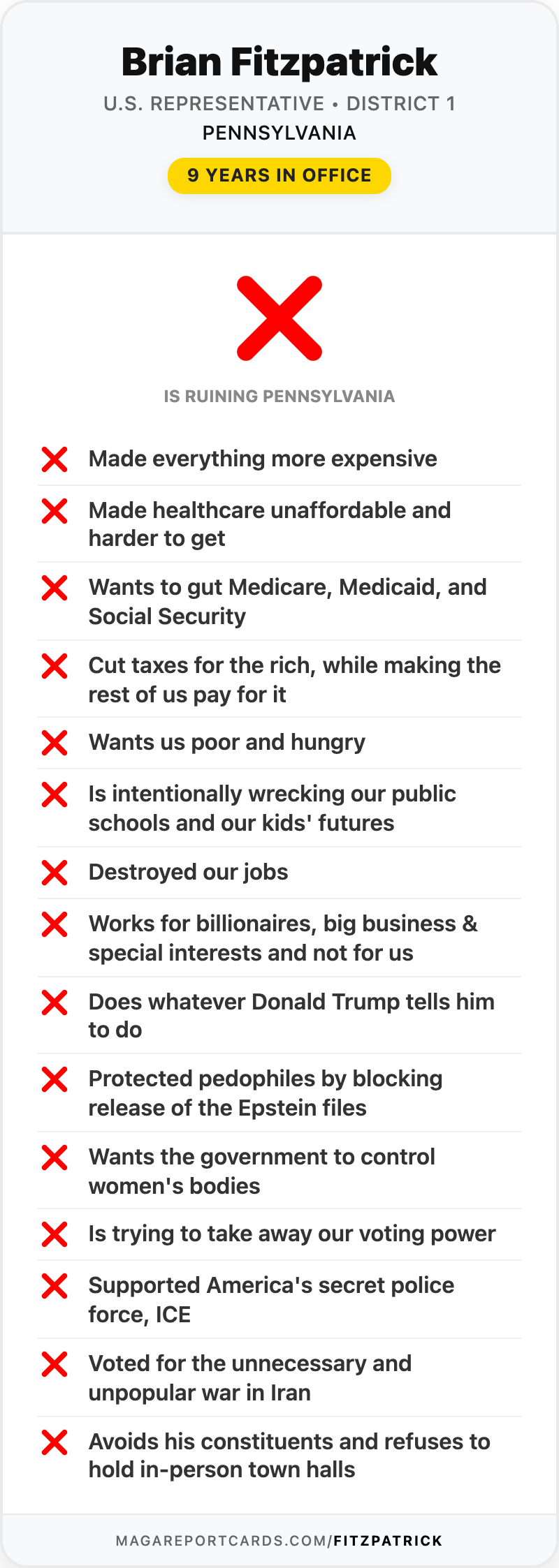
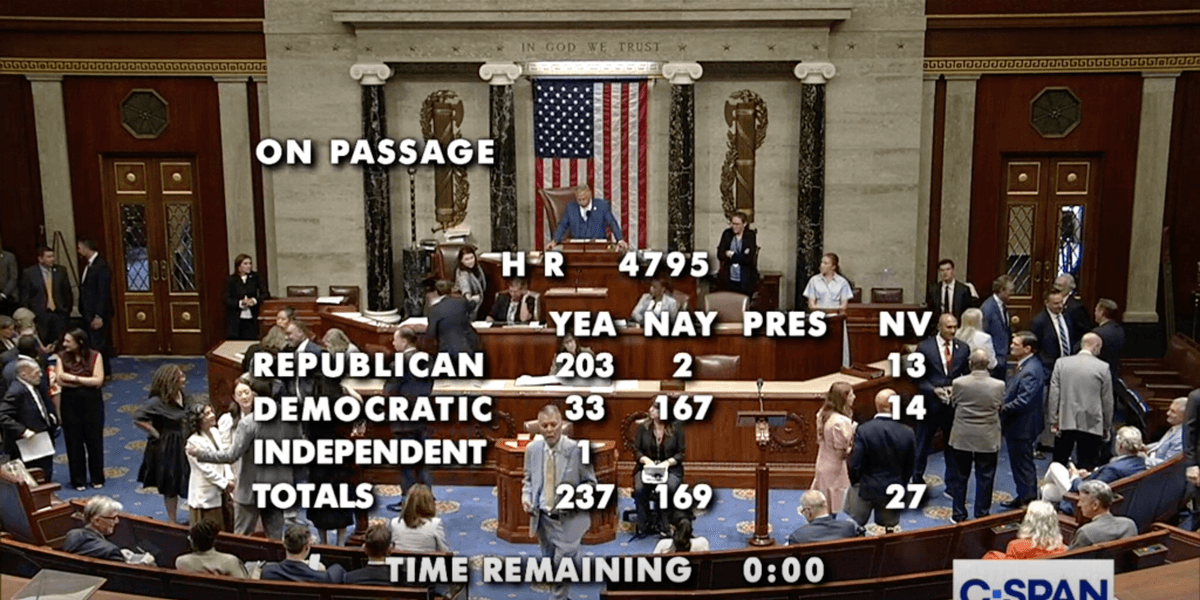
Brian Fitzpatrick has one of the most valuable talking points in Congress. He is one of only two House Republicans who voted against final passage of Trump's budget bill — the "One Big Beautiful Bill" — on July 3, 2025. The other was Thomas Massie of Kentucky.
It's true. You can look it up. And it's a useful thing for a Bucks County Republican to be able to say in a district that has voted for the Democrat for president three elections running.
Here's the rest of the record.
May 22, 2025: 215 to 214
Six weeks before that famous no vote, the same bill came to the House floor for the first time. Roll call 145, May 22, 2025.
It passed 215 to 214, with one member voting present.
Brian Fitzpatrick voted yes.
One vote. That's the entire margin. If Fitzpatrick had voted no in May, the bill would have failed 214–215 on the House floor.
Then, on July 3, after the Senate sent it back, it passed 218 to 214 — and Fitzpatrick voted no.
Notice the difference. In May, his vote alone could have stopped the bill. In July, it couldn't. The bill passed by four; it would have taken two more Republicans switching to sink it, and his no changed nothing. He got recorded against the final law only at the moment being against it cost nothing.
| Vote | Date | Result | Fitzpatrick | Could his vote alone have changed it? |
|---|---|---|---|---|
| Roll call 145 | May 22, 2025 | Passed 215–214 | Yes | Yes — the margin was one vote |
| Roll call 190 | July 3, 2025 | Passed 218–214 | No | No — it passed anyway |
His explanation, and what's wrong with it
Fitzpatrick has an answer for this, and it deserves a fair hearing. He blamed the Senate. His statement explaining the July vote, reported by The Philadelphia Inquirer, was this:
"The original House language was written in a way that protected our community; the Senate amendments fell short of our standard. I believe in, and will always fight for, policies that are thoughtful, compassionate, and good for our community."
That argument has one requirement. The House version he voted for has to have actually protected his community.
It didn't.
The Congressional Budget Office scored the Medicaid and CHIP provisions of the House-passed bill — the May 22 version, the one Fitzpatrick voted yes on — and found they would:
- Cut $863.4 billion in gross spending over ten years
- Increase the number of uninsured Americans by 7.8 million by 2034
That's the Georgetown Center for Children and Families' breakdown of the CBO estimates. The specific provisions in the version he supported included:
- Work reporting requirements on 18.5 million low-income adults — CBO projected 5.2 million fewer people enrolled in Medicaid by 2034
- Eligibility redeterminations every six months instead of annually — 700,000 more uninsured
- Mandatory cost-sharing of up to $35 per service for expansion enrollees above the poverty line
- Blocking simplified enrollment rules until 2035 — 600,000 more uninsured
You can argue the Senate made a bad bill worse. It did. What you cannot argue is that the House version "protected our community." The House version was an $863 billion Medicaid cut that CBO said would push 7.8 million Americans off their coverage. Fitzpatrick supplied a vote it could not have passed without.
What it means in Bucks County
An estimated 300,000 Pennsylvanians are projected to lose Medicaid coverage under the law that ultimately passed.
Those people don't get their coverage back because their congressman's name appears in the "no" column on the second vote. The bill is law. It became law because it survived a one-vote margin in May, and it could not have survived that margin if Fitzpatrick had voted against it.
This is the difference between a vote and a position. A position is what you tell voters you believe. A vote is what you do when the outcome depends on you.
The pattern is the point
Fitzpatrick's district is one of the most competitive in the country — a Bucks County seat that regularly votes for Democrats at the top of the ticket. His entire political brand is the reasonable Republican who breaks with his party.
The record shows a narrower version of that. He broke with his party on the vote where breaking didn't matter, and stood with it on the vote where it did.
That's worth remembering the next time you see an ad about the two Republicans who stood up to Trump's budget bill. The tally in May was 215–214. Somebody had to be the 215th.
Source
This post was prompted by a DCCC digital ad launched August 7, 2026 in Pennsylvania's 1st District. Everything above rests on the primary record rather than the ad: the two roll calls are published by the Office of the Clerk of the U.S. House, the Medicaid figures are CBO estimates of the House-passed bill, and Fitzpatrick's statement was reported by the Inquirer.