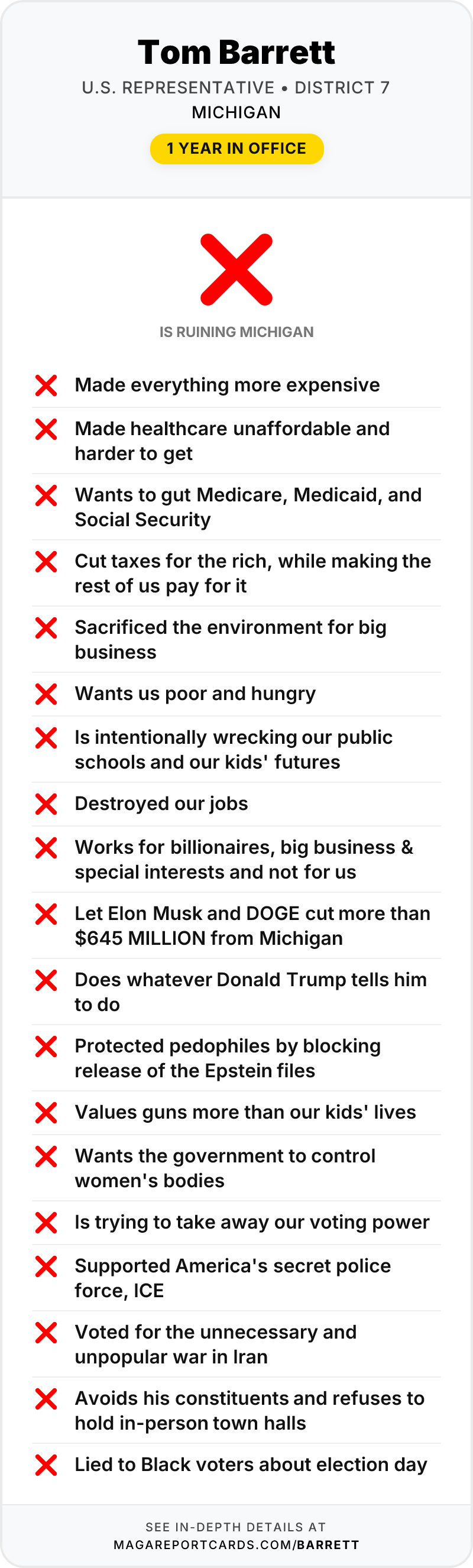
In September 2022, WXYZ in Detroit did something simple. With the midterms a few weeks out, reporter Max White went to Michigan's candidates with one question: will you accept the results of this election?
Most people can answer that in one word.
Rep. Elissa Slotkin, running in the 7th District, called it "non-negotiable." Her exact words: "anyone running for elected office must make clear that they'll accept the results of the election—full stop. Saying anything else is harmful to our country, our politics, and our very democracy."
Her opponent was a state senator named Tom Barrett. WXYZ emailed his campaign. The campaign didn't write back.
But the Detroit Free Press had already gotten an answer out of him about the last election, and WXYZ printed it:
"It's an unknowable thing. How many people mailed in absentee ballots that were ineligible to participate in the election? We can't know for sure what effect that had. That's why we have to stop it before it happens."
That's the man who now represents mid-Michigan in Congress, saying he cannot know whether the 2020 election was fair.
Here's the problem with "unknowable." Somebody had already gone and found out. They were Republicans. And Barrett was a member of the same chamber that did it.
His own party spent seven months looking. They found nothing.
After the 2020 election, the Republican-controlled Michigan Senate opened an investigation into the fraud claims people were making about Michigan's vote. It was not a quick look. The Senate Oversight Committee took more than 28 hours of testimony from nearly 90 people across nine hearings, reviewed thousands of pages of subpoenaed documents, and burned "hundreds of hours of Senate staff investigation" time.
In June 2021, the committee's chairman — Republican Sen. Ed McBroom — released a 35-page report. Bridge Michigan covered it. The findings were not ambiguous:
"There is no evidence presented at this time to prove either significant acts of fraud or that an organized, wide-scale effort to commit fraudulent activity was perpetrated in order to subvert the will of Michigan voters."
And:
"Our clear finding is that citizens should be confident the results represent the true results of the ballots cast by the people of Michigan."
The report knocked down the dead-voter claims. It knocked down the "fractional voting" claims. It knocked down the Detroit ballot dump. It knocked down the idea that any precinct had over 100% turnout. It called the Antrim County conspiracy theory "indefensible" and said the committee was "appalled" at the willful ignorance of the people still pushing it. Joe Biden won Michigan by 154,188 votes.
McBroom's summary of the whole business, to Bridge Michigan: "The claims have become so ludicrous when compared to the actual facts."
Barrett was a sitting Michigan state senator when his own party's committee published that. Fifteen months later, asked whether the election was fair, his answer was that it's "an unknowable thing."
It was knowable. Republicans knew it. He just didn't want to say it out loud in front of a primary electorate.
He was there at the beginning, too
Go back further, to the night before the Capitol was stormed.
On January 5, 2021, eleven Michigan Republican state senators sent a letter to Congress. Here is how the Detroit News described it at the time: the senators wanted Wednesday's joint session of Congress to "pursue every available option" to examine claims of wrongdoing in the election.
Tom Barrett's name was on it.
There were actually two versions floating around. As Bridge Michigan reported, the letter "originally asked Congress to delay certification of the 2020 presidential election due to unsubstantiated allegations of election fraud," and was then revised to strip that part out. Barrett said his signature had been added to that original version "without his consent."
Fine. Take him at his word on the draft. What matters is what he said after he watched a mob attack the Capitol over the exact claims his letter was demanding Congress chase.
He had no regrets about signing the final version. And this is what he told Bridge Michigan the day of the riot:
"Are we not allowed to look into election concerns? Does looking into concerns make us violent?"
That's a man watching the consequences arrive and deciding they belong to somebody else.
"Unknowable" is not a doubt. It's a tactic.
Notice what Barrett didn't say in that answer. He didn't say the election was stolen. He didn't name a single fraud he could prove. That's the smart play — a specific claim can be fact-checked and blown up, the way McBroom's committee blew up every specific claim it was handed.
So instead you say it's unknowable. You can't be fact-checked on a shrug.
And then you look at the second half of the quote, which is where the shrug stops being harmless: "That's why we have to stop it before it happens."
Stop what, exactly? Absentee voting. The thing his own party's seven-month investigation found no fraud in. The doubt isn't the goal. The doubt is the excuse for making it harder to vote.
He kept going after he got the job
This isn't a 2022 problem Barrett grew out of. It's the through-line of his career.
In October 2024, a full-page ad paid for by his campaign ran in The Michigan Bulletin, a Black-owned Lansing weekly, telling readers to vote for him on November 6 — the day after Election Day. A near-identical ad his campaign ran in another Lansing paper had the correct date. The Michigan Legislative Black Caucus filed a complaint accusing the campaign of intentionally giving Black voters false information. His campaign called it "much ado about nothing" and got a cease-and-desist notice from the Michigan Attorney General's office.
In Congress, he voted for the SAVE Act on April 10, 2025, which passed the House 220 to 208. That bill would make every American show proof of citizenship in person — a passport or a birth certificate — every time they register or update a registration. Sean Morales-Doyle of the nonpartisan Brennan Center told NPR that about 21.3 million American citizens don't have those documents readily available, on top of the millions more whose documents don't match their current name — "women who've been married and have changed their name recently." His summary of the bill: "This is not a voter ID law. This is not a show-your-driver's-license when you go to vote. This is a show-your-papers law."
And on February 4, 2026, Barrett led the entire Michigan Republican House delegation — Jack Bergman, John Moolenaar, Bill Huizenga, Tim Walberg, Lisa McClain and John James all signed — in a letter to Secretary of State Jocelyn Benson accusing her of eroding public confidence in Michigan elections. The letter's evidence was a Macomb County clerk's claim about noncitizens on the voter rolls.
Six days earlier, Votebeat had reported that the clerk's estimate was too high — the state reviewed the people he flagged and found citizens mixed in with noncitizens, and registrations that had already been cancelled years ago. The clerk in question, Anthony Forlini, is himself a Republican candidate for secretary of state.
As for the statewide number Barrett's letter leaned on: Michigan's Department of State compared more than 7.9 million driving records against over 7.2 million registered voters and found 15 credible cases of an apparent noncitizen casting a ballot in the 2024 general election. Thirteen were referred to the Attorney General for possible charges. Those cases, plus one more found in October 2024, come to 0.00028% of the more than 5.7 million votes Michiganders cast — about one ballot in every 350,000.
That's what Barrett wants Michiganders to believe their elections can't be trusted over.
We deserve better
Barrett has never had to prove a single thing. He didn't have to prove fraud in 2020 — he just signed a letter asking Congress to go looking. He didn't have to prove it in 2022 — he just called the answer unknowable. He doesn't have to prove it in 2026 — he just demands "answers" about a number that works out to one ballot in 350,000.
Every step of the way, somebody else does the real work of checking. Republican senators in Lansing. Election clerks. State investigators. And every time they come back and say the elections are sound, Barrett moves on to the next thing he can't quite know for sure.
The people of Michigan's 7th District cast real ballots and deserve a representative who will say plainly that those ballots get counted. Barrett has had more than five years and a lot of chances to say it. He still won't.
Source
Max White, "Will Michigan candidates accept the results of the 2022 election? Here's what they said," WXYZ Detroit, September 27, 2022. Photo: official congressional portrait, 119th Congress, via Wikimedia Commons.