There is one thing every campaign ad in America has to get right. Not the slogan. Not the photo. The date.
In October 2024, a full-page ad paid for by the campaign of Tom Barrett got it wrong — in a Black-owned newspaper in Lansing, five weeks before a race he would go on to win by less than four points.
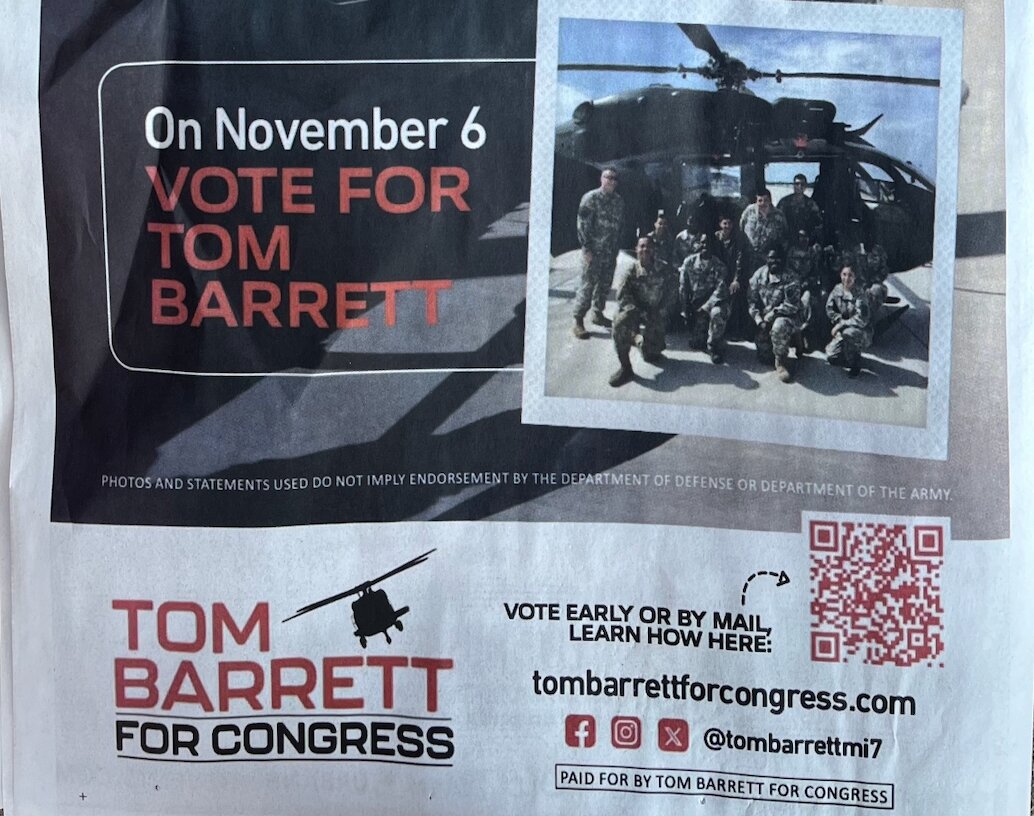
The ad ran across the back page of The Michigan Bulletin, a free Black-owned weekly that had been publishing in the Lansing area for 30 years. In a black box at the center of the page it said:
"On November 6 VOTE FOR TOM BARRETT"
Election Day was November 5. At the bottom of the page, in small type: "Paid for by Tom Barrett for Congress."
The paper next door got the right date
Here is the part that makes this more than a typo.
Barrett's campaign placed a nearly identical ad in the Lansing City Pulse, a free alternative weekly in the same town, around the same time. That version told readers "On November 5 Vote For Tom Barrett" — the correct date.
Why the difference? Because City Pulse caught it. Publisher Berl Schwartz said his paper spotted the wrong date and had the campaign change it in the file before it went to print.
So the campaign was told. Someone at Barrett for Congress was handed a corrected date and fixed the file for one Lansing paper. Then the uncorrected version — the one with November 6 on it — is the one that went to the Black-owned paper.
The campaign's own spokesman confirmed exactly that sequence. Jason Cabel Roe told WKAR that the original City Pulse version also carried the wrong date and was caught before print, and that when it came time to reformat the ad for The Michigan Bulletin and its Black readership, the designer pulled the wrong file:
"We were working with that previous version that had the wrong date. And the proofer just missed the date on that. And so, it got through without us noticing that it still had the wrong date on it from a previous version."
Meanwhile, on the page right before Barrett's ad in that same issue of the Bulletin, a full-page ad from Republican U.S. Senate candidate Mike Rogers (MI) ran with the correct Election Day printed on it.
"I'm not in the business of misinforming my readers"
The Bulletin's publisher, Marcus Jefferson, said the file came straight from the Barrett campaign and was supposed to be print-ready.
"I've been in newspapers for most of my life. I'm not in the business of misinforming my readers," Jefferson said.
By the time anyone raised it publicly, the ad had been out in Lansing for more than a week. As of that Sunday — more than a week after publication — the campaign still had not run a correction.
Black lawmakers asked for an investigation
On Sunday, October 13, the Michigan Legislative Black Caucus filed a complaint with the Michigan Attorney General and the Ingham County prosecutor, asking them to look into whether the campaign "intentionally distributed false information about the election process."
State Senator Sarah Anthony of Lansing, the caucus vice chair, didn't buy the explanation:
"For the amount of ads and flyers and robocalls that they are putting forward in the Black community, you would think that they would also use that intentional push to also make sure that Black voters have the correct date."
Barrett's campaign called it "nothing but a proofing error." Roe went further and suggested Democrats were making noise because they were worried about losing Black voters: "I understand that they are very nervous that a group of voters who have pledged their loyalty to the party and gotten very little in return are looking elsewhere."
Anthony's answer to that was short. "Any and everyone is welcome to campaign for our vote. But they also have to stand by their record. And that's what I judge people on. Not by these performative measures."
The Attorney General ordered them to stop
Two days after the complaint, on October 15, Michigan Attorney General Dana Nessel's office sent the Barrett campaign a cease-and-desist notice. It was not gentle:
"The Department finds the allegations deeply troubling; therefore, you are hereby ordered to cease and desist the dissemination of inaccurate or misleading information about the upcoming General Election and to correct the inaccurate and misleading information already disseminated."
The notice added that the office would keep watching to make sure the promised correction actually ran, and that going forward it expected the campaign "to comply with the law and only provide factually correct information regarding Election Day 2024."
Nessel's office was not being paranoid. Four years earlier, in the 2020 election, her office filed felony charges against two political operatives who sent robocalls to nearly 12,000 Detroit-area phone numbers pushing lies designed to scare Black voters away from voting by mail. Both men eventually pleaded no contest and were sentenced in December 2025. Nessel called the scheme a use of "every racist dog whistle" to steal "the most fundamental right that we often take for granted: the right to vote."
That's the history a wrong election date lands in when it shows up in a Black-owned paper in Michigan. Whether or not you believe the campaign's explanation, it's history any competent campaign in this state should have had in mind before sending a file to the printer.
The margin was 16,763 votes
Three weeks later, Barrett beat Curtis Hertel 50.3% to 46.6% — 226,722 votes to 209,959. A margin of 16,763 out of more than 450,000 cast.
Nobody can say how many people saw that ad, wrote November 6 on a calendar, and showed up a day late. That's exactly the problem. As the Black Caucus's executive director, Chris Jackson, put it: if even one person has that page on their refrigerator with the wrong date on it, there's a problem.
What he did once he got there
You would think a member of Congress who got a cease-and-desist over confusing voters would spend his first term making voting easier.
He did the opposite. On April 10, 2025, Barrett voted for the SAVE Act, which passed the House 220 to 208. The bill would force every American to show documentary proof of citizenship — a passport or a birth certificate — in person, just to register to vote or update a registration. Research has found that more than 21 million Americans of voting age don't have ready access to those documents. And because 84% of women who marry change their surname, a birth certificate that no longer matches a legal name can be enough to stop a registration cold. We wrote about the bill in more detail here.
So the record now reads like this. In 2024, his campaign put the wrong election date in front of Black voters and called it a proofing error. In 2025, he voted for a bill that would put a paperwork wall between millions of citizens and the ballot box, on purpose.
We deserve a representative who fights for every voter — not one whose campaign runs ads that confuse them, and who then votes to make voting harder. We deserve better.
Source
Michigan Republican Blames 'Proofing Error' for Misleading Ad in Black-Owned Newspaper — The New York Times, October 14, 2024. Additional reporting from WKAR, Lansing City Pulse / MIRS, and WILX. Photo of the ad: MIRS, via Lansing City Pulse.