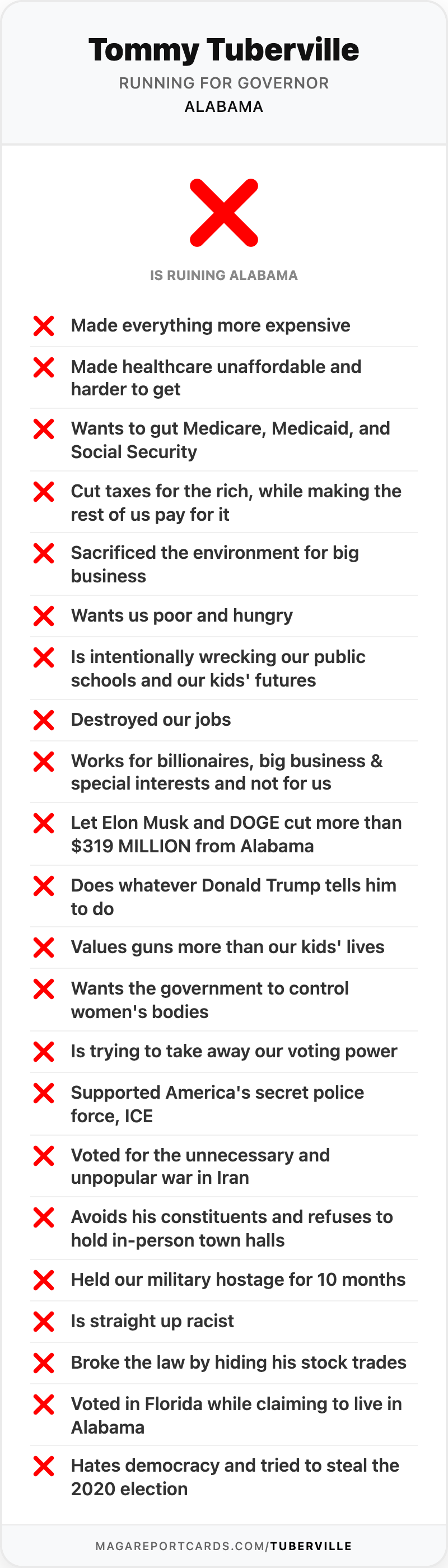
On Wednesday, August 5, 2026, Tommy Tuberville went on The Charlie Kirk Show and floated building a wall around the state of Alabama.
Not the southern border. Alabama. The state that borders Tennessee, Georgia, Florida and Mississippi.
"I'm going to go back to Alabama and, hey, we might build a 30-foot wall around our state, because I know what's coming. I can see it coming, I can hear it coming. You can just smell it out there, that they want to take this country over."
He is running for governor. This is the office he'd hold when the wall got built.
Who is "they"?
Tuberville didn't say on the podcast. His office did.
A spokesperson told AL.com the senator was referring to "radical Islamic terrorists who want to destroy America."
That clarification arrived the same day Tuberville called Abdul El-Sayed — the Democratic nominee for Michigan's open Senate seat — a "radical Islamist." El-Sayed is a Muslim American, a physician, and a former public health director for the city of Detroit. His offense, as far as anyone can tell from the record, is being critical of the Israeli government.
So the sequence is: call a Muslim candidate for Senate a "RADICAL ISLAMIST" on X, get asked about him on a podcast the same day and warn that "they want to take this country over," and have your staff confirm afterward that "they" means "radical Islamic terrorists."
This is not new for him. We wrote in July about Tuberville demanding that New York's mayor be handcuffed and shipped to Guantanamo Bay for something "stupid" he predicted Mamdani would do. He is part of a broader pattern on this site: Florida's Randy Fine went on Newsmax and said "a Muslim terrorist runs the city of New York"; Wisconsin's Derrick Van Orden has a documented habit of amplifying anti-Muslim claims online.
The difference here is that Tuberville is proposing infrastructure.
The voting claim underneath it
The wall line came at the end of a warning about elections. Here's the setup:
"If we don't straighten out this country's voting, if we don't straighten out this country's immigration system, we're not going to make it. It's going to be over with."
Voting and immigration. That's the threat he's describing.
Alabama's own record says otherwise. As AL.com noted, Alabama and other states have identified very small numbers of immigrants who fraudulently tried to vote — and Alabama already has strict voter ID laws. Election experts have found no evidence of widespread problems with American elections.
Tuberville has been on this for a while. Last week he threw his own party's talking points in the trash because Senate Republican leadership wanted members to change the subject away from the stalled SAVE America Act, and he wanted to keep pushing it. He claimed 80 to 90 percent of Americans support it. They don't.
So the pattern is consistent: name a problem the evidence says isn't happening, then propose something drastic to solve it.
What a governor of Alabama actually controls
Here's the practical problem with a wall around Alabama.
Governors don't run immigration policy. They don't control the border. A wall along Alabama's state lines — a state with no international border — would stop Georgians. It would stop trucks on I-65 and I-20. It would stop the tourists driving down to Gulf Shores.
There is no version of this that does the thing he says it would do. Which suggests it was never a plan. It was a signal.
And that's the part worth sitting with. The senator running to govern Alabama chose, on a national podcast, to tell his voters that an unnamed "they" is coming, that he can "smell it out there," and that the response might be to seal the state off. Then his office named the group.
What Alabama actually needs from a governor
While Tuberville was on a podcast talking about walls, here's what was happening in his state.
Alabama Power customers are facing rate pressure from the data-center boom — Tuberville himself has called on Alabama Power to freeze rates further into the future. Alabama ranks near the bottom of the country on the measures that decide whether people's lives are good: health outcomes, poverty, life expectancy. We laid that out in detail in what Alabama's Republicans are costing it.
None of that gets fixed by a wall. All of it gets ignored while we talk about one.
The people Tuberville is warning Alabama about are not the reason Alabamians can't afford their power bill, or their insulin, or a hospital within driving distance. He is the sitting United States senator. He has had five years of votes to do something about those things.
He'd rather build a wall around Georgia.
Source
AL.com, "Tuberville says 'we might build a 30-foot wall around' Alabama" by Ruth Serven Smith, and Raw Story's coverage of the same podcast appearance.