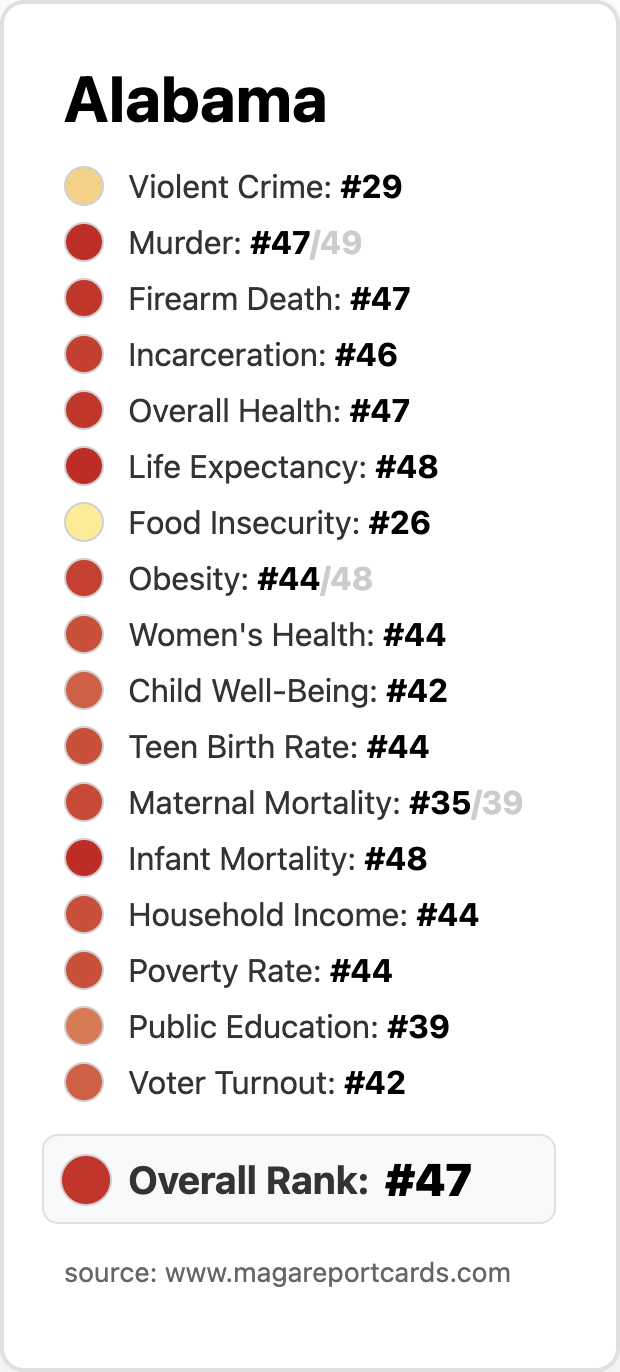
Alabama ranks 46th out of 50 states on the measures we track — health, crime, food security, education, and more. Only Oklahoma, Mississippi, Arkansas, and Louisiana score worse. That's not an accident of geography or bad luck. It's the result of choices, and lately the people Alabama sends to Washington have been making those choices worse.
To be clear about what the ranking is and isn't: it measures outcomes — how Alabamians are actually living. It doesn't by itself prove any one politician caused it. But it tells you where the state already stands. And when your state is already near the bottom on health and hunger, the votes your members of Congress cast to cut health care and food matter a lot more, because there's no cushion left. Here's what those votes are costing you.
50,000 more Alabamians projected to be uninsured
Trump's budget bill cuts deep into Medicaid and the ACA. KFF projects the law will leave about 50,000 more Alabamians uninsured by 2034 — and about 150,000 once the expiration of the enhanced ACA premium tax credits is counted on top of it.
Alabama is a state that never expanded Medicaid, so its safety net was already thin. Cutting it further means more people showing up in emergency rooms with no way to pay, and more rural hospitals pushed toward closing. Every Republican House member from Alabama voted for the budget bill that does this.
740,300 Alabamians rely on SNAP — and 1 in 4 kids faces hunger
Here in Alabama, 1 in 4 kids faces hunger. About 740,300 citizens receive SNAP benefits every month — that's 14.3% of the whole state, roughly one in seven people.
The same budget bill these members passed cuts and tightens SNAP, shifting costs onto states and pushing eligible families off the rolls. In a state where 1 in 4 children already faces hunger, taking food off the table isn't an abstraction. It's kids going to school hungry.
DOGE gutted Alabama's public health defenses
DOGE claims it saved taxpayers $319 million in Alabama. But look at what that "savings" actually cut. DOGE canceled a $190 million CDC grant to Alabama's Department of Public Health — money that, according to Rep. Terri Sewell, funded about 140 county health department positions specializing in stopping the spread of infectious diseases, including outbreak investigations in prisons, nursing homes, and day care centers.
The cuts also jeopardized care and housing for vulnerable HIV patients across the state. When the next outbreak hits, the people who would have caught it early won't be there.
Alabama has the 5th-highest rate of gun violence in the country
Alabama has the 5th highest rate of gun violence in the nation — 213.6 shooting incidents per 100,000 residents from 2014 to 2024. That's roughly 83% higher than the national average, with 10,522 shooting incidents over that decade.
This is a crisis that costs Alabama families their kids, their parents, and their neighbors. And every year Congress does nothing — no background check expansion, no red flag support, nothing. Alabama's delegation has been reliable votes for that inaction.
And it's costing you at the register, too
Alabama reportedly exported $14 billion in goods and services to Europe and China in 2024, and the state's big auto industry runs on imported parts. An economist told Alabama Public Radio that Trump's tariffs will hurt Alabama in both the short run and the long run — higher costs cutting demand, and demand cuts costing jobs. Sitting Senator Tommy Tuberville, now running for governor, has cheered the tariffs on, calling them "an important step in President Trump's plan to restore fairness to trade" even as the bills land on Alabamians' kitchen tables.
Who voted for this
These are the Alabama Republicans with report cards on this site — the ones who cast the votes behind the numbers above:
- Barry Moore — running for U.S. Senate
- Dale Strong
- Gary Palmer
- Mike Rogers
- Robert Aderholt
- Tommy Tuberville — Alabama's sitting U.S. Senator, now running for governor
None of them created Alabama's 46th-place standing overnight. But when your state is already near the bottom, the honest question is simple: did your representative vote to lift Alabama up, or to cut what little was holding it steady? On health care, food, public health, and guns, the record says they cut.
In 2026, Alabamians get to answer back. The numbers are real, the votes are on the record, and the choice is yours.