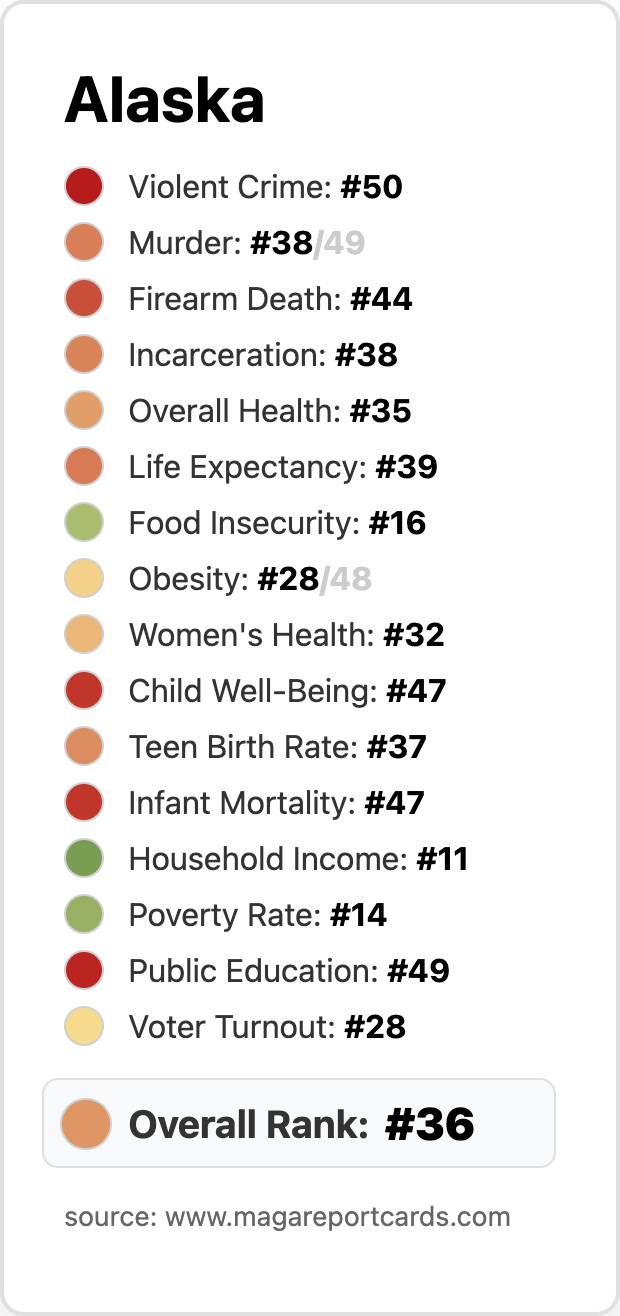
Alaska is one of the hardest places in America to get a doctor, a hot meal in winter, or a reliable weather forecast before a deadly storm. On the measures we track — health, crime, food security, and more — Alaska ranks 36th out of 50. That's the ground Alaskans are already standing on.
Then Washington made it worse. The budget law that Republicans passed in 2025 cuts Medicaid, cuts food aid, and hands the savings to the wealthiest Americans as tax breaks. All three of Alaska's members of Congress are Republicans, and all three voted for it — including the two on the ballot this year, Senator Dan Sullivan and Representative Nick Begich. Here's what that vote is costing you.
Medicaid: billions gone, thousands dropped
Alaska stands to lose an estimated $1.6–$2.7 billion in federal Medicaid funds over the next decade — about 12% of what it would otherwise get. In a state where rural hospitals already run on the edge and villages can be hundreds of miles from the nearest clinic, that means fewer doctors, more strain on the hospitals that are left, and worse outcomes for families who already struggle to get care.
More than 9,000 Alaskans could lose Medicaid coverage just because of the law's new work-reporting requirements, according to a report prepared for the Alaska Department of Health.
That's not a spreadsheet line. That's a parent in Bethel or Kotzebue deciding whether they can afford to stay covered. Dan Sullivan and Nick Begich voted for the law that does it.
Food aid, in a state where 1 in 5 kids faces hunger
Here in Alaska, 1 in 5 kids faces hunger, and about 64,600 Alaskans receive SNAP benefits every month to put food on the table.
The same budget law both members backed slashes SNAP and shifts new costs onto the state. When you make it harder to qualify for food aid in a state where 1 in 5 kids already faces hunger, the people who go without are kids, seniors, and working families.
DOGE bragged about the cuts. Alaska's fisheries and forecasts paid.
DOGE claims it "saved" Alaska more than $280 million — but look at what that number actually meant on the water and in the sky. Mass firings and budget cuts at NOAA reduced the services used to manage Alaska's fisheries — the backbone of the state's economy and the livelihood of thousands of Alaskans.
Worse, the cuts gutted weather data collection. When a deadly storm slammed western Alaska in October 2025, a lack of weather data caused by Trump's budget cuts likely made worse the forecast that villages depend on to get out of harm's way. On top of that, federal firings landed in a state with more than 15,000 federal workers, and the state saw about 56,000 layoffs and discharges in 2025.
Real jobs, real fish counts, and real storm warnings — traded away so Washington could brag about a savings number. Neither Sullivan nor Begich slowed any of it down.
Public safety, in the state with the highest violent crime rate
Alaska has the highest violent crime rate in the country, and the third-highest gun death rate — 90.6% above the national rate. Alaskans need more support to keep their communities safe — more resources for law enforcement, mental health care, and prevention.
Instead, the same delegation that voted to cut Medicaid — which pays for much of the state's mental health and addiction treatment — keeps voting against the tools that could actually bring these numbers down. You can't say you're tough on crime while defunding the services that prevent it.
Who voted for this
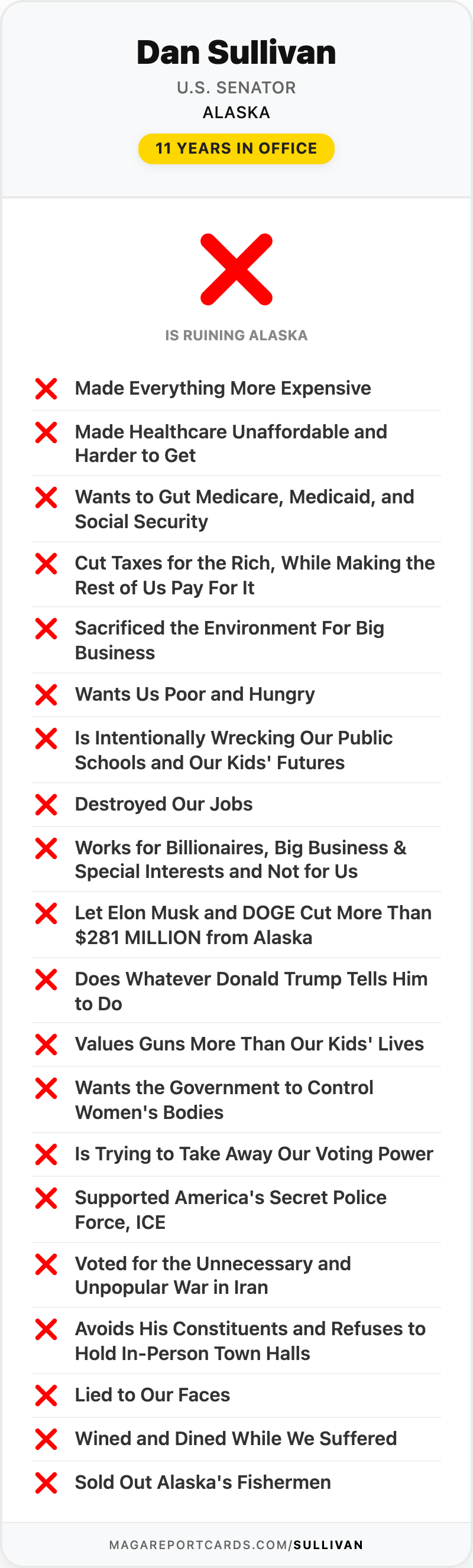
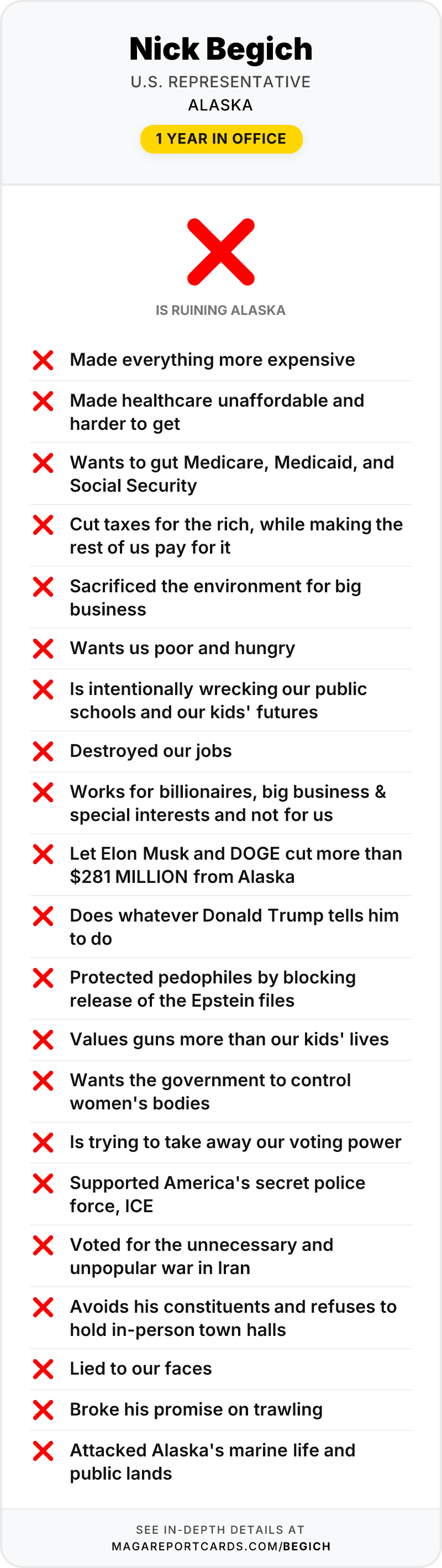
These are the two Alaska Republicans on the ballot this year who voted for the budget law behind the Medicaid and SNAP cuts, and who stood by while DOGE tore through the state:
- Dan Sullivan — United States Senator
- Nick Begich — United States Representative
In 2026, Alaskans get to decide whether that's the representation they want. The numbers are already on the wall. The only question left is who answers for them — and whether Alaska sends back the same two people who voted to make it harder to see a doctor, feed a kid, and get a storm warning in time.