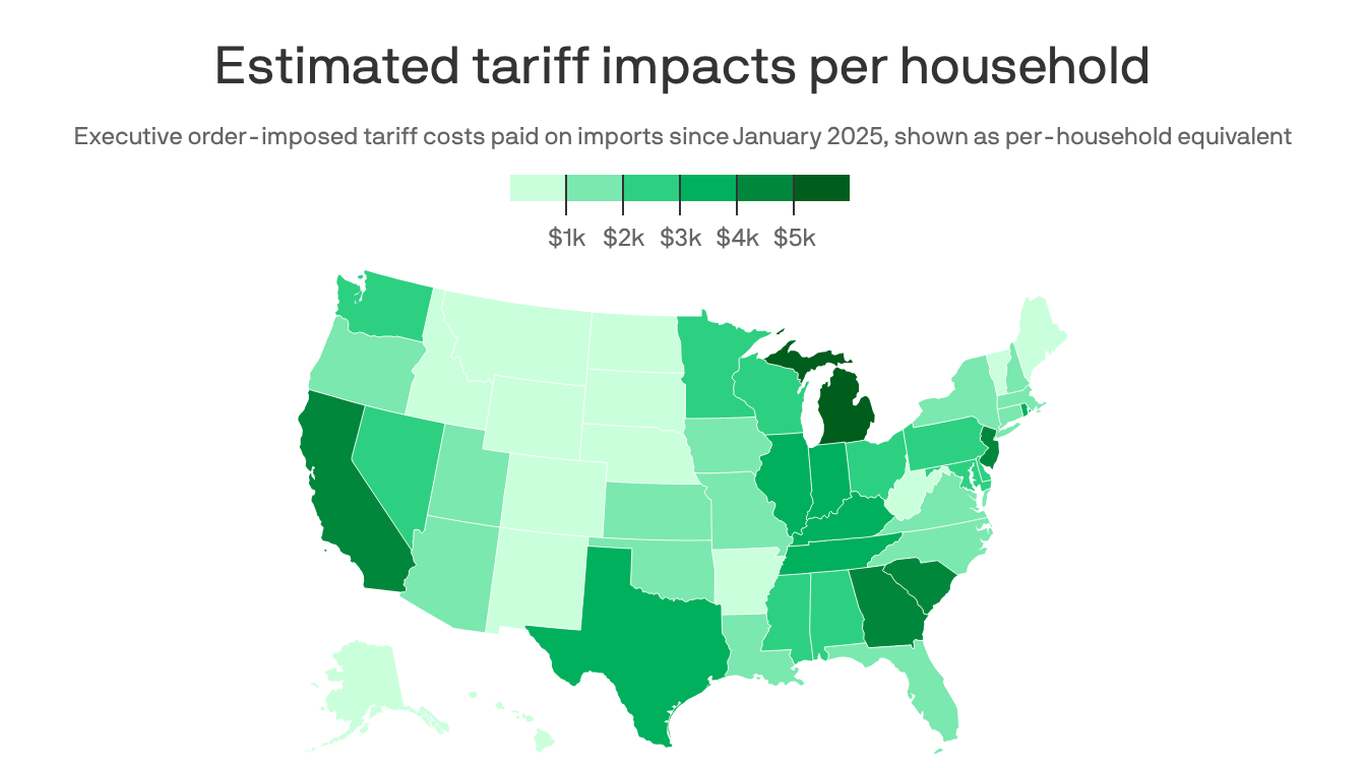
Trump's tariffs have cost American importers an estimated $342 billion since January 2025, and Axios reported this week that the bill is nowhere near evenly spread. It lands on a state according to what that state buys from the rest of the world. By that measure, no state's families are carrying more of it than Michigan's.
Michigan's importers have paid an estimated $23 billion in tariffs since January 2025, the third-largest total in the country behind California and Texas. Spread across the state's households, that comes to $5,619 each — the highest per-household figure of the 52 states and territories the National Taxpayers Union Foundation tracks, using estimates prepared for it by Trade Partnership Worldwide.
In February, Michigan's seven Republicans in Congress got two chances to end those tariffs. They voted together both times, and both times they voted to keep them.
What Michigan is actually paying for
The state's tariff bill is not a story about luxury imports. It is a story about the things Michigan builds cars out of. About 64% of the total fell on raw materials, parts, and equipment that Michigan manufacturers buy.
The four hardest-hit categories, with the average tariff rate charged between July 2025 and June 2026:
- Cars and trucks — $10 billion paid, at an average rate of 12.4%. In 2024 the rate was 1.0%.
- Auto parts — $5 billion paid, at 9.1%. In 2024 it was 2.3%.
- Steel, aluminum and other metals — $1.5 billion paid, at 35.3%. In 2024 it was 1.7%.
- Machinery and parts — $681 million paid, at 16.6%. In 2024 it was 1.3%.
Those costs were supposed to buy Michigan something. The promise was that the pain would be short and the factory jobs would follow. Michigan instead lost about 4,000 auto parts manufacturing jobs in the year ending in June 2026, a 3.5% decline, according to federal labor data compiled by Bridge Michigan. Vehicle manufacturing added roughly 500.
The vote to stop the vote
There is a law called the National Emergencies Act, and it contains a safety valve. When a president declares a national emergency, any member of Congress can force a vote on ending it, and the statute puts a clock on that vote so leadership cannot simply bury it.
Trump used emergency powers to impose the tariffs. For nearly a year, House Republicans kept that clock switched off by writing a single sentence into unrelated procedural resolutions — a trick we traced through four separate resolutions.
On February 10, 2026, they tried it one more time. Buried in a routine resolution setting the terms for debate on three ordinary bills was Section 4:
"Each day during the period from February 10, 2026, through July 31, 2026, shall not constitute a calendar day for purposes of section 202 of the National Emergencies Act..."
Days would stop being days through the end of July. Four separate tariff emergencies would be unvotable until then.
It failed, 214 to 217. Every Republican who voted backed it except three: Don Bacon of Nebraska, Kevin Kiley of California, and Thomas Massie of Kentucky. "A rule is meant to bring a bill to the floor, set the parameters for debate," Kiley told Roll Call. "It's not meant to smuggle in unrelated provisions that expand the power of leadership at the expense of our members."
All seven Michigan Republicans — Tom Barrett, Jack Bergman, Bill Huizenga, John James, Lisa McClain, John Moolenaar and Tim Walberg — voted for it.
The vote they couldn't stop
The next day, the House finally voted on the thing itself.
The measure was H.J.Res. 72, sponsored by Rep. Gregory Meeks of New York and introduced on March 6, 2025. It did one thing: end the emergency Trump declared on February 1, 2025, the one that put tariffs on goods coming in from Canada. It had waited eleven months for a vote it was legally entitled to. "They're trying to change the rules again, and again, and again, and again to do what?" Meeks said on the floor the night before. "To avoid voting on ending Trump's tariffs."
It passed, 219 to 211. Six Republicans crossed over.
None of them were from Michigan, the state on the other side of that border. All seven voted no.
The resolution went to the Senate on February 12, was read twice, was referred to the Finance Committee, and has not moved since.
Nine days after the House vote, the Supreme Court ruled that the 1977 emergency law never gave the president the power to impose those tariffs at all. Michigan had already paid.
What each of them said
Tom Barrett defended the tariffs at a telephone town hall on April 7, 2025, calling them "a tool we can use to get there, but of course it can't be done recklessly" and brushing off the market's reaction: "a handful of days is not indicative of a broader market." Asked by a farmer in his district what the trade war would do to crop prices, he promised only that the effect would be "blunted as much as possible."
Jack Bergman represents Sault Ste. Marie, where the Canada trade war cost the area at least $82.9 million in lost local spending in a single year as border crossings fell by nearly 24%. ProPublica found he had been "virtually silent on the new tariffs" while constituents pressed him to speak up.
Bill Huizenga has been on both sides. In 2018 he called metal tariffs on America's trading partners a "misguided proposal" and warned that any short-term gain "may be quickly blunted by hardworking men and women losing their jobs in West Michigan." In March 2025, defending the new tariffs to reporters in Battle Creek, he said: "Is it the right thing to do? Absolutely it is."
John James, now running for governor, went on CBS's Face the Nation on March 2, 2025 and was read a warning from the Republican mayor of Sterling Heights, in his own district, who called the tariffs the "single biggest threat to our local economy." James defended them anyway, answering that "what's devastating and staggering is the fact of the matter that we have been taken advantage of for decades."
Lisa McClain chairs the House Republican Conference and represents a district full of auto workers. In April 2025 she told Breitbart that "it isn't an immediate fix, and there is going to be some discomfort," but that "people are willing to make that tradeoff for long-term more jobs." Complaints, she said, were only "about 15 percent of what I'm hearing." She added: "I thought it would have been worse, to be honest with you."
John Moolenaar chairs the House Select Committee on China and backed Trump's tariffs the day after they were announced, describing American shoppers as the leverage: "Trade deficits reflect that imbalance, but they also reveal something deeper: the strength of the American consumer. It's time we stopped allowing that strength to be used against us."
Tim Walberg backed the 25% tariffs on Canada and Mexico even as the Detroit Regional Chamber's MichAuto affiliate called them "punitive" and "counterproductive to commerce," and posted the story about his support on his own congressional website.
The refund is going to somebody else
Because the Supreme Court ruled the emergency tariffs illegal, that money has to be returned. The ruling left the separate duties on cars, auto parts and metals in place — Michigan's three biggest tariff categories — so much of the state's bill is not coming back at all. What is coming back is not going to the households in that $5,619 figure. Tariffs are legally paid by the company that brings the goods across the border, so the company is the one owed the refund. Apple, Ford, Nike, Amazon and General Motors are collecting billions, while the families who paid the higher prices at the register get nothing.
What the record shows
Michigan's importers paid an estimated $23 billion in tariffs, the equivalent of $5,619 per household and the heaviest household burden in the country, with $10 billion of it on cars and trucks and another $5 billion on auto parts. In February, all seven of Michigan's Republicans in Congress voted for a resolution declaring that days would not count as days, so the House could not vote on those tariffs. When the House got its vote anyway, all seven voted against ending them. Nine days later the Supreme Court ruled the emergency tariffs had never been legal — leaving the duties on cars, auto parts and metals standing — and those refunds are going to the companies that import the goods rather than to the households that paid the higher prices.
Source
"Where Trump's tariffs hit hardest," Axios, August 27, 2026. Map: Brad Jennings/Axios.


