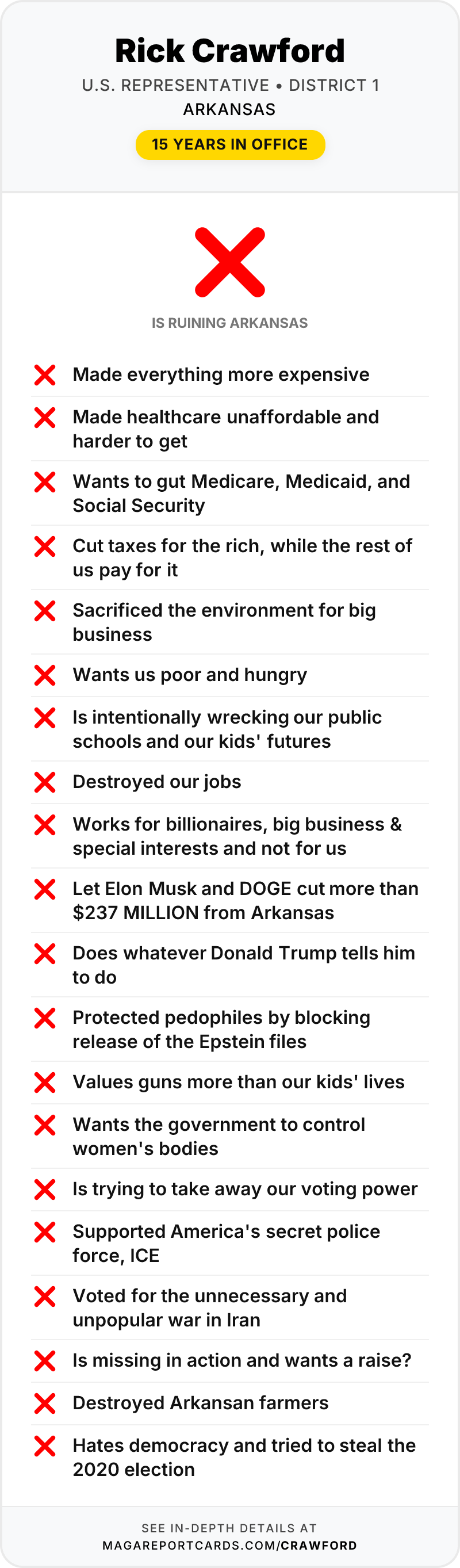
Rick Crawford wants the farmers of east Arkansas to know he feels their pain.
"I'll be blunt about it. Gas prices suck right now," he told the Arkansas Advocate this week, in a story on his race for a ninth term. "There's no other way to put it. Diesel is the lifeblood of our economy."
He's right about that. What he left out is his own part in it.
Fuel prices in his district went up because of the war with Iran. Since that war began, the House has voted six times on resolutions to make the president stop it without permission from Congress. Rick Crawford voted no all six times.
What the war is costing his district
Crawford represents Arkansas's 1st District — 31 counties of mostly farm country in the eastern half of the state. Farms there run on diesel. It powers the tractors at planting, the pumps that irrigate rice fields, the combines at harvest and the trucks that haul the crop away.
Here is what has happened to that diesel since the war started, according to an analysis by the University of Arkansas Division of Agriculture, reported by Talk Business & Politics on October 7:
- Arkansas farm budgets for 2026 were built around diesel at $2.46 a gallon.
- From March 1 through September 30, farm diesel averaged $4.22 — 72% over budget.
- The current price is $5.47, more than double what farmers planned for. Highway diesel, which runs the farm trucks, is $5.94.
- Urea, a common fertilizer, was up about 39% as of May.
Add it up and the economists estimate the war has cost Arkansas farmers $343 million in extra expenses this year — and they call that estimate low. Rice takes the hardest hit per acre: about $118.69 more per acre for diesel and fertilizer combined.
The reason, in the words of extension economist Ryan Loy: "Iran has largely blocked traffic through the Strait of Hormuz since early March." Both fuel and fertilizer move through it.
Six chances to end it. Six no votes.
Congress — not the president — has the power to declare war. A war powers resolution is how Congress tells a president to stop fighting one it never approved. Crawford has had six chances to vote for one. The House clerk's records show he voted no every time:
- March 5 — H. Con. Res. 38. It failed.
- April 16 — H. Con. Res. 40. It failed by a single vote, 213 to 214.
- May 14 — H. Con. Res. 75. It failed on a 212–212 tie.
- June 3 — H. Con. Res. 86. It passed anyway.
- July 23 — H. Con. Res. 89. It passed again.
- September 15 — H. Con. Res. 93. It passed 220 to 204.
Twice, one Republican changing sides would have been enough. Crawford was never that Republican. And this isn't a man who just goes along quietly. He chairs the House Intelligence Committee, the panel that's supposed to check the intelligence used to justify a war. In August he went on Fox News and told Trump to "finish the job" in Iran.
His Democratic opponent, Terri Yarbrough Green, told the Advocate she would have voted for the resolution. "Ending that war and getting the strait opened up, I think that will help a lot of the price issues," she said.
Blaming something else
Asked about fuel prices, Crawford told the Advocate there was more behind them than the Iran war, and he questioned whether prices were being artificially inflated. He also said he believes the war has made the world a safer place.
The government's own budget office doesn't see it his way. The Congressional Budget Office now expects oil prices to be 41% higher this year than it had forecast before the war started. It says the war will add about half a percentage point to inflation in early 2027, mostly from higher energy prices. It also says the war itself had already cost taxpayers $38.1 billion through August 1.
Crawford isn't the only Republican trying to point at something besides the war. In Virginia, John McGuire blamed Biden-era refinery closures while diesel there sat at a record.
Tariffs on top of it
The war isn't the only thing hitting east Arkansas farmers. Crawford was asked about President Trump's tariffs, too. He called them "a good conversation starter" and pointed to steel — his district's Mississippi County is the largest steel-producing county in the country.
Farmers don't sell steel. In an August 2025 interview with Talk Business & Politics, Crawford said he "actually commend[s] the president" and called the tariffs "a powerful move to help support American ag producers." What farmers got instead was a $12 billion federal bailout tied to the trade war. Arkansas now has more family-farm bankruptcies than any other state.
He has broken with Trump on one trade question: he and other Arkansas Republicans oppose Trump's plan to let more foreign beef in without higher tariffs. When cattle farmers object, Crawford can find his voice. On the war that sent their diesel soaring, he has voted with the president every time.
The Farm Bill and the food bill
Crawford sits on the House Agriculture Committee. He voted for the $390 billion House Farm Bill, which, the Advocate reports, carries forward the cuts to food assistance from Trump's budget bill.
That budget bill cut food assistance by nearly $187 billion over ten years, and Crawford voted for it too. In his own district, 39,659 households rely on that help to buy groceries, according to the USDA — the same families now paying more for everything a diesel truck delivers.
Health care: 'fraud'
On health care, Crawford told the Advocate the biggest problem with Medicaid is fraud. He also said benefits should be changed so people don't turn down promotions or overtime to keep their coverage.
That's what he chose to talk about while the Trump administration has refused to renew the program that covers about 200,000 low-income Arkansans, and the state is asking for a two-year extension to keep it going. The Center for American Progress estimates that Trump's budget bill — the one Crawford voted for — together with the lapse of the Affordable Care Act's enhanced tax credits will leave 40,000 more people in his district without insurance by 2034.
What the record shows
Rick Crawford says gas prices "suck," but he voted against all six House resolutions to end the Iran war that University of Arkansas economists say has pushed farm diesel to $5.47 a gallon and cost Arkansas farmers an estimated $343 million this year. He told Trump to "finish the job," praised the tariffs that ended in a $12 billion bailout for farmers, and voted for a budget bill that cut food assistance by nearly $187 billion and, along with the lapse of the ACA tax credits, is projected to leave 40,000 more people in his district uninsured by 2034.
Source
Andrew DeMillo, Arkansas Advocate (via Arkansas Times): Fuel prices, tariffs weigh heavily in east Arkansas' US House race, October 9, 2026.