On Tuesday, Michigan Democrats picked Abdul El-Sayed for U.S. Senate. They did it over the loudest objection money can buy.
A super PAC tied to the American Israel Public Affairs Committee spent $32 million trying to hand the nomination to Rep. Haley Stevens instead. It didn't work. El-Sayed won 48.5% to 47.5% — about a point. It was the largest sum AIPAC has ever put into a single race, and Michigan Democrats shrugged it off.
Most groups would take that as a message from voters.
AIPAC took it as a rounding error. Within a day, the New York Times reported that the organization had told allies it is considering a major financial campaign to elect the Republican in November — the Republican being Mike Rogers (MI), who was already the beneficiary of the whole exercise. People who have spoken with AIPAC's leadership expect the number could run into the tens of millions. The group's super PAC had about $80 million sitting in the bank at the end of June.
So let's be clear about what is being weighed here. A lobby just tried to choose one party's nominee, failed, and is now shopping its money to the other party — in a race that will help decide control of the U.S. Senate.
The super PAC is named "United Democracy Project"
That is its real name. The United Democracy Project.
Its record on democracy is worth reading in full. When AIPAC first started endorsing candidates directly, more than a quarter of its endorsement list — 37 Republicans — had voted against certifying Joe Biden as president. Not "raised concerns." Voted, after a mob attacked the Capitol, to throw out other states' electoral votes. Asked about it, AIPAC's spokesman explained that it is a single-issue organization. Whether you tried to overturn an American election simply isn't the issue.
Michigan is about to find out what that policy looks like when it's applied to a swing-state general election.
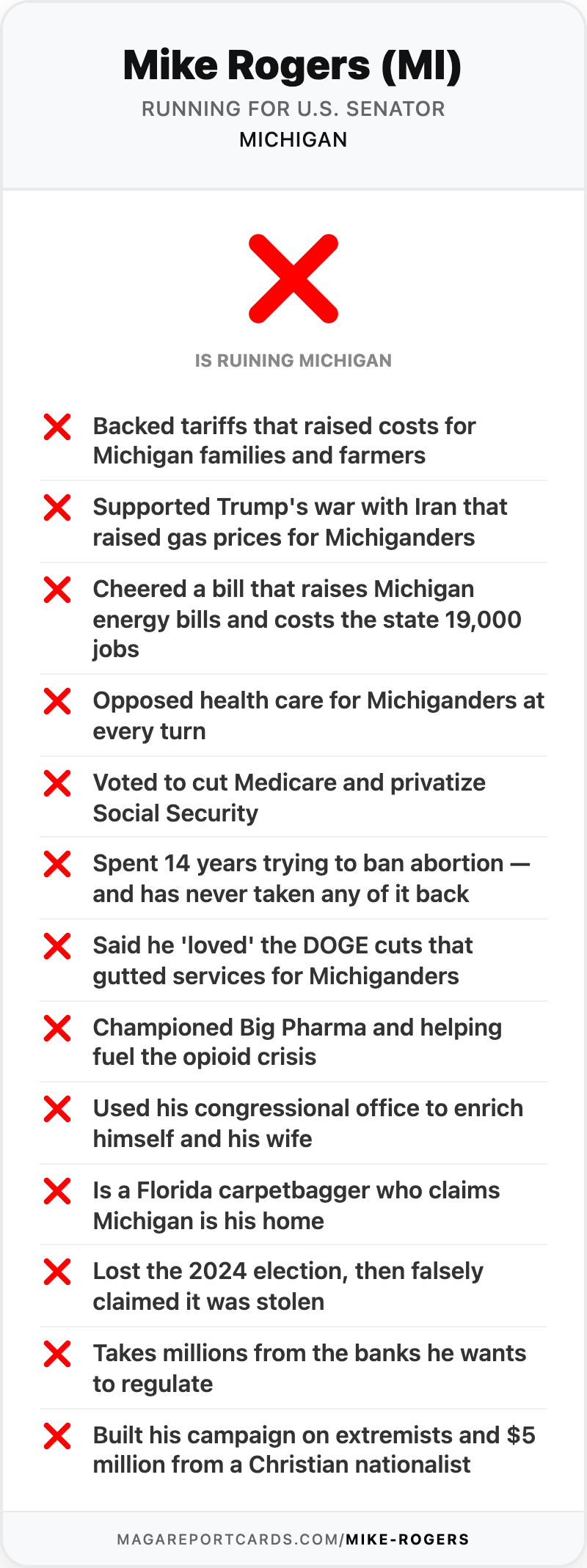
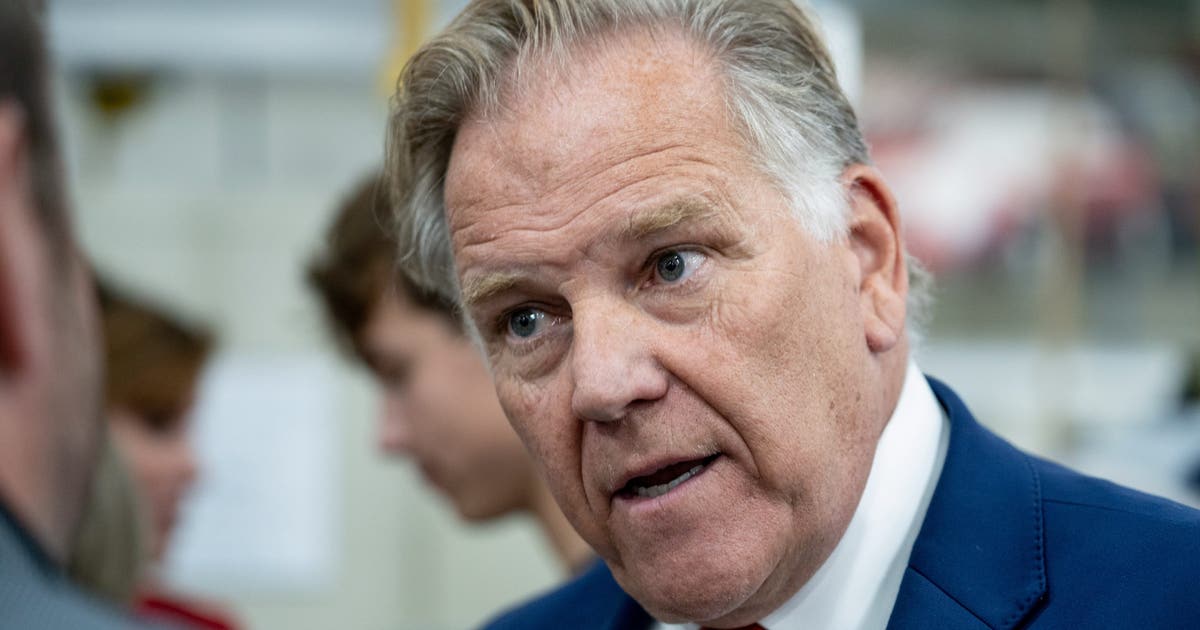
The man the money would be electing says a van stole his last election
Rogers lost the 2024 Michigan Senate race to Elissa Slotkin by about 19,000 votes. He conceded. He alleged no fraud at the time.
Then he decided to run again, and the story changed. He began telling audiences that ballots "showed up at 5:30 — I wish I were kidding — in a van" in Detroit, and that it "swung the election on us." When the Detroit News asked his campaign to produce any evidence at all, nobody answered.
This is the same man who, in an op-ed published January 5, 2021, wrote that the Trump administration's behavior was "seen in Third World dictatorships, not the leading democracy in the world." He knew. He said so. Then he found it more useful to say the opposite.
Any group that spends tens of millions of dollars to put him in the Senate is telling you, plainly, that none of that counts against him.
He says antisemitism on the right is "still fringe." Look at his own campaign.
In April, Rogers sat down with Jewish Insider and talked about rising anti-Israel and antisemitic sentiment among conservatives. He was reassuring about it:
"I do think on the right, we've got to be careful it doesn't creep into the mainstream. I do still think it's fringe."
He added that the answer is to elect candidates who will "push back on that."
Then the Detroit Metro Times went through the roster of his newly announced student outreach team.
- Cameron Dundas, a member of the team, replied "Send them to North Korea?" to a February 25 post on X asking what should be done about "these people" — a comment the paper reported appeared to refer to Jews. Dundas repeatedly promoted a far-right internet figure the Southern Poverty Law Center ties to Nick Fuentes' Groyper movement.
- Alexander Richmond, listed on LinkedIn as the campaign's University of Michigan campus coordinator, defended the participants in the leaked Young Republicans group chat — the one with "I love Hitler," gas chamber jokes, and racial slurs. "Loyalty is the only political virtue that matters," he wrote. "Capitulation is for losers."
The campaign's response was to blame Democrats for noticing. A spokeswoman said there are "a lot of people across the state, with varying view points, who want to volunteer," and suggested Democrats should spend "less time misconstruing posts to attack ours."
That's the pushback. That's what electing a candidate who'll "push back on that" gets you.
The $5 million behind him came from a man who said only Christians should lead
The super PAC that has been carrying Rogers is called the Great Lakes Conservative Fund. In the first half of 2025, more than 98% of everything it raised came from one person: Texas oil billionaire Tim Dunn, who wrote two checks of $2.5 million each.
Former Texas House Speaker Joe Straus, who is Jewish, has said Dunn told him in 2010 that "only Christians should hold leadership positions" in the chamber Straus was leading. In 2023, a top official at one of Dunn's Texas PACs met with white nationalist Nick Fuentes. The same super PAC had already spent more than $21 million on Rogers' losing 2024 campaign.
When the Michigan Advance reported it in August 2025, Rogers had not publicly spoken about Dunn's involvement, and his campaign didn't respond.
So the pitch to AIPAC's donors is this: spend tens of millions to elect a candidate whose largest single benefactor reportedly told a Jewish official he wasn't fit to lead, and whose student team defended a Hitler group chat. Because the alternative is worse on one issue.
He privately told supporters he'd be in "good shape" against El-Sayed
Here's the part that should embarrass everyone who wrote a check.
On a June 15 call with supporters, a recording of which was provided to CNN, Rogers was asked about his strategy against El-Sayed. His answer:
"If he wins, I think we're in good shape. I mean, I think he's so radical. I think he's going to lose big parts of the west part of the state."
AIPAC spent $32 million to keep off the November ballot the one Democrat the Republican privately said he'd be in "good shape" against. Then it lost anyway. Now it's weighing tens of millions more for that Republican.
That's not strategy. That's a checkbook with one instruction written on it.
Michigan already told them what it thinks
Michigan Democrats didn't have to guess about any of this — they got it in the mail, on their phones, and on every commercial break for months. A July poll of 500 likely Democratic primary voters by the Glengariff Group for the Detroit News found 49% held an unfavorable view of AIPAC, against 12% favorable.
The group's own allies see where this goes. Jeremy Ben-Ami, who runs the more liberal pro-Israel group J Street, told the Times that directly funding the Republican would be "political malpractice."
"Every dollar that they are spending is deepening the problem that anyone who cares about Israel should want to resolve, not inflame."
Others were blunter about the actual motive. Ron Weiser, a three-time chair of the Michigan Republican Party who has given $125,000 to AIPAC's super PAC this cycle, said the group should spend for Rogers, whom he called a friend. His first reason wasn't Israel:
"First of all, because I am a Republican."
AIPAC has called itself bipartisan for decades. It only started spending in federal elections in 2022, and in three cycles it has waded into exactly one general election between a Democrat and a Republican. It is also weighing money for Susan Collins in Maine this fall, though allies say it's unlikely to do both.
Strip away the branding and the arithmetic is simple. An organization with $80 million tried to buy a Democratic primary in a swing state. Voters told it no. Its answer is to consider spending the rest electing a man who says a van stole his last election, whose campaign staffs itself with people who defend Hitler jokes, and who told supporters in private that he'd be in "good shape" against the guy who just won.
The people of Michigan get to decide this seat in November. Nobody in Texas, and no super PAC with "democracy" in its name, gets to decide it for them.
Source
After Michigan Loss, AIPAC Weighs a Second Effort to Defeat El-Sayed — Jennifer Medina and Theodore Schleifer, The New York Times, August 5, 2026. Photo: Getty Images, via FOX 2 Detroit.