In May, a sitting Republican congressman lost his primary because he wouldn't vote the way a lobby wanted him to.
Thomas Massie had represented Kentucky's 4th District for 14 years. He is about as conservative as they come. But he had one habit his party's donors couldn't tolerate: he voted no on foreign aid. All of it. "I have never voted for foreign aid to Egypt, to Syria, to Israel or to Ukraine," he told CBS News.
So they bought the seat out from under him. Massie lost the GOP primary by 10 percentage points in what Al Jazeera called "the most expensive House of Representatives primary contest in the history of the United States" — $37 million spent by the campaigns and aligned super PACs in a single congressional district.
On the night he conceded, Massie didn't sugarcoat it:
"For 14 years, those S.O.B.s in Washington tried to buy my vote. Why did the race get so expensive? Because they decided to buy the seat."
What $8 million buys in one Kentucky district
Here's where the money came from. AIPAC's super PAC, the United Democracy Project, spent $4.1 million on mostly attack ads against Massie. The Republican Jewish Coalition Victory Fund spent another $3.9 million on ads boosting his opponent, Ed Gallrein. A pro-Trump PAC called MAGA KY kicked in $7.4 million more.
The individual checks tell you who was actually behind it. Republican megadonor Paul Singer put $3 million into MAGA KY and a PAC that funded it. Casino billionaire Miriam Adelson wrote MAGA KY a check for $750,000.
Add up what AIPAC's super PAC and two other groups backed by pro-Israel donors spent against Massie or for his opponent, and The Intercept counted more than $15.8 million poured into one House race in Kentucky.
Massie's own campaign raised $5.5 million, more than Gallrein's, according to Al Jazeera. It wasn't close to enough. And he said out loud what most members of Congress only say in private:
"It didn't come from regular people. It's come from billionaires."
The money doesn't come from your neighbors
AIPAC likes to talk about its grassroots members. Its spokeswoman describes "six million grassroots members" who are "determined and eager as ever to participate this election cycle."
The federal filings say something different. When FactCheck.org went through the disclosures for AIPAC's super PAC in the last cycle, the top of the donor list looked like this:
- Jan Koum, the WhatsApp co-founder — $5 million
- Jonathon Jacobson, a financier — nearly $4.6 million
- Bernard Marcus, the Home Depot co-founder — $3 million
- David Zalik, the GreenSky CEO — $2 million
That's four men accounting for roughly $15 million. The super PAC had raised about $68.4 million by that August and spent about $56 million of it.
This cycle they're bigger. Pro-Israel groups entered the 2026 midterms with more than $100 million to spend — $96 million of it sitting in AIPAC's super PAC alone. That puts them in what the report called "pretty rare company," alongside the crypto industry, the AI industry, and the political parties themselves.
They pick your primaries for you
The general election is not where this money does its work. Primaries are — because primaries are cheap, turnout is low, and $5 million lands like a bomb.
In the last cycle, AIPAC's super PAC spent $9.9 million to defeat Rep. Jamaal Bowman in New York and another $4.8 million boosting his opponent. It spent more than $5.2 million against Rep. Cori Bush in Missouri. It spent about $4.6 million trying to beat a state senator in a California House primary.
Right now, in Michigan, it's doing the biggest one yet. AIPAC and its affiliated groups have spent close to $30 million backing Rep. Haley Stevens in the Democratic Senate primary against Abdul El-Sayed — their largest investment in a single race, ever. Michigan votes on August 4.
At their final debate this week, AIPAC was the main event. El-Sayed said he was being outspent twelve to one, and said the quiet part plainly:
"They've set a record in this race to help elect my opponent because they know that she'll be a reliable vote."
That's the whole transaction. Not persuasion. Not debate. A reliable vote.
And when the spending gets embarrassing, the money puts on a costume. Al Jazeera traced how it moves through shell PACs: in Illinois, AIPAC's super PAC sent more than $4 million to a group called "Elect Chicago Women," which passed $1 million to a group called "Chicago Progressive Partnership," which ran ads designed to split the progressive vote. Another $1.3 million went to "Affordable Chicago Now." A voter watching those ads had no way of knowing who paid for them.
They bought Republicans who tried to overturn an election
Here's the part that should matter most to anyone who cares about this country before any other one.
When AIPAC launched its PAC and started endorsing candidates directly, it put out a list of 120 endorsements. More than a quarter of them — 37 Republicans — had voted against certifying Joe Biden as president.
Not "raised concerns." Voted, after a mob attacked the Capitol, to throw out other states' electoral votes.
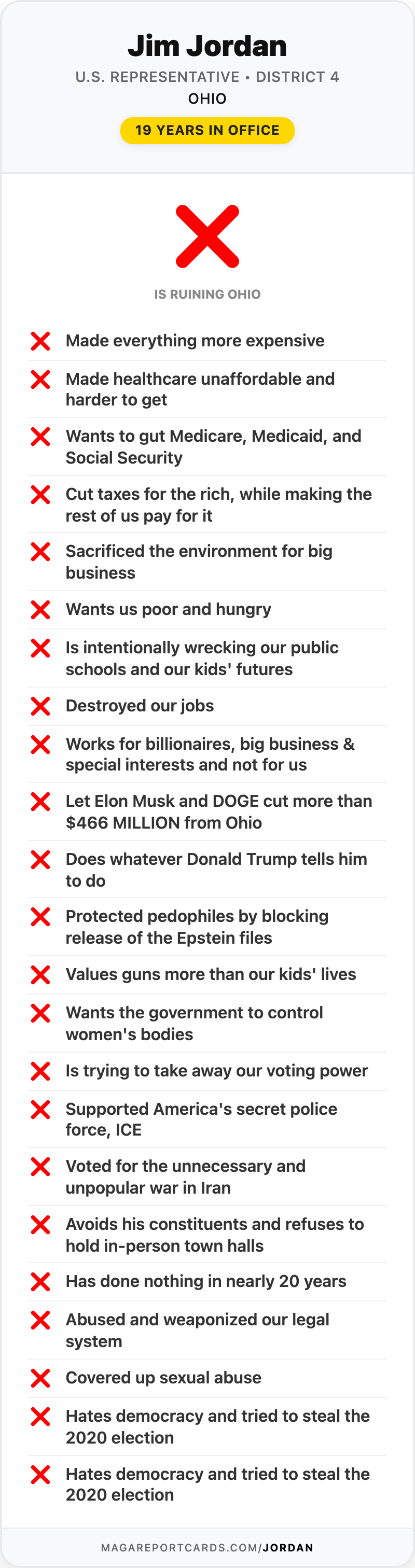
Jim Jordan was on that list. He has since taken $250,698 from pro-Israel PACs, according to FEC data compiled by TrackAIPAC.
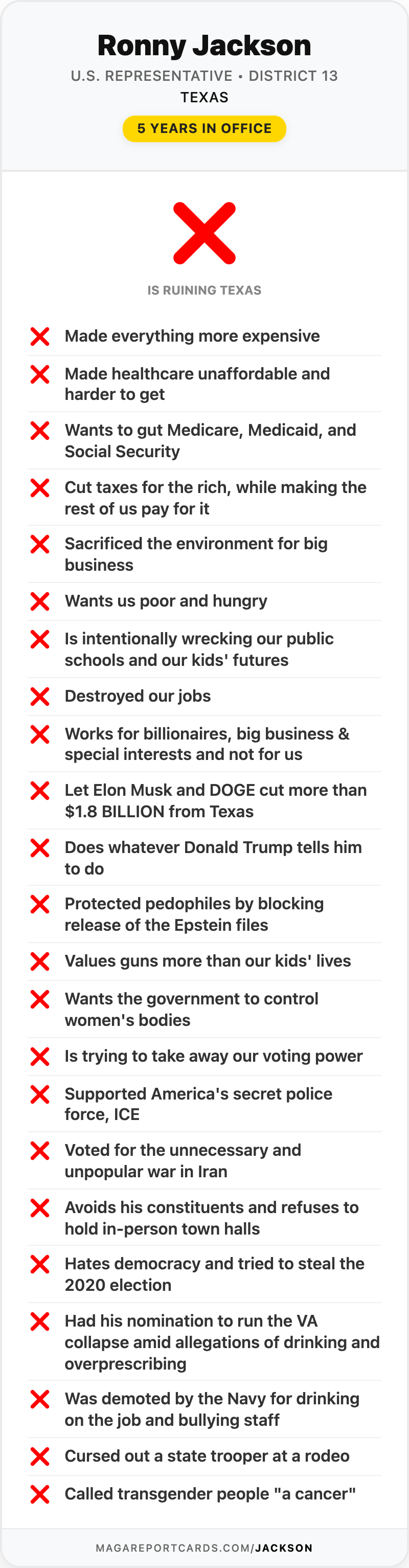
The pattern didn't stop with that one list. Ronny Jackson, hours after the Capitol attack, voted to reject the electoral votes from Arizona and Pennsylvania, and voted against impeaching Trump for inciting the mob. Pro-Israel PACs have since put $90,676 into Jackson, who counts AIPAC among his largest contributors.
When people objected, AIPAC's spokesman explained the policy:
"As a single-issue organization, we remain focused on our mission of building bipartisan support in Congress to strengthen the US-Israel relationship."
Read that again. American democracy is not the single issue. Whether you tried to overturn an American election is simply not a factor. There is one test, and it isn't about America.
What the money actually bought
In February 2026, Trump bombed Iran without a vote in Congress. When members tried to use the War Powers Act to end it, Republicans voted against it nearly to a man — and the two resolutions the House passed anyway, over their objections, carried no force of law — and the rest of us paid at the pump for a war most Americans opposed.
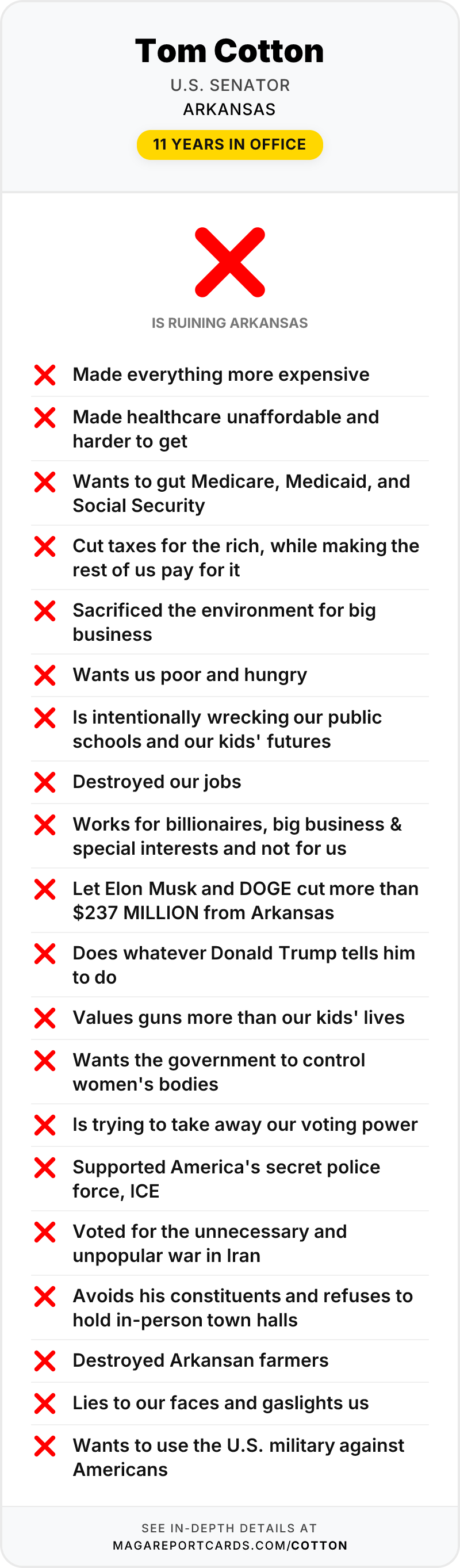
Tom Cotton spent a decade as the Senate's loudest Iran hawk. In 2015 he organized a letter signed by 46 other Republican senators to Iran's supreme leader to sabotage a sitting president's nuclear deal. TrackAIPAC's tally of FEC records puts pro-Israel PAC money to Cotton at $1,127,943.
That is the return on investment. Not a policy paper. A war that Congress never voted for.
Republican voters didn't ask for any of this
And here's the thing the money can't fix: Republican voters are walking away from this position, and their representatives aren't moving an inch.
Pew found in April that 57% of Republicans under 50 now have an unfavorable opinion of Israel — up from 50% just a year earlier. Six in ten Americans overall view Israel unfavorably, up nearly 20 points since 2022.
The base moved. The votes didn't. That gap is what capture looks like. When a party's officeholders stop tracking their own voters and start tracking their donors, the primary stops being a conversation and becomes an auction.
So is it a foreign government?
You'll hear this described as a foreign government running the Republican Party. That's not quite what the records show, and the truth is bad enough without the exaggeration.
AIPAC is an American organization. Its donors are American billionaires. The Justice Department treats it as a domestic lobby, not a foreign agent, precisely because the money is American money. Nobody has shown that a foreign government is writing the checks or giving the orders.
Massie's argument — and he's a Republican congressman, not a critic on the outside — is that this is a loophole. His AIPAC Act, introduced in May as the money was burying him, would amend the Foreign Agents Registration Act so that a U.S. organization whose lobbying aims, even in part, to advance a foreign country's interests — with that country a principal beneficiary — counts as a foreign principal and has to register and disclose, even when it takes no foreign money. He was careful about applying it evenly:
"Whether it's Great Britain, Australia, Turkey, Qatar, or Israel, it needs to be reported."
You don't need the conspiracy version. The documented version is plenty. A few billionaires put nine figures into American primaries. They took out a sitting Republican congressman for voting his conscience on foreign aid. They endorsed and funded 37 members who tried to overturn a presidential election, and said so openly. And Congress delivered a war that most Americans, including a growing share of Republicans, never wanted.
Nobody had to be a foreign agent for that to happen. It's legal. That's the problem.
What you can do about it
Ask your representative one question, and don't accept a speech in reply: how much have pro-Israel PACs and their donors given you, and will you vote for Massie's disclosure bill?
If they can't answer the first part, look it up. If they won't answer the second, you have your answer.
Sources
- A record-shattering $37M was spent on Kentucky's Massie-Gallrein race. Here's who funded it — Louisville Public Media
- Rep. Thomas Massie Loses His Seat in a Win for Trump — and AIPAC — The Intercept
- AIPAC is the top issue at final primary debate between Stevens and El-Sayed in Michigan — JTA
- Are your representatives working with the Israel lobby? — Track AIPAC