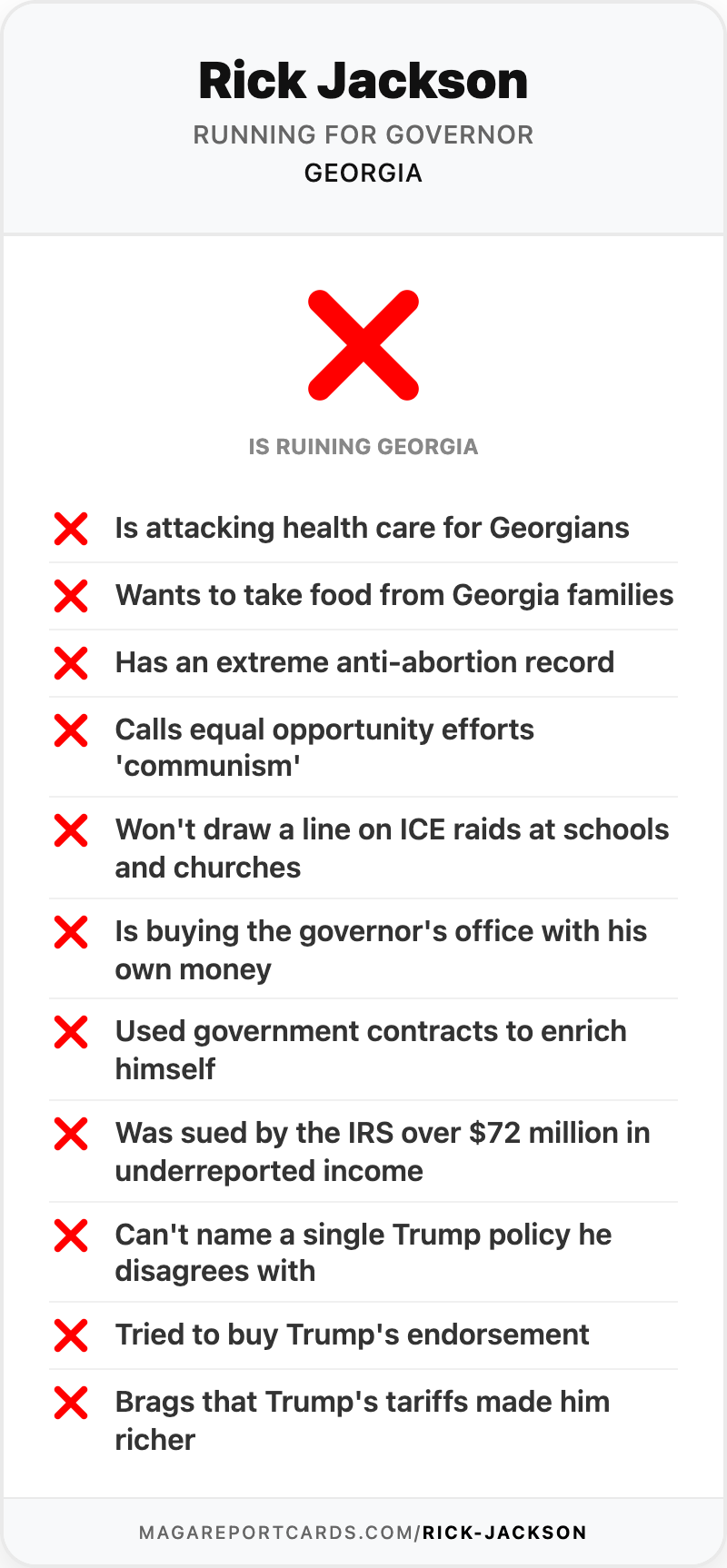
Rick Jackson, the billionaire Republican nominee for governor of Georgia, is deadlocked with Democrat Keisha Lance Bottoms in the polls. He is also running a lawsuit operation in a Texas bankruptcy court, where he gets to help decide which wealthy and well-connected people get sued, and which don't.
The New York Times reported on October 23 that the fight "has the potential to create an ethical quagmire for a governor." The court's own records show how it works.
The bank
GloriFi was billed as an "anti-woke" bank when it emerged in 2022 — a financial hub for MAGA-leaning Americans, with plans for credit cards made of the same metal used for shell casings. Its major investors included Peter Thiel, Ken Griffin and Jeff Sprecher, along with two Republicans now running for governor: Vivek Ramaswamy in Ohio and Rick Jackson in Georgia.
It collapsed fast. When GloriFi filed for bankruptcy in February 2023, only a few months after its website launched, it had about $600,000 in assets against roughly $40 million in debts.
How Jackson took control of the lawsuits
When a bankrupt company has claims against people — former executives, lawyers, vendors — those claims belong to the estate, and a court-appointed trustee normally decides whether to pursue them for everyone who is owed money.
Jackson bought his way into that role. He had already put about $5 million into GloriFi, and before it filed for bankruptcy he bought a $5 million stake held by Griffin's hedge fund, Citadel — for $100, according to the Times. Then in January 2025, the bankruptcy judge approved a deal between the trustee and Jackson Investment Group, the firm of Richard L. Jackson, the CEO of Jackson Healthcare. Under it:
- A new company backed by Jackson's firm, GloriFi Acquisitions LLC, paid the estate $6 million for the right to pursue the estate's lawsuits (plus $100,000 for the GloriFi name).
- Out of anything those lawsuits win, Jackson's company gets paid back first: the $6 million, plus legal fees it advances, plus 1% a month, compounding.
- After that, Jackson's company takes 80% of the next winnings up to $30 million, half up to $50 million, and a shrinking share above that.
- It has "joint standing" in the cases — and if it disagrees with the trustee about how to handle them, Jackson's company takes over.
Who's been sued, and who hasn't
A trustee the Times describes as aligned with Jackson has sued GloriFi's founder, Texas billionaire Toby Neugebauer, along with the company's law firms and former vendors. One suit seeks more than $1.7 billion from the law firm Winston & Strawn and one of its partners.
Others caught up in the litigation include Joe Lonsdale, a Trump ally; Joe Ricketts, the founder of TD Ameritrade and a Republican megadonor; and Sprecher, who chairs the parent company of the New York Stock Exchange and is married to former Georgia Senator Kelly Loeffler, now head of the Small Business Administration in Trump's cabinet. The major investors have largely sided with Jackson, and the Times reports that the billionaires other than Neugebauer have notably not been among those sued by the estate.
Jackson isn't a bystander in the fight either. Neugebauer filed racketeering claims in Delaware and Georgia against Jackson and Ramaswamy or their businesses. The court records list Jackson himself as a defendant in the Georgia suit; a bankruptcy judge halted them before they got going.
When Jackson testified in 2024, he referred to handwritten notes without disclosing them at first, as required. Judge Michelle V. Larson called that "incredibly inappropriate." Asked about his litigation strategy, he said: "To me, everybody is on the potential target list."
Why it matters if he becomes governor
Norm Eisen, the Obama White House's ethics counsel, reviewed the list of creditors for the Times and noted that some of them could be open to pressure from a governor.
"Not in a million years would I have allowed anybody in government to maintain this kind of arrangement," Eisen said, because of "the extreme danger of a conflict" of interest "or the appearance of a conflict." His fix: "You need to completely separate and appoint an independent trustee to manage this."
Jackson's campaign told the Times he is "supporting legal action because he believes there needs to be accountability for the company's downfall." It would not say whether he would dial back his litigation if he is elected.
He's made promises like this before
Jackson has promised voters he'll keep his business away from the governor's office. His campaign told the Times he "will not sign new contracts with the state of Georgia and will terminate any existing contracts" once elected. But three weeks before he said he didn't want "even the appearance" of an ethics problem, his company renewed a Georgia state contract that runs past the next governor's inauguration. And he's running on the idea that his money makes him impossible to buy while spending $187 million of it to win the office.
What the court records show
In January 2025, a bankruptcy court approved a deal letting a company backed by Rick Jackson's investment firm pursue a failed bank's lawsuits — and take over if it disagrees with the trustee — in exchange for $6 million, the first payout of any winnings plus 1% a month, and 80% of what comes after that, up to $30 million. The estate has sued the bank's founder, its law firms and its vendors, but not the other billionaires caught up in the fight, one of whom is married to a Trump cabinet member and former Georgia senator. Jackson's campaign won't say whether he'd step back if elected governor.
Source
The Financial Woes of a MAGA Bank Entangle 2 G.O.P. Candidates — The New York Times