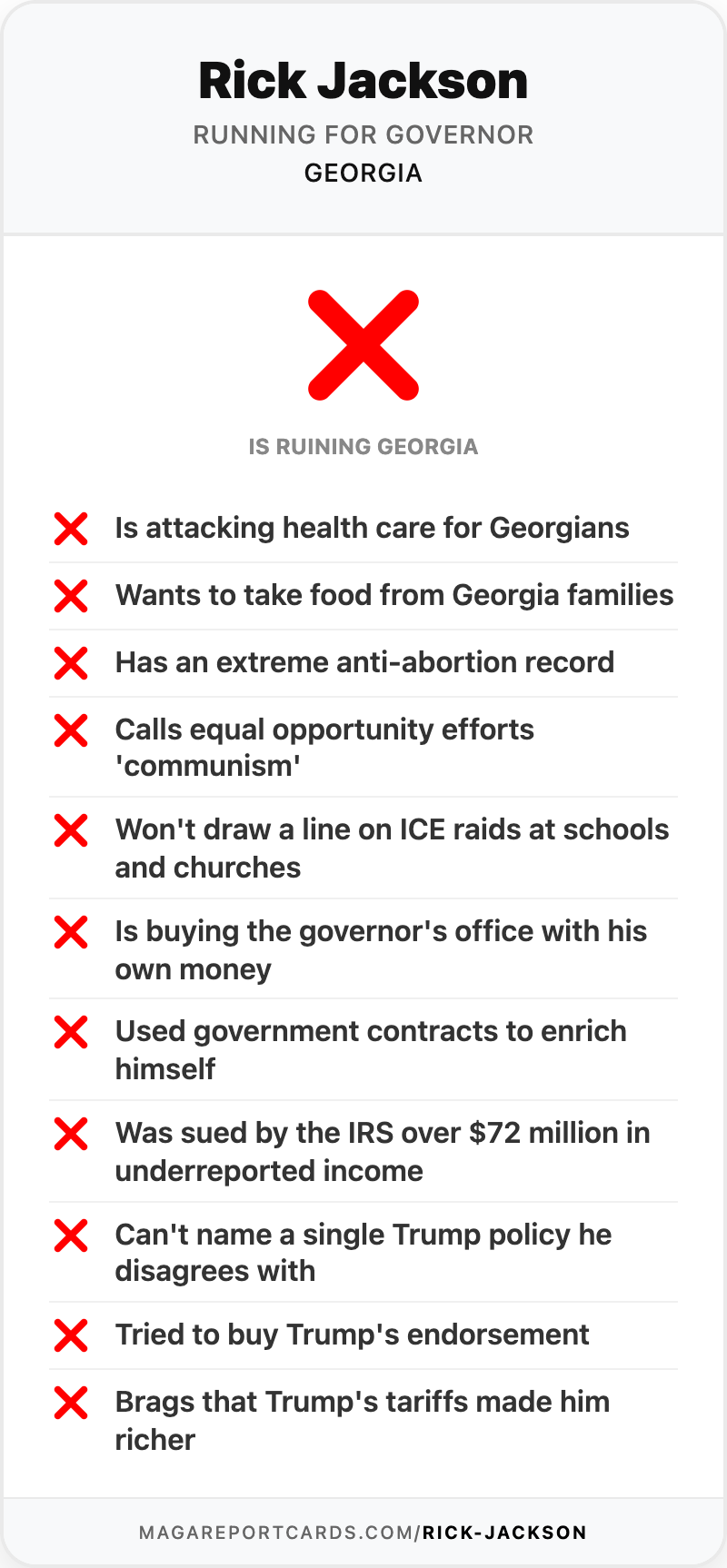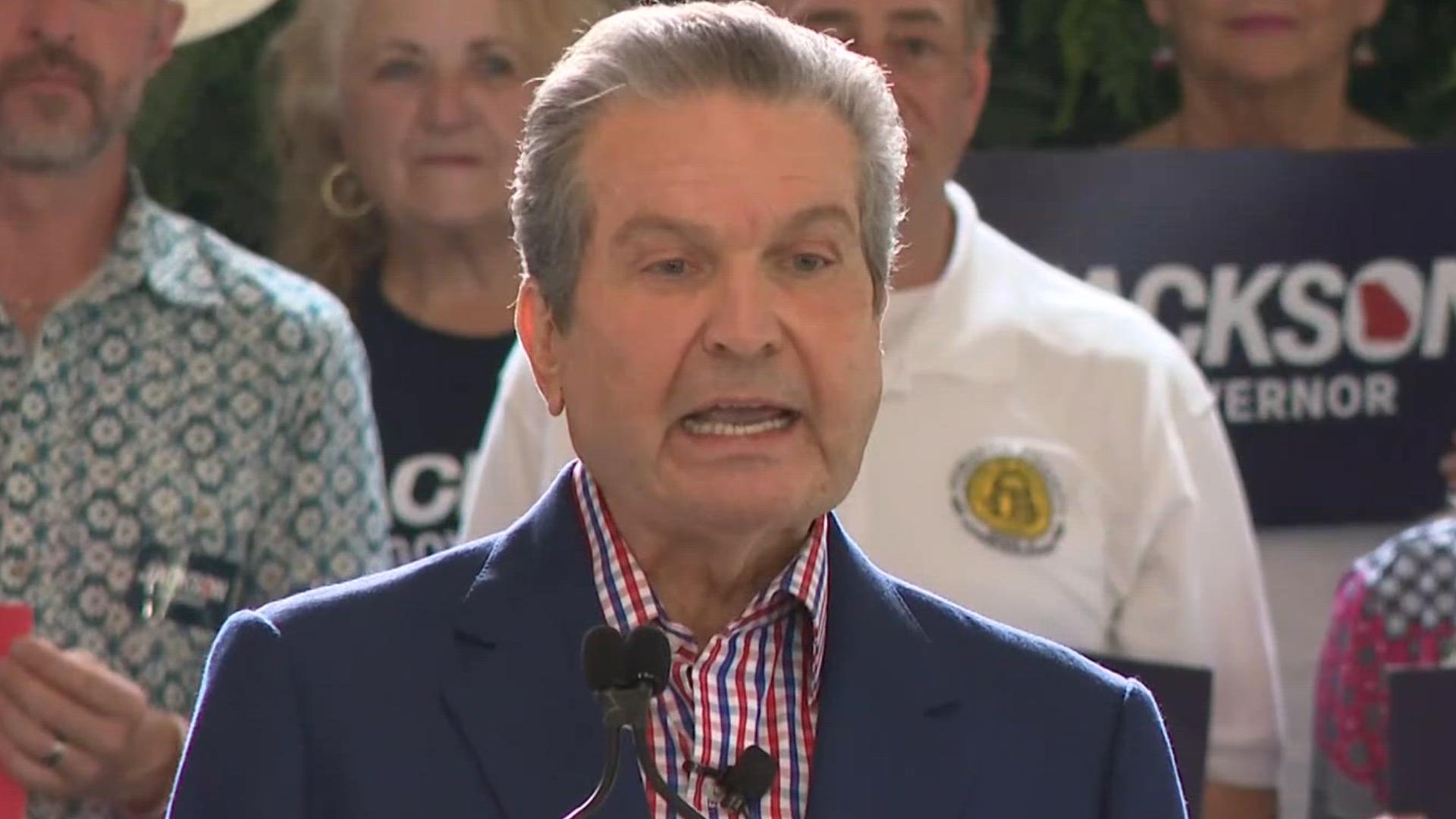
Rick Jackson, the billionaire Republican running for governor of Georgia, has a line he uses when reporters ask about the roughly $1 billion his companies have collected from Georgia state agencies.
He says he'll unwind it.
On Wednesday, August 12, he said it again:
"I don't want even the appearance that there's ethics impropriety and all that. … I never will do business with the state of Georgia."
11Alive reports the second sentence was about what he would do as governor.
Twenty-one days earlier, his company had signed a new one.
The contract
On July 22, 2026, a subsidiary of Jackson Healthcare called Locum Tenens renewed its contract with the Georgia Department of Behavioral Health, 11Alive's Doug Richards reported. Locum Tenens supplies temporary healthcare workers to the agency.
State records show the agency has paid the company $17,903,044 since 2022.
One of the renewal documents carries Rick Jackson's own signature.
And here is the detail that turns an awkward coincidence into something worth paying attention to: the renewed contract runs to June 30, 2027. Georgia's next governor is sworn in that January. The contract was written to last a full six months into the term of the person Jackson is running to become.
If he wins, he takes office as the head of the executive branch — and his own company holds a live contract with an agency he now oversees.
"A continuation," says the campaign
Jackson's campaign didn't dispute any of it. A spokesman told 11Alive:
"This is a continuation of a service provided to the state since 2021. As Rick has said before: after he is elected he will unwind any business with the state and not seek any new contracts."
Read that carefully, because it's doing a lot of work.
- "A continuation" — a renewal signed three weeks ago is a new signature on a new agreement with a new end date. It is not the same thing as an old contract running out on its own.
- "After he is elected" — the unwinding happens later. Between now and then, the money keeps coming.
- "Not seek any new contracts" — a renewal, apparently, is not a new contract.
Asked directly whether Jackson would keep providing the service under the new agreement, the spokesman would only repeat that he'd "unwind any contracts he has with the state as governor."
That's a promise about the future being used to answer a question about what he did last month.
To be clear: this is legal
There is no law stopping a candidate for governor from doing business with the state. Jackson hasn't broken a rule.
That's exactly why it matters. He isn't being accused of doing something illegal. He's being measured against his own standard — the one he set himself, on a stage, in front of Georgia voters, three weeks after the signature.
His Democratic opponent, former Atlanta mayor Keisha Lance Bottoms, put it plainly at an event in Cobb County:
"He says he's going to dial back his business with the state, but my understanding is that just last week, he got another contract from the state. So don't just say it. Do it."
The pattern
This isn't the first time Jackson's public position and his private ledger have pointed in opposite directions.
- His companies have been paid nearly $1 billion by Georgia state agencies since fiscal 2020, including about $709 million in federal pandemic money under a contract Georgia Health News described as sole-source, and whose bidding opportunity does not appear in the state's public database of contracting opportunities.
- He owns part of a data center — and then told Georgia's business leaders that one could eliminate a county's property taxes.
- He says he can't be bought, while spending $187 million of his own money to buy the governor's office.
- He lent a bankrupt hospital $35 million at 14% interest and called it "venture philanthropy".
The through-line is not that Jackson is dishonest about money. It's that he keeps describing arrangements that benefit him as something other than what they are — a no-bid contract as normal business, a high-interest loan as charity, a renewal signed in July as a continuation of something from 2021.
What Georgians should ask
Georgia's Department of Behavioral Health serves people in mental health crisis and people fighting addiction. It is chronically stretched. The temporary staffing it buys is not a luxury — it's how understaffed facilities keep the lights on.
The question isn't whether Locum Tenens should provide those workers. It's whether the man who owns Locum Tenens should also be the man who appoints the commissioner of the agency buying them, sets that agency's budget, and signs off on the next contract.
Jackson says he'll fix that after the election. He had a chance to fix it on July 22, and instead he signed.
Georgia deserves a governor whose promises are kept before the votes are counted, not after.
Source
Despite pledge to 'unwind' his business, Rick Jackson extends a state contract — Doug Richards, 11Alive, August 18, 2026.