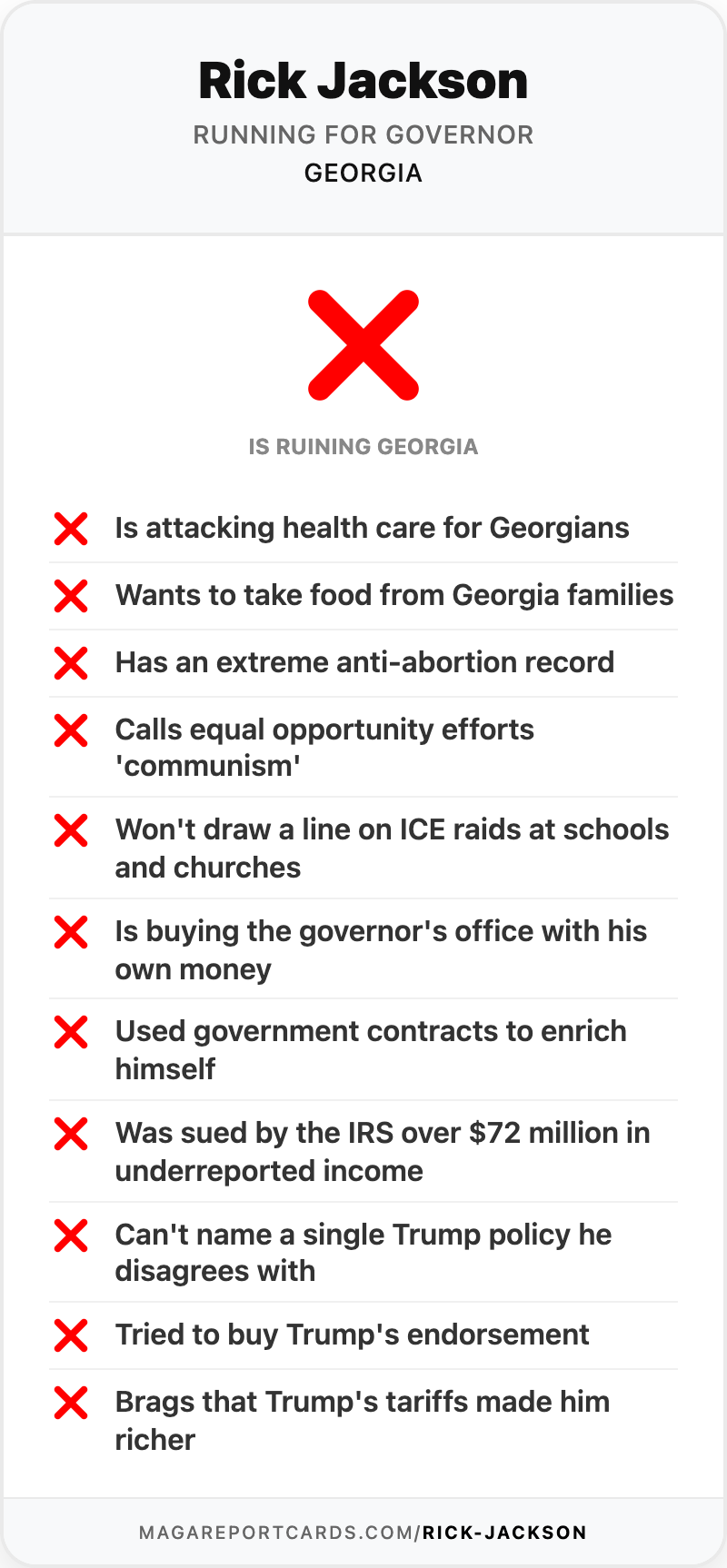
Rick Jackson, the healthcare executive spending a fortune to become governor of Georgia, has a story he likes to tell about a struggling hospital in Montgomery, Alabama.
He describes what he did there as charity. The Atlanta Journal-Constitution went and looked at the paperwork.
Here is what the paperwork says.
The numbers
Jackson Hospital in Montgomery — no relation to Rick Jackson, despite the name — filed for bankruptcy last year. It's a safety-net hospital in a state that, like Georgia, never expanded Medicaid.
At the moment it went bankrupt, per the AJC: "Rick Jackson's medical staffing company was the facility's second-largest creditor with nearly $10 million in unpaid bills."
So he was already deeply exposed. If the hospital died, his company's $10 million died with it.
His investment group then offered a rescue. The terms:
"His $35 million loan to the hospital comes with a 14% interest rate — that increases to 19% if payment is missed."
Fourteen percent. Nineteen if they stumble. From a bankrupt nonprofit hospital that is, in the words of its own attorney Stuart Memory, on "fourth down on the 2-yard line, so we've got our last shot." At the same bankruptcy hearing he added: "We are running out of money."
And that loan is not the only money holding the place up. The AJC notes that "$80 million of public funding" is also going to the hospital "from the state, county and city."
Taxpayers put in $80 million. Jackson put in a loan at 14%.
Even with all of it, the AJC reports the hospital's fate is still uncertain. It has stayed open partly through a verbal agreement among the hospital, Jackson's investors and Blue Cross Blue Shield, struck during a contentious fight over reimbursement rates.
What he calls it
Here is how Jackson describes this arrangement:
"We call our approach venture philanthropy: we deploy capabilities and capital to solve structural problems in healthcare that traditional philanthropy or market-rate capital alone can't fix."
Philanthropy is when you give money away. A 14% loan with a 19% penalty rate, made to a bankrupt borrower, secured against a hospital, by a creditor already owed $10 million by that same hospital, is a lot of things. It is not giving money away.
Jackson also explained why he didn't just buy the hospital outright. A full turnaround was estimated to cost $250 million to $300 million.
"There's no way anybody could justify — certainly not us — to do that."
That's the honest sentence in the whole story. He ran the numbers on actually fixing the hospital, decided it didn't justify the cost, and structured a deal that protects his existing $10 million and earns 14% instead.
That is a perfectly ordinary business decision. It's just not philanthropy, and a man running for governor on his healthcare record shouldn't get to call it that.
Why this matters for Georgia
Jackson isn't running for office in Alabama. He's running for governor of Georgia — where the same problem is coming, and where he opposes the main tool for fixing it.
At the Georgia Chamber's luncheon this month, Jackson rejected Medicaid expansion, offering instead what he calls "an intelligent Medicaid expansion" — which on inspection means work requirements and fixed federal block grants rather than open-ended matching funds. Block grants cap the money no matter how many people need care.
Georgia is one of the last states that hasn't expanded Medicaid. Georgians pay the federal taxes that fund expansion in other states, and Georgia declines to take its own share back.
Meanwhile the Joint Economic Committee's House minority staff projects 566,000 Georgians will lose health coverage by 2034 — 38,300 of them losing Medicaid under the Republican budget law, and 527,800 losing Affordable Care Act coverage as the enhanced premium tax credits lapse. More than 1.3 million Georgians rely on ACA marketplace coverage.
And Jackson's own company said out loud what that does to hospitals. Jackson Physician Search published a February white paper warning of "considerable fear and uncertainty," noting the law "is projected to cause between 10 and 15 million people to lose health coverage" and that "Medicare and Medicaid cuts are creating significant financial pressure across healthcare organizations." The same firm had said on its website in September 2025 that the bill's "sweeping cuts to Medicaid and ACA programs raise serious concerns about access, equity, and sustainability," and warned that some hospitals may need to "adapt or close their doors."
His own firm wrote the forecast. He's campaigning against the remedy.
The business model, stated plainly
Put the two halves together and the shape is unmistakable.
A hospital in a non-expansion state runs out of money, because that's what happens to hospitals that treat a lot of uninsured people in states that refused federal coverage dollars. It goes bankrupt. Public money — $80 million of it — rushes in to keep the doors open. And a private investor who was already one of its largest creditors lends it more at 14%, declining to buy it outright because fixing it properly "couldn't be justified."
Then that investor runs for governor of the state next door, on his healthcare expertise, opposing the policy that would keep the next hospital from getting there.
There is a word for benefiting from a problem you're working to preserve, and it isn't philanthropy.
He's asked to be judged on his money
Jackson has made his wealth the centerpiece of his campaign — the argument being that a man this rich can't be bought. He's put more than $100 million of his own money into the race and added an $87 million ad buy on top of it.
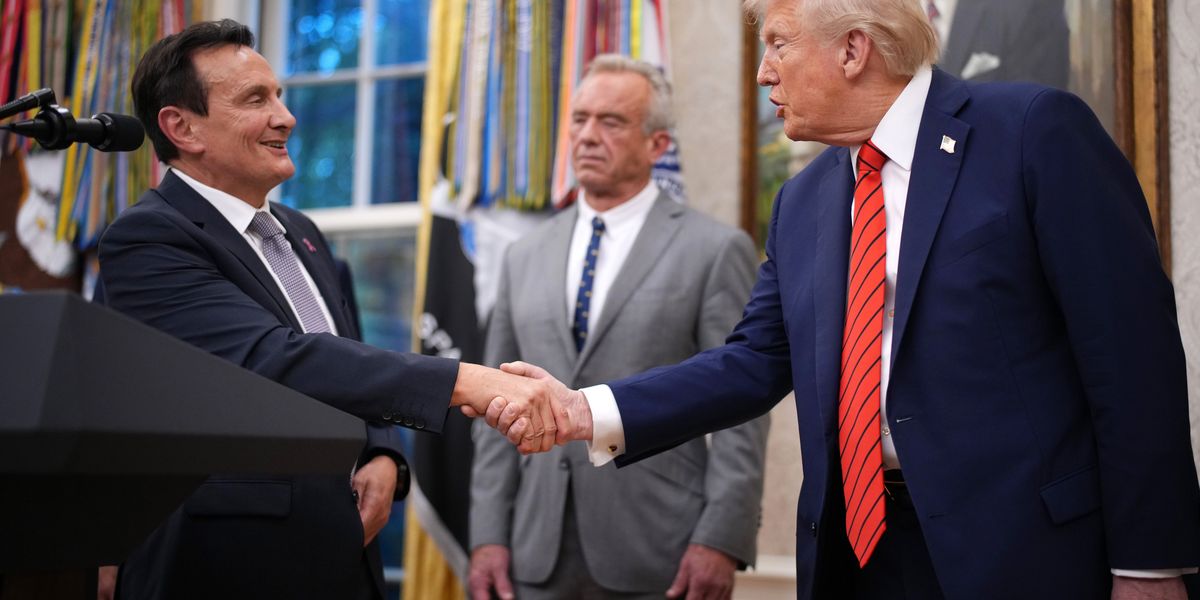
That claim gets harder to hold. Trump endorsed him after backing his primary opponent, and said out loud that Jackson had given him "a couple of" million dollars. Jackson then stood on stage and promised to be "this man's favorite governor."
Now add the Montgomery deal. The pattern isn't a man too rich to be influenced. It's a man whose money and whose policy positions keep pointing the same direction — toward his own balance sheet.
Georgians voting in November are being asked to hand the state's health policy to someone who looked at a dying hospital, calculated that saving it properly wasn't worth it, and lent it money at 14% instead.
Source
Why Rick Jackson poured millions into a failing Alabama hospital — The Atlanta Journal-Constitution, August 2026. Photos: Jason Getz, Hyosub Shin and Riley Bunch / AJC; Vasha Hunt / AP.