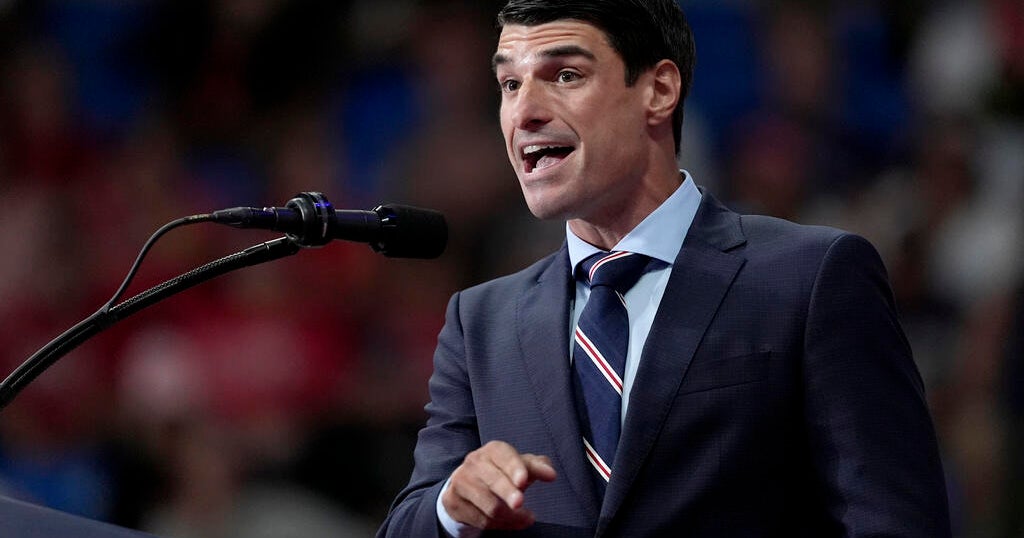
On Wednesday, more than 1,000 members of Georgia's business community filled an Athens event center for the Georgia Chamber of Commerce's annual luncheon. Both candidates for governor made their pitch.
Rick Jackson used his to argue for two things: that Georgia counties could eliminate their property taxes by hosting a data center, and that Georgia still should not expand Medicaid.
He has a personal financial interest in the first one. He made his fortune in health care.
The data center pitch, and what he didn't lead with
Georgia has been flooded with proposals for data centers — the enormous, power-hungry server warehouses that AI companies are building across the country. Opposition has been loud enough to reach city halls up and down the state. In the 2026 legislative session, several bills with bipartisan support tried to rein the projects in. None made it to the governor's desk.
Jackson's position is that counties should decide for themselves — and his pitch is that a data center pays in so much that a county could stop collecting property taxes altogether. In the Georgia Recorder's summary, he "said data center projects could eliminate property taxes in some Georgia counties."
"No property taxes for the data center, or don't have one. It's totally up to them," Jackson told reporters. "As a business person, I just want to give them that option so that they know both sides of the street."
Here is the sentence from the Recorder's report that reframes that whole quote: Jackson is invested in a data center in Texas.
"As a business person" is doing a lot of work there. He is not a neutral observer offering counties a menu. He is an investor in the industry, running to be the state official who will set the terms for that industry, telling counties that the industry will cover their bills.
He has made that promise all year. He told 13WMAZ in April that if the deals "are set up correctly, they can eliminate some cities' property taxes and reduce power bills" — and confirmed in the same interview that he is an investor: "Yes, I do. I do have an investment and that's the reason I'm knowledgeable about it." He told WRBL that a data center "has the opportunity to eliminate property taxes and reduce power bills. It just needs to be negotiated correctly with guardrails."
To be clear about what he is not proposing: in that same WRBL interview he said "we don't need to give away a lot of taxes and stuff like that to data centers." His position is not that data centers should be exempt from tax. It is that they will generate so much of it that everyone else can stop paying.
His Democratic opponent Keisha Lance Bottoms took a different position — a temporary pause, not a ban. "I just want us to pause," she told reporters, citing constituents' concerns about environmental impact and rising utility bills, while acknowledging that rural leaders say data centers help them balance budgets.
You can argue about which policy is better. What you cannot do is pretend the man who owns part of a data center is offering disinterested advice about data center tax policy.
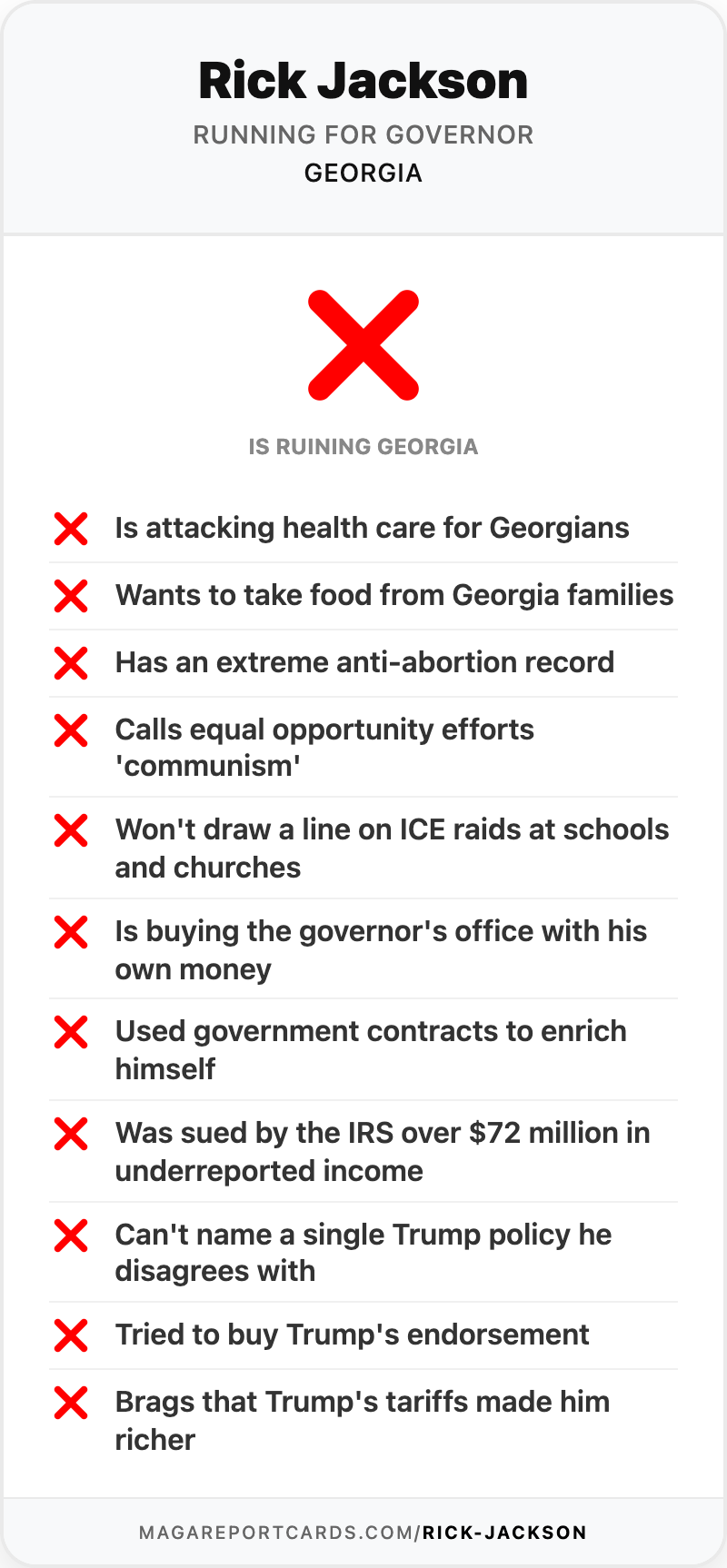
We've seen this pattern from him before. Jackson has already put over $100 million of his own money into this race and added an $87 million ad buy, all while arguing his wealth is what makes him incorruptible.
"I'm not going to measure our state by how many people are on Medicaid"
Georgia is one of only 10 states that still has not fully expanded Medicaid under the Affordable Care Act.
Jackson — a wealthy healthcare executive — is not for changing that. He says he supports "an intelligent Medicaid expansion," which on inspection means work requirements and fixed federal block grants instead of open-ended matching funds. Block grants are how you cap the money regardless of how many people need care.
"I want to be able to give the opportunity to every Medicaid recipient to be able to be trained and at least get a job and get off of Medicaid. I'm not going to measure our state by how many people are on Medicaid. I want to measure how many people are on commercial insurance, and the way to do that is reduce the cost of commercial insurance, and that's what I want to do."
That is a clean statement of the philosophy: coverage is a failure metric, not a goal.
Bottoms said she'd scrap Georgia Pathways — the partial expansion created under Gov. Brian Kemp — and fully expand instead. Her argument was about hospitals:
"There's not a single community that you go into in this state that hasn't been touched by our refusal to expand Medicaid, from hospitals in the metro area to hospitals in our rural communities. And it weakens our entire healthcare system when we don't expand Medicaid. And the irony of it is we are paying into a system that's helping fund healthcare in states throughout the United States. We just haven't done it in Georgia."
That last point is worth sitting with. Georgians pay federal taxes that fund Medicaid expansion in other states. Georgia just declines to take its own share back.
His own company already told him what this does
Jackson praised Trump's budget bill. At a Thomasville campaign event he said there were "many parts" of it that were "great" — and noted that without it, "I'd be paying 40% more in taxes right now."
Meanwhile his own firm, Jackson Physician Search, published a February white paper warning of "considerable fear and uncertainty" from that same law. The company's materials noted it "is projected to cause between 10 and 15 million people to lose health coverage," and that "Medicare and Medicaid cuts are creating significant financial pressure across healthcare organizations." The same firm had said on its website in September 2025 that the bill's "sweeping cuts to Medicaid and ACA programs raise serious concerns about access, equity, and sustainability," and warned that some hospitals may need to "adapt or close their doors."
His business analysts and his stump speech reached opposite conclusions about the same bill. He kept the tax cut and the talking point.
For Georgia specifically, the Joint Economic Committee's House minority staff projects 566,000 Georgians will lose health coverage by 2034 — 38,300 of them on Medicaid. More than 1.3 million Georgians rely on ACA marketplace coverage.
Those are the people Jackson wants to move onto "commercial insurance." His answer on how they would afford it is that he will bring the cost of commercial insurance down. He did not say how.
The through-line
Both halves of Jackson's Chamber pitch point the same direction.
On data centers, he's promising counties a windfall from an industry he's personally invested in. On healthcare, he'd hold the line against expansion in a state whose rural hospitals are already under strain — a strain his own company documented in writing.
In both cases the constituency he's serving was sitting in the room. Over 1,000 business leaders. Not the 38,300 Georgians on Medicaid who are projected to lose it.
Jackson has been open that he thinks his money makes him independent. He has also paid Trump millions and then promised to be "this man's favorite governor." The record keeps showing the opposite of independence: it shows a man whose policy positions track his own balance sheet with remarkable precision.
Source
Bottoms, Jackson offer competing visions on data centers, Medicaid expansion at business luncheon — Ross Williams, Georgia Recorder, August 5, 2026. Photo: Ross Williams/Georgia Recorder.