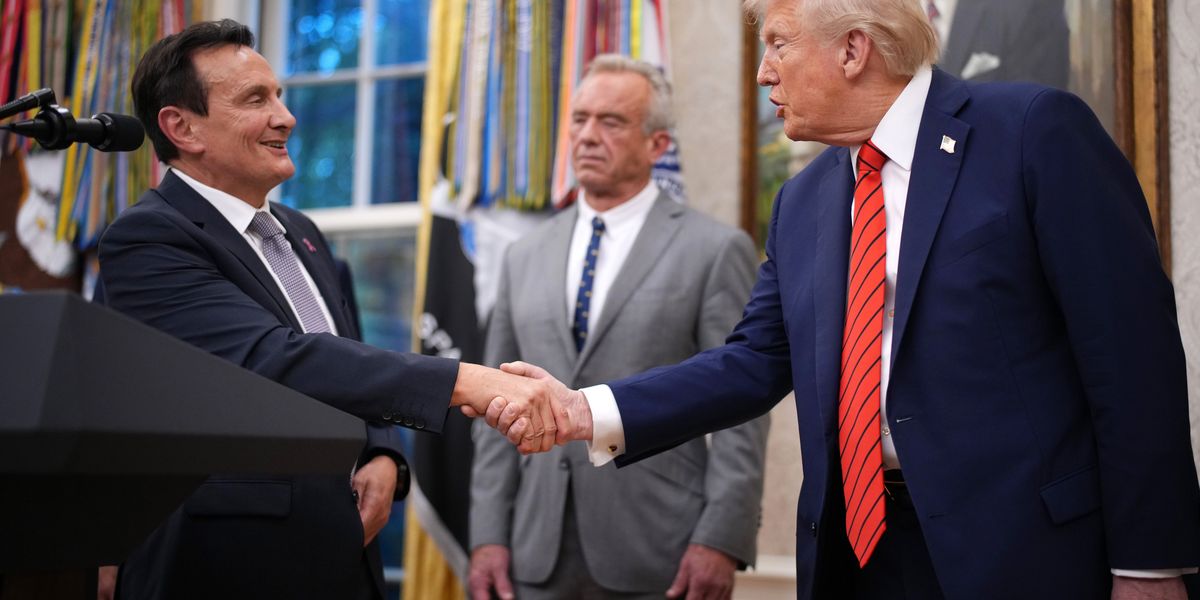
For months, President Trump has said his deals with drug companies got Americans the lowest prescription prices in the world. The contracts behind those deals were secret.
Now two of them are out, and only because a watchdog group sued to get them.
Public Citizen published its analysis of the Pfizer and Eli Lilly deals on September 19. It asked for them under the Freedom of Information Act. When the administration didn't answer, it sued. Nearly six months after the lawsuit, and ten months after the White House announced the first of these deals, it handed over copies. They are heavily redacted.
What's left, Public Citizen wrote, reveals terms "that will help facilitate pharma companies charging more for drugs abroad or discontinuing supplying drugs in other countries so that they can continue to charge U.S. customers high prices."
How the deals were sold
The idea was called "most favored nation" pricing: a drug company would charge Americans no more than it charges people in other wealthy countries.
The contracts show several ways around that promise.
The loopholes
Lilly can stop selling a drug abroad to get rid of a low price. Lilly's agreement lets the company stop supplying a drug to one of the countries used for comparison, tell the U.S. government, and then have that country's price left out of the calculation. If a country's price is too low, Lilly can walk away from that country, and the low price stops counting.
Lilly's biggest drugs are carved out of the Medicaid discount. Mounjaro and Zepbound, Lilly's diabetes and weight-loss drugs, are left out of GENEROUS, the program that is supposed to give state Medicaid programs the lowest foreign price. Instead they go into a separate program with a flat $245 price. Public Citizen found that $245 "is higher than the list prices paid for Mounjaro and Zepbound in some of the reference countries."
Thomas Hwang, director of the Cancer Innovation and Regulation Initiative at Harvard Medical School, estimated for Public Citizen what that carve-out costs:
- Up to $0.3 billion in lost Medicaid savings in the program's first year, from leaving out Lilly's two drugs.
- If Novo Nordisk's Wegovy and Ozempic are left out the same way, which Public Citizen calls a reasonable assumption since the $245 price covers both companies, the total comes to $1 billion to $1.7 billion in lost savings in the first year.
That's 12% to 20% of the $8.6 billion Hwang had first predicted the Medicaid program could save.
Pfizer gets to do some of its own math. For newly launched drugs, Pfizer's deal says the company "shall calculate net prices under this Section for Newly Launched Drugs using good faith, reasonable assumptions as determined by Pfizer."
Pfizer's deal overrides the Medicaid pricing model. Where the two conflict, Pfizer's terms supersede the GENEROUS program that sets how state Medicaid programs get the foreign price.
Pfizer doesn't have to offer its TrumpRx discounts to people on government health plans. TrumpRx is the administration's website where companies with these deals offer discounts to patients paying cash. Pfizer's deal says it "has no obligation to offer Covered Products to patients enrolled in any federal health care program" through it.
Pfizer's deal ends with Trump's term. It terminates on January 20, 2029, which Public Citizen said confirms "that these were at most 3-year deals." Lilly's deal refers to a "covered period," but its end date is redacted.
What's still hidden
The redactions cover some of the most basic questions. In Pfizer's deal, they hide the list of drugs and prices Pfizer offers on TrumpRx, even though that information is already public on the website.
The perks the companies got in return aren't in the documents either. Lilly's papers don't cover the tariff relief the Trump administration said the company received. Public Citizen got Commerce Department documents on Pfizer's tariff exemptions, but not a final agreement, and not the total amount Pfizer has to invest in U.S. manufacturing.
A pattern with the drug companies
The drug companies have done fine. We've reported that while Trump claimed he had cut drug prices "by like 1,000%," big drug companies booked $298 billion in six months.
What the documents show
Trump's drug-price contracts with Pfizer and Eli Lilly stayed secret until Public Citizen sued for them, and came back heavily redacted. What can be read lets Lilly stop selling a drug in another country to drop that country's low price from the math, carves Lilly's weight-loss drugs out of the Medicaid discount at a price higher than some other countries pay, and lets Pfizer calculate its own prices for newly launched drugs. A Harvard researcher estimates that if Novo Nordisk's weight-loss drugs are left out the same way, Medicaid could lose $1 billion to $1.7 billion in savings in the first year.
Source
This post is based on Public Citizen's analysis of the Pfizer and Eli Lilly agreements it obtained, and Common Dreams' reporting. Photo via Common Dreams.