You cannot cut a price by 1,000%. A 100% cut makes something free. Anything past that means the pharmacy pays you.
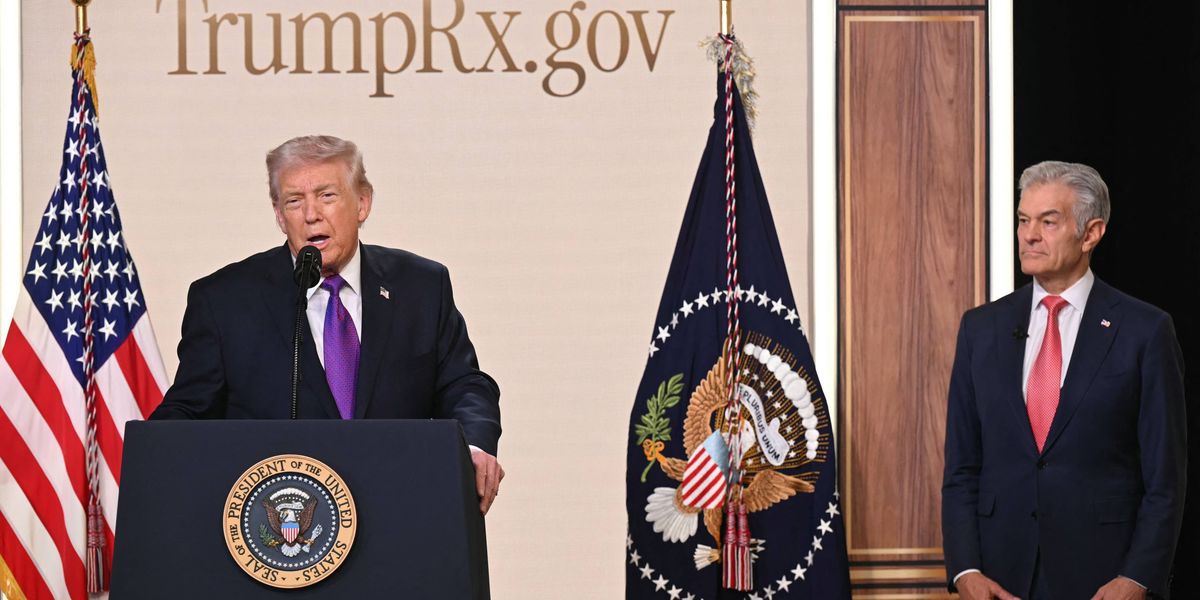
Trump keeps saying it anyway. "You know, we've cut drug prices by 1,200, 1,300, 1,400, 1,500%," he told reporters in August 2025. "I don't mean 50%, I mean 14 — 1,500%." A month later, at event after event, the number was "not by 20%, 30% — by like 1,000%."
Here is what actually happened in the same period. The world's ten largest pharmaceutical companies — Johnson & Johnson, Novartis, AbbVie, Merck and Pfizer among them — booked $298 billion in combined global revenue in the first half of 2026. That's $24 billion more than the same stretch last year.
They sent $63 billion of it to shareholders in buybacks and dividends.
What Americans are doing about their prescriptions
While that was happening:
- 60% of U.S. adults say they are struggling with or worried about affording their prescriptions — the highest share KFF has measured since 2018.
- Tens of millions of Americans have traded off daily expenses to cover health care, including skipping meals and stretching prescriptions to make them last longer.
Stretching a prescription means taking half a pill, or taking it every other day, or waiting a week to refill. People do it with insulin. They do it with heart medication. It is not a budgeting strategy; it's a medical decision made by a household ledger instead of a doctor.
The gap is the policy
The obvious question is how both things can be true at once — record industry revenue and record trouble at the pharmacy counter, under a president who campaigned on lowering prices.
They're true at once because they're the same fact seen from two ends. Vaishu Jawahar of Protect Our Care, which published the analysis:
"The numbers speak for themselves. While big drug companies make record-breaking sales, raking in billions more than they did last year, a growing number of Americans are struggling to afford their prescription drugs. Yet again, Trump has betrayed the American people and put billionaires ahead of working families."
And on the mechanism:
"Instead of lowering drug prices for seniors, Trump is holding backroom deals with big drug companies and handing them blockbuster giveaways. He has created loopholes for industry giants to evade price negotiations and jack up drug prices for seniors."
Two things worth understanding
The deals are voluntary and secret. Trump's approach to drug pricing has run on handshake agreements with individual companies — arrangements the companies can quietly abandon later, because nothing binds them. A promise announced at a press conference is not a price control. It's a press conference.
TrumpRX was denounced as a scam. The administration's marquee consumer offering was widely dismissed as something that will do virtually nothing to lower drug costs for most Americans.
Meanwhile the one tool that did have teeth — Medicare's authority to negotiate drug prices, established during the Biden administration — is the program Trump has worked to weaken.
That is the part that matters most, and it's the part that gets the least attention. Negotiation is binding. Backroom deals are not. The administration traded the first for the second and called it a win.
Why this belongs on an accountability site
Because none of it happened by itself.
Medicare negotiation exists because Congress passed it. It can be weakened because Congress lets it be weakened. Every Republican who votes to protect pharmaceutical loopholes, or who stays silent while the negotiation program is hollowed out, is choosing the $298 billion side of this ledger.
We've documented what that looks like up close. Marsha Blackburn sent lawyers after an ad calling her "queen pharma mama" — but the record underneath the ad is real: a 2016 law that stripped the DEA's power to immediately freeze suspicious opioid shipments. And when the House voted on capping insulin at $35 a month, only 12 Republicans voted yes; Trent Kelly was not one of them, in a state where 348,000 adults have diagnosed diabetes.
Those are individual votes. This is the aggregate: $24 billion more for the industry, $63 billion out to shareholders, and 60% of American adults worried about paying for the medicine they've been prescribed.
The president says he cut prices by upwards of 1,000%. The pharmacy counter says otherwise, and so do the earnings reports.
Source
Jake Johnson, "Pharma Giants Reap Record $300 Billion in Revenue Under Trump as Millions of Americans Ration Medications," Common Dreams, Aug. 14, 2026, reporting on an analysis by Protect Our Care.