A dark-money group is running a TV ad in Tennessee calling Marsha Blackburn "queen pharma mama." Blackburn's lawyers want it off the air.
According to the Tennessee Lookout, attorneys for Blackburn's gubernatorial campaign sent a letter to the Alexandria, Virginia-based American Exceptionalism Institute accusing it of hitting a sitting U.S. senator with "knowingly false and defamatory accusations of bribery and corruption." The letter demands the ad stop and that the group confirm it within 48 hours, and demands the group disclose whether AI was used to make it.
Blackburn's attorney calls the ad "a calculated attempt to deceive viewers by accusing Senator Blackburn of quid pro quo without a shred of factual support."
Set the ad aside for a moment. The record it's built on is not in dispute.
What the 2016 law actually did
In 2016, Congress passed the Ensuring Patient Access and Effective Drug Enforcement Act. It was sold as a way to make sure patients in pain could get their medication.
Blackburn, then a member of the House, was one of its leading co-sponsors. It was introduced by Pennsylvania Rep. Tom Marino and, as the Washington Post reported, written by a pharmaceutical industry lobbyist.
Here's what it did in practice, according to the joint Washington Post and "60 Minutes" investigation: it stripped the Drug Enforcement Administration of its ability to immediately freeze suspicious shipments of prescription narcotics — right as the opioid epidemic was tearing through small communities.
Jonathan Novak, who worked in the DEA's legal office, described what the agency was left with after the law passed. Asked how hard it became to hold distributors accountable, he said it made it "nearly impossible."
"They are toothless. I don't know how they stop this now."
Joe Rannazzisi, the former DEA deputy assistant administrator who ran its Office of Diversion Control, and the whistleblower at the center of the story, put it this way:
"If I was gonna write a book about how to harm the United States with pharmaceuticals, the only thing I could think of that would immediately harm is to take the authority away from the investigative agency."
The money
While that bill moved, Blackburn was taking money from the industry it helped.
WPLN reported that Blackburn took $120,000 in campaign contributions from the drug industry, an industry that spent more than $100 million lobbying overall as the measure moved to passage.
That's the factual core the ad is pointing at. Blackburn's lawyers are right that "bribery" is a specific criminal accusation and that she has not been charged with one. But the money, the sponsorship, the lobbyist-written text, and the gutted enforcement power are all documented.
The part that should stop you
Here's the piece of history that makes this week's legal threat look less like a one-off.
When Rannazzisi — the DEA official raising the alarm — testified against their bill, Marino and Blackburn didn't stop at arguing with him. A week after the hearing, they wrote to the Justice Department's inspector general demanding he be investigated for trying to "intimidate the United States Congress."
Think about the sequence. A career drug enforcement official warns Congress that a bill will hobble the DEA during an opioid epidemic. Blackburn's response is to demand an investigation into him.
Ten years after the bill became law, a group runs an ad about that same bill, and Blackburn's response is a demand letter from a law firm.
The Tennessee Lookout notes that after the October 2017 Washington Post and "60 Minutes" report — in which a whistleblower said he had warned Blackburn's staff the bill could cause problems — her staff said she would work to end "unintended consequences." Her spokesman's line at the time was that if there were unintended consequences, "they should be addressed immediately."
That was nearly nine years ago.
Why now
The timing isn't complicated. Blackburn is running for governor of Tennessee, and she's trying to get past U.S. Rep. John Rose and state Rep. Monty Fritts in the August 6 Republican primary. This is the second ad the group has run against her.
The American Exceptionalism Institute is itself a dark-money outfit — a nonprofit that, per ProPublica filings cited by the Lookout, took in $2.8 million and spent $2.5 million in 2024, after reporting $11.6 million in contributions the year before. It doesn't have to say who funds it. The Lookout couldn't reach its officers for comment.
There's no reason to cheer for an anonymously funded attack ad. But the answer to a dark-money group distorting your record is to explain your record — not to send lawyers to make the subject go away.
The bottom line
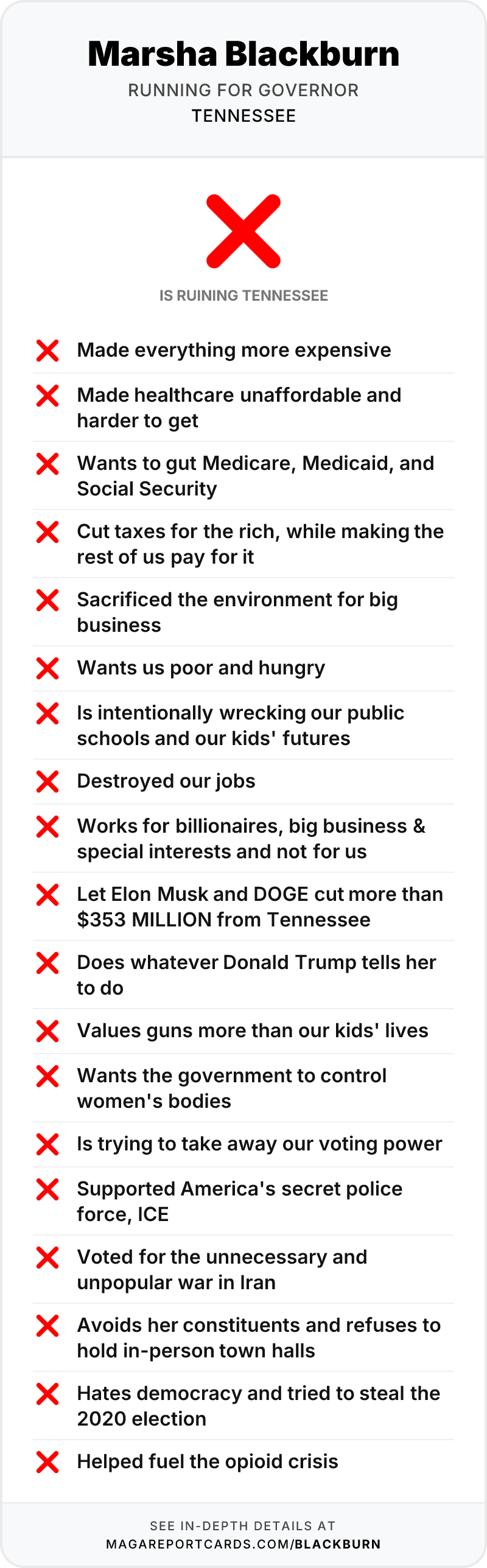
Marsha Blackburn co-sponsored a law, written by a drug industry lobbyist, that took away the DEA's power to immediately freeze suspicious narcotics shipments in the middle of an opioid epidemic. She took $120,000 from that industry. When the DEA's own whistleblower objected, she asked for an investigation into him.
Tennesseans buried people during those years. They're allowed to ask her about it, and so are the people running ads. We deserve better.
Source
This post is based on reporting by the Tennessee Lookout: Blackburn goes after dark-money group calling her 'queen pharma mama' by Sam Stockard, with additional reporting from WPLN and CBS News/60 Minutes.