There are bills where you can argue about the details. And then there are bills where the whole thing fits in one sentence: nobody should have to pay more than $35 a month for insulin.
On March 31, 2022, that bill came to the floor of the U.S. House. It was called the Affordable Insulin Now Act. It passed — but almost entirely on Democratic votes. Of the 205 Republicans who voted, only 12 voted yes.
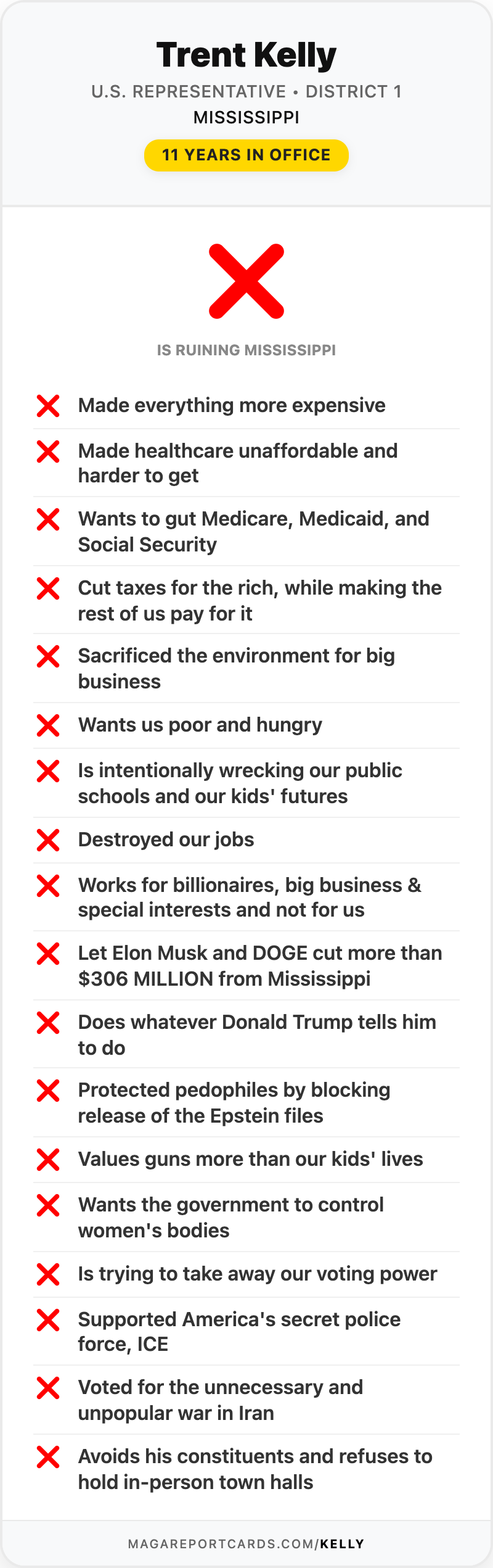
Trent Kelly voted no.
He represents Mississippi's 1st District. Mississippi has one of the worst diabetes problems in the country. And he voted against a $35 cap on the drug that keeps people with diabetes alive.
What the vote actually was
The bill was simple. It capped what a patient pays out of pocket for a month's supply of insulin at $35, for people on Medicare and for people with private health insurance.
That's the heart of it. It didn't nationalize anything. It didn't set the price drug companies charge. It capped what you hand over at the pharmacy counter.
The roll call is public, and you don't have to take anyone's word for it. On the Clerk of the House's site the tally reads 220 Democrats and 12 Republicans in favor, 193 Republicans against. Kelly is in the "Nay" column.
Why this one lands harder in Mississippi
The American Diabetes Association publishes a fact sheet for every state. Here is Mississippi's, as of June 2026:
- About 348,000 Mississippi adults — 13.2% of the adult population — have diagnosed diabetes.
- About 20,000 more Mississippi adults are diagnosed every single year.
- Diagnosed diabetes costs Mississippi an estimated $5.1 billion a year — $3.4 billion in direct medical costs and $1.7 billion in lost productivity.
America's Health Rankings, which tracks adult diabetes using the CDC's national health survey, ranks Mississippi 45th on the share of adults who have been told they have it — 15.2%. Only four states rank worse: Arkansas, Louisiana, Kentucky and West Virginia. Tennessee has no data at all.
Now stack that against the other thing Mississippi is known for. Writing ahead of the 2022 primary, the Commercial Dispatch pointed out that Mississippi has the highest poverty rate in the nation and that one in five Mississippians had no health insurance at all. When insulin is expensive here, people don't grumble about it. They ration it.
That is not a figure of speech. The ADA's own fact sheet lists what diabetes does when it isn't controlled: heart disease, stroke, amputation, end-stage kidney disease, blindness — and death.
And the price didn't climb because more people needed the drug. The Dispatch, writing the day after the vote, cited a Health Care Cost Institute study showing that per-person insulin spending had doubled over five years while average daily insulin use rose just 3%. People weren't using more. They were being charged more.
The paper in his district called it "unconscionable"
The Commercial Dispatch in Columbus — which covers a chunk of Kelly's district — did not let this vote slide. Columnist Slim Smith wrote it up twice.
The first time, right after the vote:
"House Resolution 6833, which would cap the price on insulin at $35 for a month's supply, narrowly passed a House vote Thursday, thanks not at all to our Republican representatives — Trent Kelly, Michael Guest and Steven Palazzo, each of whom voted against the bill and against the compelling interests of Mississippians."
And he predicted exactly how the congressman would handle it afterward:
"It's unlikely that Kelly, Guest or Palazzo will mention this vote in their weekly newsletters. For obvious reasons, they would prefer Mississippians not to know about it."
Months later, ahead of the primary, Smith came back to it and used a blunter word:
"It is unconscionable for Kelly and Guest to have voted against this measure."
This is not a national group parachuting into Mississippi to score political points. This is the paper in Columbus, writing about the congressman who represents Columbus.
Mississippi's own Republican senator disagreed with him
Here's the part that makes "I had to vote no on principle" hard to sell.
The insulin bill went nowhere in the Senate. Democrats then tried to put the $35 insulin cap into a larger bill later that year. The Senate parliamentarian ruled that the cap could stay for people on Medicare but not for people with private insurance, and Democrats moved to overrule her. That motion needed 60 votes. It got 57, on August 7, 2022, so the private-insurance cap came out.
Seven Republicans voted to keep it. One of them was Mississippi's own Republican senator, Cindy Hyde-Smith.
So the argument that a Republican simply could not support a $35 insulin cap doesn't survive contact with Mississippi's own delegation. A Republican senator from this state looked at the same policy and voted yes. Kelly, representing a district in one of the four states with the lowest median household income in the country, voted no.
Who he was listening to
Kelly's money picture is not the profile of a man who has to worry much about what people in Tupelo think of a copay. 95% of what he raises comes from PACs and large donors; about 3% comes from small grassroots donors.
Smith made the same point at the time, and he wasn't subtle about it:
"You can rest assured that the votes by Kelly, Guest and Palazzo have not escaped the attention of the insurance lobby."
The bigger pattern
The insulin vote isn't a one-off. It fits a record.
On July 3, 2025, Kelly voted for Trump's budget bill, the law that cut Medicaid — the program about 714,600 Mississippians, roughly 24% of the state, were on in 2024. Analysts estimate the law will cost about 115,000 Mississippi residents their health coverage. His colleague Michael Guest spent an August recess promoting a $206 million rural hospital fund after voting for that same law. We've laid out what the whole delegation's record adds up to in what Mississippi's Republicans in Congress are costing you.
The insulin vote is just the cleanest example, because there's nothing to hide behind. No thousand-page bill. No complicated formula. One number, one drug, one vote.
The question for north Mississippi
If you have diabetes in the 1st District — or your mother does, or your kid does — you already know what a vial costs.
Your congressman had a chance to cap it at $35 a month. Twelve Republicans in the House took it.
Trent Kelly wasn't one of them.
Source
Slim Smith, "Slimantics: Kelly, Guest and Palazzo vote against Mississippians on insulin bill," The Commercial Dispatch.