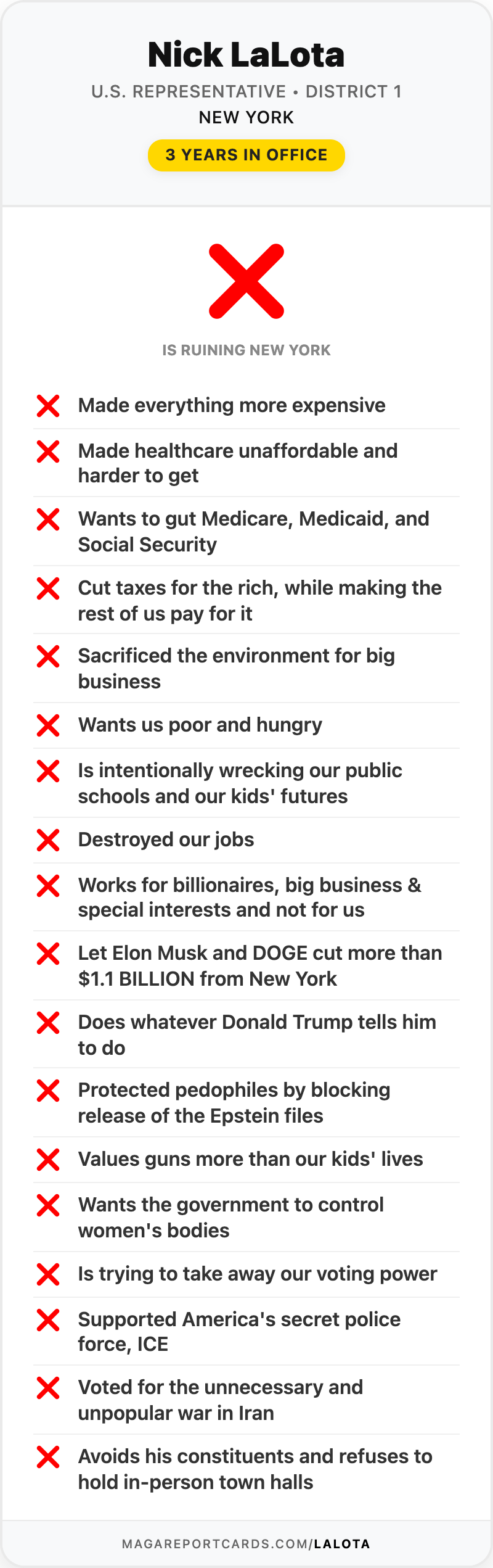
On June 12, 2025, Speaker Mike Johnson was about to lose.
The House was voting on H.R. 4 — the White House's request to cancel $9.4 billion Congress had already approved and appropriated. Most of it, $8.3 billion, was foreign aid: global public health, disaster relief, hunger programs. The rest, $1.1 billion, was two years of funding for the Corporation for Public Broadcasting, the body that sends federal money to local public radio and TV stations.
It was the first time Congress had ever formally voted on Elon Musk's DOGE cuts. And it was failing.
Nick LaLota had voted no.
Then, as CNN reported from the floor:
"Then he pulled aside Rep. Nick LaLota, a New York centrist, who had just voted no. With the vote still open, several minutes of tense conversation followed before LaLota ultimately went to change his vote. Within seconds, the package of spending cuts narrowly passed."
The final tally was 214 to 212. LaLota is recorded as a Yea.
Two votes. His was one of them.
What he says he got
Reporters asked him what changed in those minutes. He wouldn't say.
"I had some conversations with the speaker that raised my level of confidence that will put this and future issues in the right trajectory," LaLota told CNN — while declining to offer specifics of the conversations, or any promises on SALT.
SALT is the state and local tax deduction — the cap on how much of your property and state income taxes you can write off on your federal return. It is the signature issue of Long Island's Republicans, and it had nothing whatsoever to do with foreign aid or public radio.
So the trade, as far as anyone was allowed to know, was this: LaLota supplied the deciding vote to cancel money for global AIDS programs and public broadcasting, and in exchange he received a raised level of confidence about an unrelated tax negotiation.
He was not the only New Yorker in the huddle. Rep. Mike Lawler, another suburban New York Republican working the same tax issue, was in the conversation with Johnson and also agreed to vote yes. Two Republicans in all had pressed no and then switched: LaLota, and Nebraska's Don Bacon.
Texas Rep. Chip Roy posted the obvious question to X right after the vote: "Real question on the $9B rescissions package that narrowly passed – is how expensive were the 2 original no votes who flipped to yes…?"
We still don't know. LaLota has never said.
Four Republicans held. One of them was from New York.
The vote wasn't unanimous on the Republican side, and this is the part that makes the "I had no choice" defense impossible.
Four Republicans voted no and stayed no: Brian Fitzpatrick of Pennsylvania, Nicole Malliotakis of New York, Mike Turner of Ohio, and Mark Amodei of Nevada. Malliotakis is a New York Republican in a swing seat, facing the same Speaker, on the same night, with the same leverage available to her.
She held. He didn't.
And LaLota's first instinct was hers. He had already pressed the button for no. He knew what was in the bill. What changed wasn't the bill.
Then he did it again
Five weeks later the Senate sent back its version, and the House had to act one more time.
On July 18, 2025, LaLota voted Aye on H.Res. 590, the rule that carried the Senate's amended package to final passage. That one went 216 to 213.
The Senate had put the global AIDS money back on its way through — the $400 million PEPFAR line came out, and the enacted law bars any of the remaining global health rescission from touching "HIV/AIDS, Tuberculosis, Malaria, Nutrition, or Maternal and Child Health" — which is what brought the package down from $9.4 billion to $9 billion. It did not put back a dollar of public broadcasting: the CPB clause is word for word what the House sent over.
Trump signed it on July 24, 2025. Every dollar for the Corporation for Public Broadcasting through fiscal 2027 was gone.
What that did to Long Island
On August 1, 2025, CPB announced it was winding down. Most of its staff were terminated at the close of the fiscal year on September 30. Its president, Patricia Harrison, noted it was the first time in nearly 60 years that Congress had refused to fund it, and described what the money had bought:
"Public media has been one of the most trusted institutions in American life, providing educational opportunity, emergency alerts, civil discourse, and cultural connection to every corner of the country."
Note emergency alerts. CPB was the conduit for the federal grants that keep local stations' warning equipment running — which matters on a barrier-island district that takes hurricanes.
Here is who that hit in NY-01.
WLIW-FM, 88.3 out of Southampton, is Long Island's only NPR station — it's the East End's, and it produces The Long Island Daily along with local coverage of towns like Riverhead. It sits inside LaLota's district.
WSHU, whose signal reaches eastern Long Island through repeaters, told its listeners that "this year, WSHU received over $350,000 in federal funding" — money it says is "roughly equivalent to 2.5 pledge drives," and which paid for NPR programs, music royalties, satellite interconnection, and emergency alert systems. The station called the rescission "the strongest threat to public media that we have ever seen. It is quite literally unprecedented."
That is what LaLota's switched vote bought, on the way to a tax conversation he wouldn't describe.
The design of the cut is upside down
The argument for defunding CPB is always about NPR's newsroom in Washington. That's not where the money mostly goes.
As NPR reported when CPB folded, the network relies on direct federal funds for "only a small portion of its budget." Its approximately 1,000 member stations "receive a heftier portion of their operating revenue through CPB" — and the ones in rural and poor areas lean on those grants hardest.
So the cut barely dents the thing the complaint is about, and it lands squarely on the local station. In Michigan, John Moolenaar called defunding public radio "a win for the American people" and took $1.6 million from WCMU, the station in his own district serving 42 Michigan counties. In Oklahoma, Tom Cole accepted an award for protecting public broadcasting in 2016 and then cosponsored the bill that shut its funder down — including his own tribe's radio station. In Florida, Kat Cammack wrote the Defund NPR Act and then voted for the package that cost the station housing Florida's statewide storm-alert network about 20% of its funding.
LaLota's version is different in one way, and it isn't a flattering one. Cammack, Cole and Moolenaar believed in the cut. LaLota didn't — he voted against it. He then reversed himself in the middle of the vote for something he wouldn't name.
The pattern on Long Island
There's a version of this argument that says: fine, that's how the sausage gets made, and he was fighting for Long Island taxpayers on SALT.
Except look at what the fight has actually produced. LaLota's neighbor Andrew Garbarino spent months as one of five Republicans holding Trump's budget bill hostage over the SALT deduction — and then slept through the vote when it came at 6:54 in the morning. The tax break is the thing Long Island's Republicans talk about constantly. It's also the thing they keep trading other people's programs away for, and then not showing up for.
And LaLota's own accounting of the June 12 trade never got any more specific than "a raised level of confidence."
He voted no because he thought the cuts were wrong. Then he made them law. When his constituents asked what he got, the answer was that he'd rather not say.
Long Island still doesn't know the price. It knows the bill: the public radio station in Southampton, and the emergency alerts, and $9 billion Congress had already promised.
We deserve better.
Source
House GOP narrowly approves $9.4 billion package of DOGE cuts — Sarah Ferris, CNN, June 12, 2025, with contributions from Brian Stelter and Liam Reilly. Roll calls: House Roll Call 168 (June 12, 2025) and House Roll Call 203 (July 18, 2025). Photo: CNN.