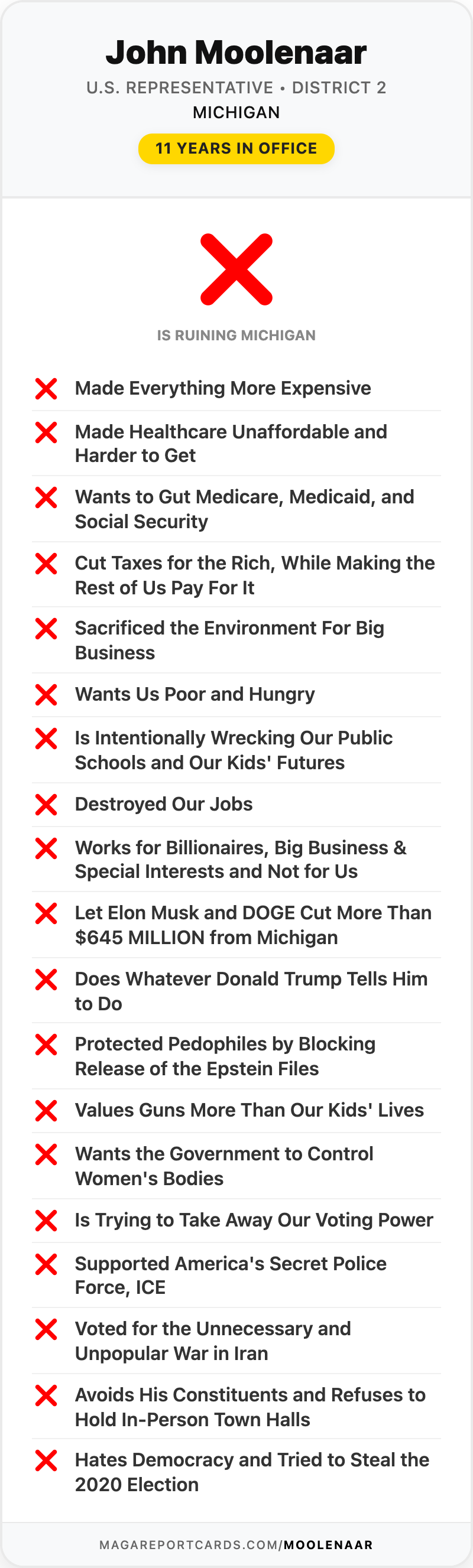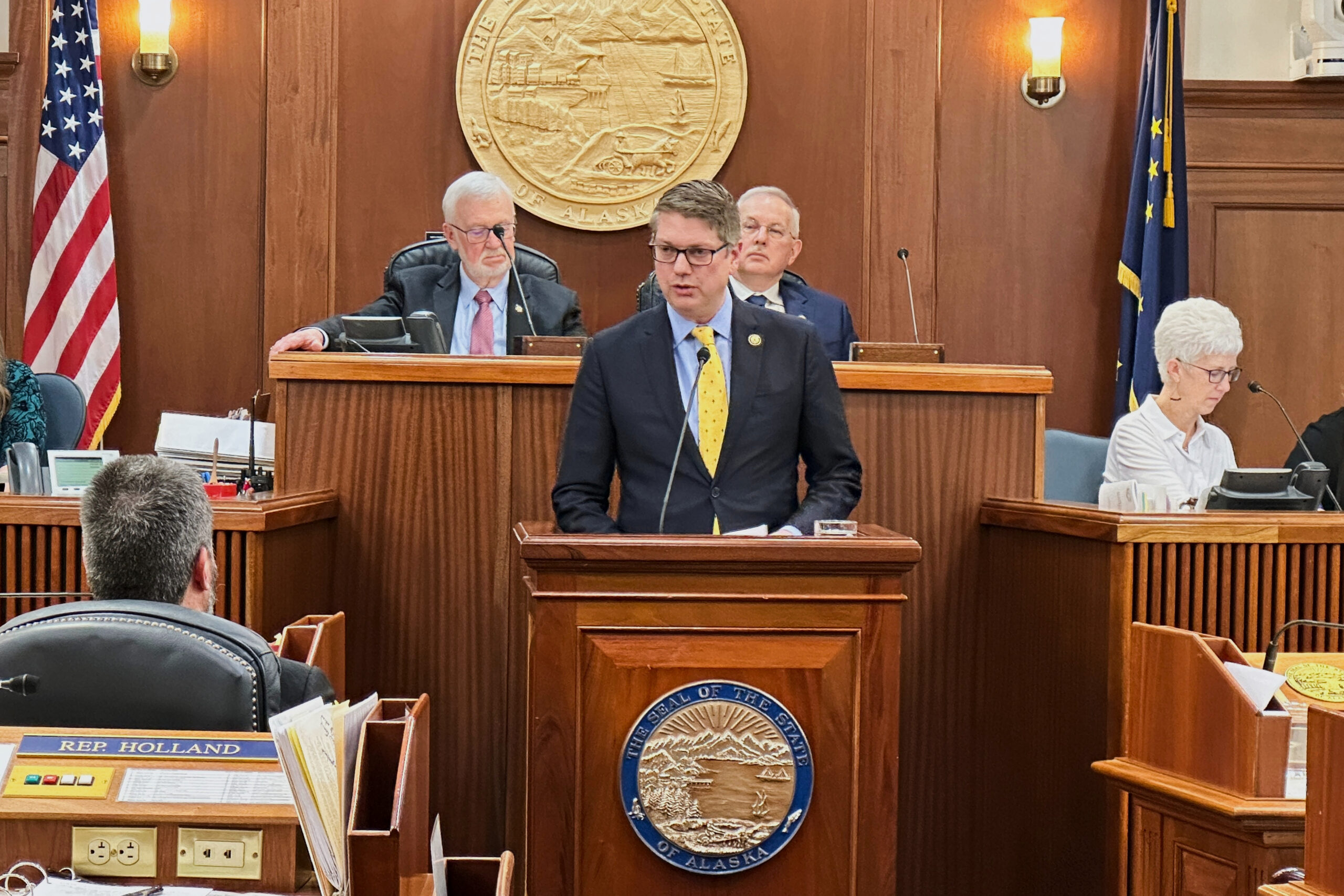
On June 12, 2025, John Moolenaar put out a press release with a headline that told you exactly how he wanted the vote remembered: "Moolenaar Votes to Cut Wasteful Spending."
The bill was the Rescissions Act of 2025. It did something Congress had not done since 1992 — it took back money the government had already promised to spend. Lawmakers had voted for that money. The president had signed off on it. Communities had built budgets around it. And then Congress reached back in and took it away.
Here is what Moolenaar said about it in his own press release:
"Today's legislation is a win for the American people because it addresses the broken status quo in Washington and cuts billions of dollars in wasteful spending. Michigan residents work hard, and they expect their tax dollars to be used responsibly, not spent on international projects which have no impact on their lives, or clearly biased news coverage of the Corporation for Public Broadcasting."
"Clearly biased news coverage." That's the whole argument. That's what he told Michigan residents their money was being wasted on.
Now let's look at what the money actually was.
$1.1 billion, and 1,000 local stations
The Corporation for Public Broadcasting is not a newsroom. It's a pass-through. It takes federal money and sends most of it out to local television and radio stations — the ones with a transmitter in your county and a handful of employees in your town.
The bill cancelled $1.1 billion meant to fund CPB for the next two years, on top of $7.9 billion cut from other programs, most of it foreign aid. NPR itself gets only a small slice of its budget directly from the federal government. Its roughly 1,000 member stations get a much bigger slice.
Even some Republicans said out loud that the math didn't work. Nevada Rep. Mark Amodei, talking to reporters the day of the final vote:
"If you're mad at the editorial people, that's fine. But you shouldn't be mad at the stations. And, oh, by the way, you ought to look at where those stations are, because it's a lot of Trump country, and they're not the problem. And so cutting them off of funds doesn't seem very well thought out."
Moolenaar wasn't persuaded. He voted yes on the first House passage on June 12, which squeaked through 214–212. Five weeks later he voted yes again on the final vote that sent it to the president, 216–213. Trump signed it on July 24, 2025.
On January 5, 2026, CPB's board voted to dissolve the organization entirely, 58 years after Congress created it. Board chair Ruby Calvert named the cause: "Congress eliminated all funding for CPB, leaving the Board with no way to continue the organization or support the public media system that depends on it."
The station he defunded is in his district
Here is the part Moolenaar's press release didn't mention.
WCMU Public Media is licensed to Central Michigan University in Mount Pleasant. Mount Pleasant is in Isabella County. Isabella County is in Michigan's 2nd Congressional District — Moolenaar's district. He has a district office up the road in Clare.
WCMU covers 42 Michigan counties and more than 2 million people, most of them across the rural middle and north of the state, where there is no local TV bureau and often no daily paper left.
General Manager Rick Westover put the damage in plain numbers:
"For WCMU, this is roughly $1.6 million for each of those two years. For WCMU, this is a cut of about 19% of our annual budget."
Nineteen percent. Gone in a single vote, from a station that had built its budget assuming the money Congress had already approved would actually arrive.
Westover watched it happen live:
"It was certainly disheartening. I was up in the middle of the night to watch that vote by vote by vote, and just hoping that the work that had been done through an advocacy group was enough to see us through."
At the end of December, on WCMU's own program, he said the same thing more bluntly: the loss was "roughly 19 to 20% of our operating budget, we rely on our donors more than we ever have before."
When Westover spoke to Epicenter in October, the station had no plans for staff cuts or layoffs. That is not because the cut was painless. It's because listeners in Moolenaar's district dug into their own pockets to cover what their congressman took away — donations up 77.7% year over year, revenue per donor up 48.8%.
That's the real trade. Moolenaar called it a win for taxpayers. What it actually did was move a bill from the federal government onto the people who listen to the station, in the counties he represents.
"Clearly biased news coverage"
The people who lose here aren't NPR executives in Washington. NPR CEO Katherine Maher, right after the final vote:
"Public funding has enabled the flourishing of a uniquely American system of unparalleled cultural, informational, and educational programming, and ensured access to vital emergency alerting and reporting in times of crisis — all for about $1.60 per American, every year. Parents and children, senior citizens and students, tribal and rural communities — all will bear the harm of this vote."
Emergency alerting matters a lot in the 42 counties WCMU covers. When the power and the cell towers go down in rural Michigan, the thing still working is a radio transmitter. North Carolina Rep. Alma Adams made exactly that point on the floor, describing Hurricane Helene: "Widespread power, cellular and internet outages meant that for thousands of North Carolinians, public radio was how they received their news."
And here's the small, telling detail. Westover's description of what the station does:
"We're impacting people's lives every single day with new information. We're teaching their kids … We're providing lifelong learning to folks that you know might not have another outlet."
That is the "clearly biased news coverage" Moolenaar said Michigan's tax dollars shouldn't pay for.
It's worth remembering that WCMU is also the newsroom that covers him. When roughly 200 constituents packed an "empty chair" town hall at the Isabella County Commission on Aging in March 2025 after Moolenaar declined to show up, WCMU reporters were there to write it down. His communications director's explanation, given to that same station:
"Congressman Moolenaar will not be participating in any event sponsored by a radical (George) Soros-funded group with the sole purpose being for him to be heckled, screamed at or threatened."
A congressman who won't take questions in person, defunding the local newsroom that shows up when he doesn't.
This is what "cutting waste" looked like
Moolenaar was not alone, and the pattern is familiar. Ohio's Troy Balderson told a room of business leaders that "Not the president, not Elon Musk. Congress decides." — and then voted for this same package four months later. The rescissions bill cancelled spending Congress had already voted for, at the president's request, and House Republicans lined up to do it.
They were told to call it DOGE savings. DOGE itself was quietly shut down without ever producing the promised accounting. What's left of it in mid-Michigan is a public radio station running 19% short, kept alive by its own listeners.
Moolenaar got his headline. WCMU got the bill.
Source
WCMU Public Media faces funding cuts but finds strength in donors — Sarah R. Adams-Slominski, Epicenter Mt Pleasant, October 9, 2025. Photo courtesy WCMU Public Media, via Epicenter Mt Pleasant.