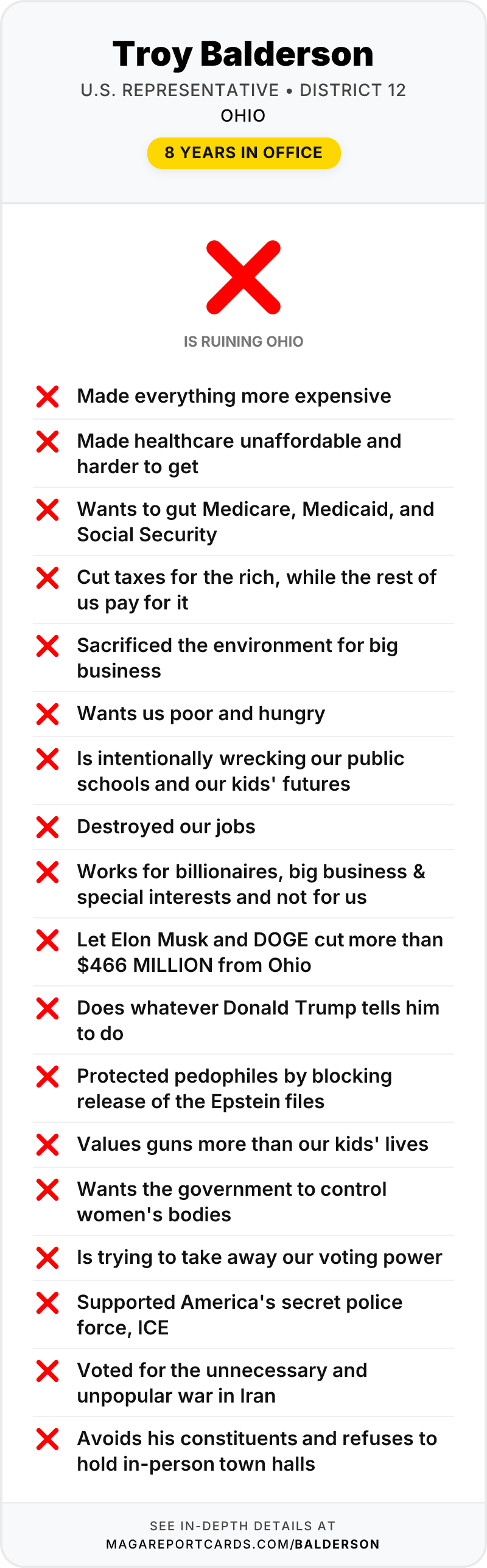
In February 2025, Troy Balderson stood in front of a room of business leaders from Westerville, Ohio, and said something almost no House Republican was saying out loud.
Trump's executive orders, he said, were "getting out of control." He pushed back on the idea that the decisions belonged to Trump and Elon Musk alone. And then this, as the Columbus Dispatch reported it:
"Congress has to decide whether or not the Department of Education goes away. Not the president, not Elon Musk. Congress decides."
It was the right answer. It is, in fact, the answer written into Article I of the Constitution.
It lasted about a day.
The walk-back
By February 21, The Hill was reporting that Balderson's office said his remarks had been "mischaracterized."
His spokesperson's clarification:
"Without congressional action, there is no certainty from one administration to the next. Congressman Balderson supports President Trump's efforts, but Congress must do its job to make his executive actions permanent."
Read that again, because it inverts the thing he'd said.
The Dispatch quote was about authority — that only Congress may decide whether a federal department exists. The clarification is about durability — that Congress should ratify what the president already did so it can't be undone later.
Balderson posted the same line on X himself: "It's up to us on Capitol Hill to make permanent his executive actions, ensuring continuity in public policy from one administration to the next."
So the position went from "Congress decides" to "Congress signs off." Twenty-four hours, no vote required.
Then came the actual test
Talk is easy to walk back. Roll calls aren't.
Four months later, the House took up H.R. 4, the Rescissions Act of 2025 — a bill that cancelled $9.4 billion Congress had already voted to spend on foreign aid and public broadcasting, at the president's request. It is the purest possible version of the question Balderson had raised in Westerville: when Congress appropriates money and the president decides not to spend it, who decides?
On June 12, 2025, Balderson voted Yea. It passed by two votes.
When the Senate sent back a narrower version, he voted Aye again — just after midnight on July 18, on the rule that finished it.
The man who said "Congress decides" voted twice to cancel, at the president's request, money Congress had already decided to spend.
And on the Education Department specifically
The department he named in Westerville is the cleanest test of all, because Congress did eventually put its position in writing — and then didn't act on it.
We've documented that story: Congress wrote down that dismantling the Education Department without a law was illegal, passed the funding bill anyway, asked for briefings it never received, and started drafting new laws to make the dismantling legal after the fact.
Balderson has never introduced a bill to stop it. To his credit, he is not among the 37 Republicans who cosponsored the one-sentence bill to abolish the department outright. But not signing that bill is a low bar for someone who told a room full of constituents that this was Congress's call and nobody else's.
He said Congress decides. Congress didn't decide. He voted with the people who took the decision away.
Why an Ohioan should care about a process fight
This can sound like inside baseball. It isn't.
When the president can cancel spending Congress approved, the money your representative "secured" for your district stops being a commitment and becomes a suggestion. Balderson sits on the House Energy and Commerce Committee and is vice chairman of its Oversight and Investigations Subcommittee — a job whose entire purpose is checking the executive branch.
He has a 0% score from the League of Conservation Voters for 2025 and a 6% lifetime score, and he ranks #297 out of 440 House members in grassroots funding, with $40,000 from American Electric Power's PAC and $39,000 from Marathon Petroleum's — companies whose industry his own committee regulates.
Ohio ranks 35th of 50 on the measures we track, and its Republicans in Congress voted to make Medicaid, food aid and jobs worse. Balderson was one of them.
He isn't taking the question
Constituents have been trying to ask him about this in person. In Knox County, organizers invited him to a town hall on August 23, 2025; he declined, and they scheduled it without him, inviting the audience to submit the questions they would have asked. The Columbus Dispatch put a Knox County reader's letter under a more direct headline: "Rep. Troy Balderson is ducking and dodging us. We're hold town hall anyway." In Athens County, residents who showed up got a meeting with his staff, not him.
The one time he did say the quiet part in a room in Ohio, his office spent the next day explaining he hadn't meant it.
We deserve better.
Source
Ailia Zehra, "Troy Balderson: Congress must 'do its job' to make Trump executive actions permanent," The Hill, February 21, 2025, reporting on and following up the Columbus Dispatch's account of his Westerville remarks. Roll calls from the Office of the Clerk of the U.S. House. Photo: official congressional portrait via Wikimedia Commons.