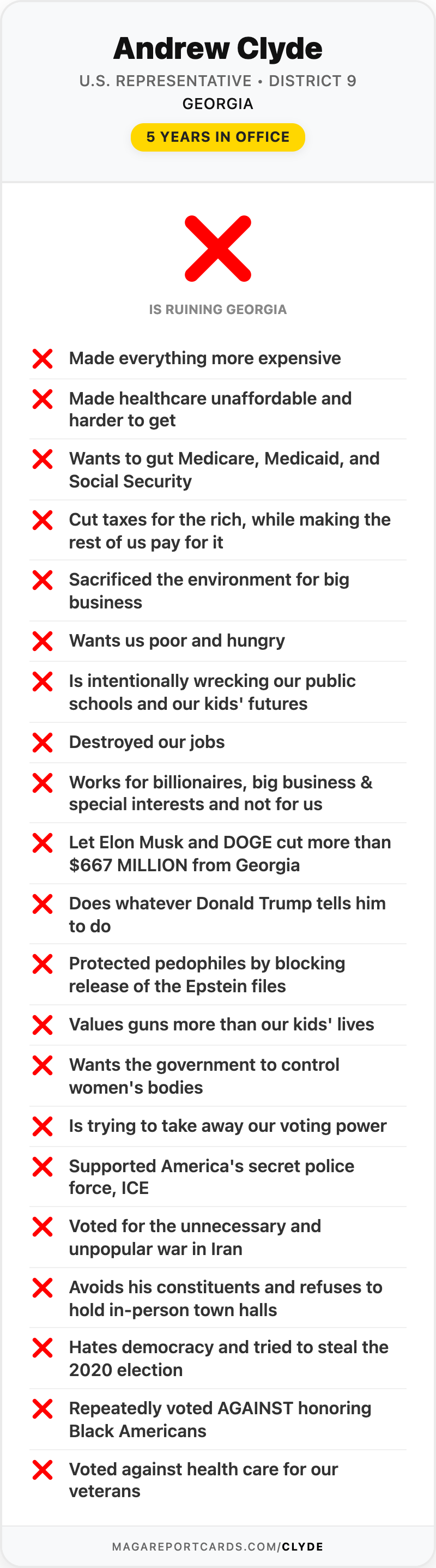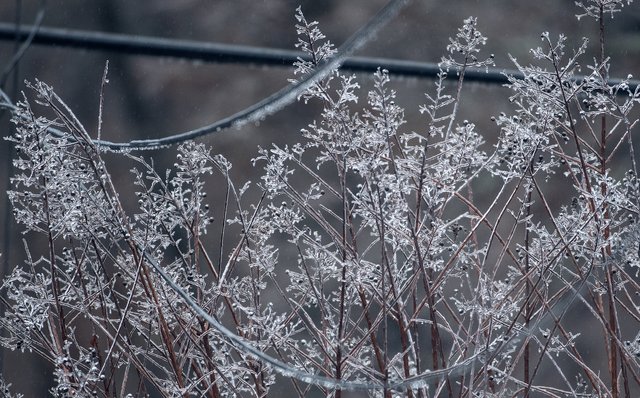
On March 19, 2026, Andrew Clyde sent a letter to the acting head of FEMA about Winter Storm Fern, which had hammered Northeast Georgia in late January. It's a good letter. He'd walked the damage himself in White, Habersham and Rabun counties, and he laid out the numbers in detail.
"The damage caused by Winter Storm Fern is simply beyond the capacity of these counties' budgets to address alone. This burden is compounded by the economic vulnerability of these communities, as the majority of the affected counties are rural and have poverty rates above the national average… They have made clear to me that without additional federal assistance, a full and timely recovery will not be possible."
Habersham County came in at $7,223,461 in eligible damage — nearly 32 times the level FEMA treats as the outer limit of what a county can absorb on its own. White County was 35 times over. Rabun County, more than 20 times.
He closed by promising: "I will use every tool available to me as a Member of Congress to advocate in a fiscally responsible way for the resources Northeast Georgians need and deserve."
Here is one of the tools he's already used.
H.R. 1180
On February 11, 2025, Clyde introduced H.R. 1180. The whole bill is contained in its title: "To repeal the Impoundment Control Act of 1974."
The Impoundment Control Act is the law that says when Congress appropriates money, the president has to spend it. If he wants to cancel some, he has to send Congress a formal request, and Congress has to agree. It's a 1974 Nixon-era law — the response to a president who decided on his own that money Congress had approved wasn't going out the door.
Clyde wants it gone. When he and Sen. Mike Lee first introduced the repeal in December 2024, Clyde called the 1974 law "unconstitutional" and said rolling it back is "one of the most effective ways Congress can help President Trump in the fight to deliver the spending cuts and government efficiency that the American people overwhelmingly voted for."
He was blunter to Fox News Digital when he reintroduced it: "I think it goes hand in hand with what DOGE is doing right now and with what the president has in mind to do, and that is to make our government more effective and more efficient."
That's not a technical claim about budget procedure. It says out loud what the bill is for: making it easier for one man to decide that money Congress appropriated doesn't get spent.
Which includes FEMA money
This isn't a hypothetical. The Government Accountability Office — Congress's own nonpartisan watchdog, not a partisan outfit — has been investigating whether the administration is withholding money it was ordered to spend. It has found violations of the Impoundment Control Act again and again: at Head Start, at NIH, at the Institute of Museum and Library Services, at the Department of Energy. GAO publishes every one of those decisions.
And twice at FEMA. In a decision issued September 29, 2025, GAO found that FEMA had illegally withheld money from three programs, including $117 million from the Emergency Food and Shelter Program and nearly the entire 2022–2024 appropriation for FEMA's Next Generation Warning System.
GAO's finding:
"Currently available evidence indicates that FEMA has violated the ICA by improperly withholding, delaying, or effectively precluding the obligation or expenditure of budget authority."
That's the law Clyde wants repealed. It is the only law that made those findings possible. Take it off the books and FEMA withholding disaster money isn't a violation anymore — it's just a decision, and nobody in Habersham County gets a vote in it.
He is on both committees this runs through
Clyde is not a bystander to appropriations. By his own biography, he "currently serves on the House Appropriations and Budget Committees." H.R. 1180 was referred to the Budget Committee — the one he sits on.
So the job description is: decide how federal money gets spent. And the bill he wrote would make that decision advisory.
If Congress can't compel the money to move, then an appropriations bill is a suggestion. Clyde's own FEMA letter is an argument for why federal dollars have to reach four rural Georgia counties that can't cover the cost themselves. His bill is an argument for why the president shouldn't have to send them.
Both of those are his.
The pattern
This isn't the first time Clyde has treated the machinery that protects his own constituents as the enemy.
When Sen. Raphael Warnock warned Georgia seniors that DOGE had flagged Social Security offices in the state for lease termination, Clyde took DOGE's own denial as the answer and went after Warnock — "Senator Warnock has peddled lies and fearmongered Georgia seniors long enough" — calling the criticism part of a campaign to "distort the Administration's work."
Meanwhile, in March 2025, more than 100 Northeast Georgia residents turned out on the Gainesville square outside his district office asking him to hold a town hall. Ten days later, about 50 came back, chanting "why do you hide Andrew Clyde" — and asking, specifically, what DOGE was doing to the Social Security office in Gainesville.
He is not alone in the trade-off he's making. Ohio's Troy Balderson told a room of business leaders in February 2025 that "Not the president, not Elon Musk. Congress decides." — and his office walked it back within a day. The difference is that Balderson at least said the right thing once. Clyde wrote the bill.
We deserve better
Everything in Clyde's FEMA letter is true. Rural counties really can't absorb a $7 million hit. Federal disaster money really is the difference between a full recovery and a partial one. He was right to write it, and Northeast Georgia should get the declaration.
But you can't spend a year arguing that the president should be free to ignore what Congress appropriates, and then send a letter asking that same president's agency, please, to spend what Congress appropriated.
Congress holds the purse. That's Article I, and it's the only real leverage a member from a rural district has when his counties need help. Andrew Clyde put his name on a bill to give it away.
Sources
- Rep. Clyde Urges FEMA to Recommend Major Disaster Declaration for Northeast Georgia After Winter Storm Fern — Office of Rep. Andrew Clyde, March 19, 2026.
- Rep. Andrew Clyde seeks disaster declaration in wake of Winter Storm Fern — The Gainesville Times, March 19, 2026. Photo: Scott Rogers / The Gainesville Times.