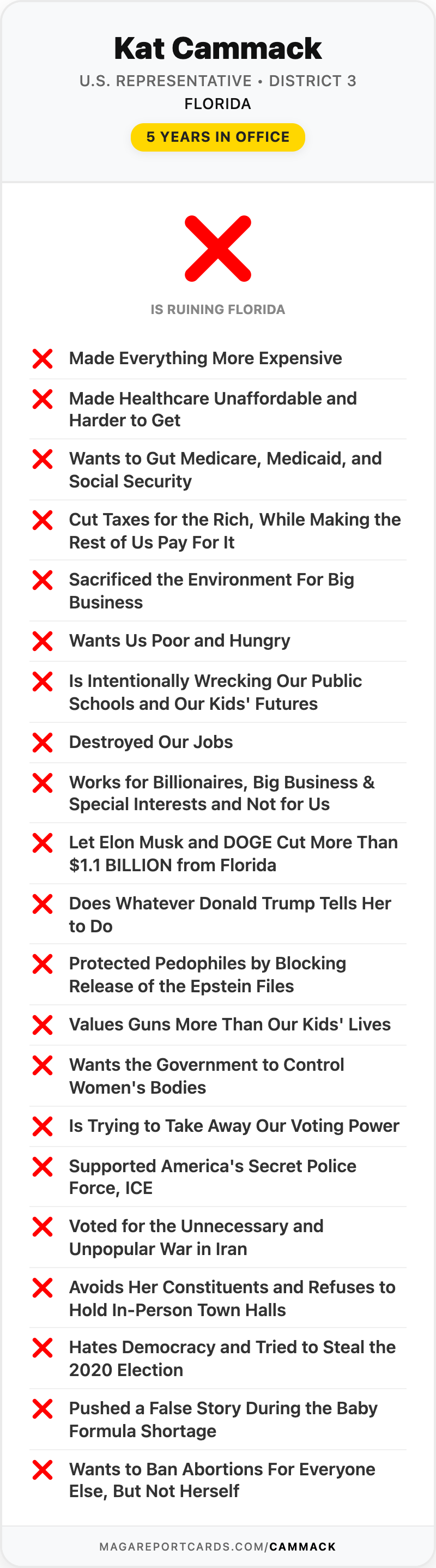
Florida's 3rd Congressional District covers Gainesville, Ocala and the rural counties around them. It is hurricane country — Kat Cammack's own congressional website keeps a standing hurricane preparedness section for constituents, with its own sub-page of agricultural resources.
It is also home to WUFT, the public radio and television operation at the University of Florida — and to the Florida Public Radio Emergency Network, the statewide storm-alert service housed there.
In February 2025, Cammack introduced a bill to defund public radio. Five months later she voted for the package that gutted the whole system. Here is the sequence.
February 2025: the Defund NPR Act
On February 26, 2025, Cammack and Sen. Jim Banks introduced the Defund NPR Act, H.R. 1595. It amends the Communications Act to ensure "no federal funds, direct or indirect, support NPR, including dues or programming purchases."
Note the phrase direct or indirect. That's the part that reaches local stations. The bill text bars federal money from supporting NPR "including through the payment of dues to or the purchase of programming from the organization by a public broadcast station using Federal funds received by the station" — so a station could no longer spend a dollar of its federal money on NPR dues or on Morning Edition.
Her case for it was about coverage she didn't like:
"For too long, NPR cherry-picked its coverage in favor of its majority Democrat listeners… Federal funds shouldn't be available to NPR."
Banks was blunter: "Taxpayers shouldn't be forced to fund NPR's liberal propaganda."
The bill did not mention storms.
June and July 2025: the votes that did the damage
Cammack's own bill didn't need to pass. A different vehicle did the work.
She voted Yea on H.R. 4, the Rescissions Act, on June 12, 2025, and Aye again on July 18 on the resolution that sent the Senate's version to final passage. That package clawed back roughly $9 billion Congress had already approved — including $1.1 billion for public broadcasting through fiscal 2027.
On August 1, 2025, the Corporation for Public Broadcasting announced it was shutting down. Most staff were terminated at the end of the fiscal year. CPB's president, Patricia Harrison, noted it was the first time in nearly 60 years that Congress had refused to fund it, and described what CPB had paid for:
"Public media has been one of the most trusted institutions in American life, providing educational opportunity, emergency alerts, civil discourse, and cultural connection to every corner of the country."
Emergency alerts. CPB was the conduit for the federal grants that keep local stations' warning equipment running.
What it cost her district
WUFT is licensed to the University of Florida, in Cammack's district. The Independent Florida Alligator reported in November 2025 what the cuts did to it:
- $1.2 million a year in federal CPB money, gone
- About $470,000 more lost when Gov. Ron DeSantis vetoed state public-broadcasting funding
- Together, roughly a 20% cut to operating funds
WUFT has held on so far by burning reserves through fiscal 2026, cutting part-time staff hours and station-funded travel, with no full-time positions eliminated yet. The Florida Public Radio Emergency Network, housed at WUFT, was spared the state veto.
So far, so good is not a plan. It is a station spending its savings while it looks for a long-term answer — and it is the station that houses the emergency network the rest of Florida's public radio system leans on when a storm comes ashore.
Who actually loses public radio
Cammack's argument is about NPR's newsroom in Washington. The money doesn't mostly go there.
As NPR reported when CPB folded, the network itself relies on direct federal funds for only a small share of its budget. Its roughly 1,000 member stations get a much heftier share of their operating revenue through CPB — and stations in rural and poor areas rely on those grants in particular.
So the design of the cut is upside down from the complaint. If you dislike national NPR's editorial choices, defunding CPB is the least efficient possible way to punish them: NPR barely notices, and the transmitter in a rural county goes dark.
That is also, as it happens, the group of people Cammack represents.
She is not the only one, but she wrote the bill
Plenty of Republicans voted for the rescissions package. Tom Cole accepted an award for saving public broadcasting in 2016 and then cosponsored the bill that shut its funder down — including his own tribe's radio station.
The difference with Cammack is authorship. She didn't just vote for someone else's cut. Five months earlier, she put her name on a bill whose entire purpose was to sever federal support from public radio, "direct or indirect."
Most Americans disagreed with her, including most of her own party's voters: a Harris Poll conducted for NPR in July 2025 found 66% of Americans support federal funding for public radio — 58% of Republicans and 77% of Democrats.
She does her town halls by telephone. In April 2025 more than 100 constituents held an in-person one without her and addressed an empty chair; her office called it a "political stunt." Three weeks later she told the same station that "recently in-person town halls are all about the theatrics" and that on a telephone town hall "we call 75,000 people at a single time."
Source
Corporation for Public Broadcasting says it's shutting down — Scott Neuman and Frank Langfitt, NPR, August 1, 2025, and WUFT lost millions in funding. Here's what the changes mean. — The Independent Florida Alligator, November 10, 2025. Photo: Getty Images via PBS NewsHour.