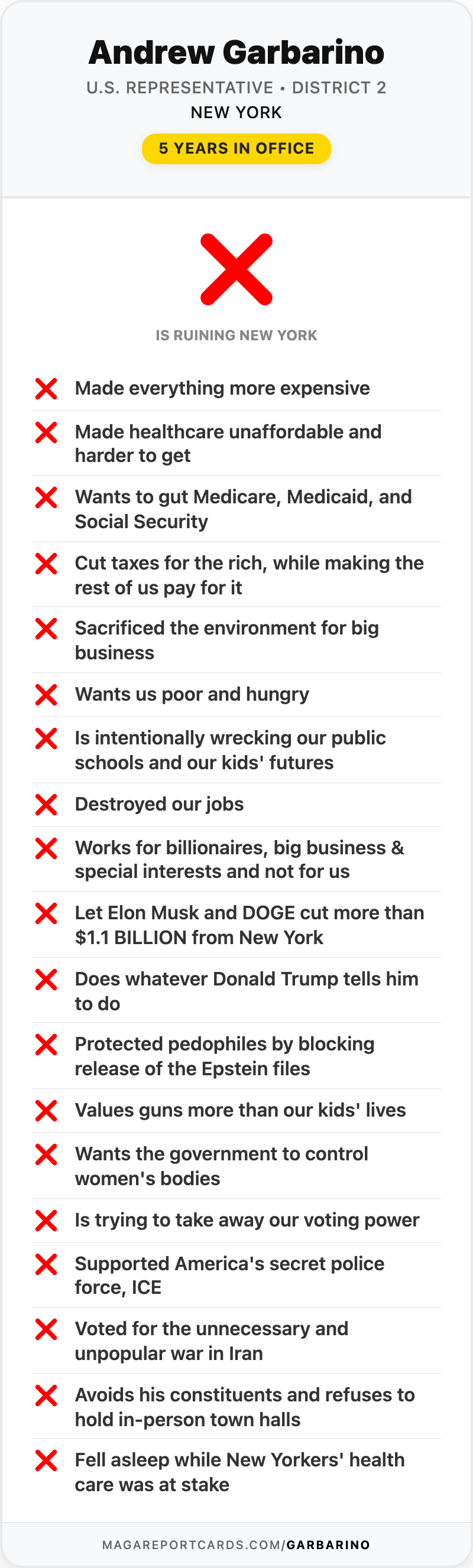
At 6:54 in the morning on May 22, 2025, after an all-night session, the House passed Trump's "One Big Beautiful Bill." The official roll call says it passed 215 to 214 — a one-vote margin.
Two Republicans didn't vote at all. Andrew Garbarino was one of them.
Speaker Mike Johnson told reporters why:
"Andrew Garbarino did not make it in time. He fell asleep in the back. No kidding, I know. I'm going to just strangle him, but then, he's my dear friend."
Johnson said it as a joke. It isn't one. The congressman for New York's 2nd District, on Long Island, was not on the floor for the biggest vote of his career because he was asleep.
He wasn't protesting. He wanted it to pass.
There's a version of this story where a member misses a vote because he's torn, or hiding, or trying to have it both ways. That's not what happened here.
Garbarino put out a statement the same day, and it's worth reading closely. He did not deny falling asleep. He didn't mention sleep at all. What he said was:
"I was moments away from the House floor, to vote 'yes,' when the vote was closed. While I am frustrated that the vote was closed before I was able to cast my vote, I am proud of the work we accomplished to deliver huge results for Long Island."
So: he was for it. He wanted it. He was frustrated that the House didn't wait for him.
He didn't just support the bill. He negotiated part of it.
This is the part that makes the nap more than a punchline.
Garbarino was one of five Republicans who spent months holding the entire bill hostage over one issue: the cap on how much state and local tax — SALT — people can deduct from their federal taxes. The Washington Examiner later reconstructed the negotiation from interviews with the people in the room. Garbarino, Nick LaLota, Mike Lawler, Young Kim, and Tom Kean had a group chat. Kim said it was called "saltiest."
LaLota described the five of them as the "ride-or-die group" that "weren't going to cave in until we got the $40,000 that we were bargaining for."
Garbarino was blunt about how far he'd go:
"Would we have voted against the bill if it didn't have SALT in it? I would. I know I would have. I mean, if it kept the cap at 10, I would have had to have — I would be packing my desk up already."
He got his number. The final deal raised the cap from $10,000 to $40,000. Garbarino was pleased: "I think we're very happy with what we got, rather than $30,000 forever, because the $40,000 really covers a lot of people, especially my district and other districts."
After the deal came together, he and a few others walked over to Joe's Seafood, a high-end spot near the White House. "It was mentally exhausting, so we went and had a nice cocktail afterwards — we earned it!" he told the Examiner. (The Examiner's account doesn't say which night that was.)
Threaten to quit over it. Win it. Celebrate it. Then sleep through the vote on it.
What he was fighting for, and who gets it
The SALT deal Garbarino called a big deal for his district comes with a catch he acknowledged himself: it's temporary. The $40,000 cap runs 2025 through 2029, and the Tax Foundation notes that starting in 2030 it "will revert to its prior law value of $10,000 for all filers" — permanently.
And the money doesn't reach most people. The Tax Foundation ran the numbers on this exact proposal — a $40,000 cap with a $500,000 income phase-out — two days before the vote. Their conclusion: "the top 20 percent of taxpayers would be the only group to meaningfully benefit," and "the bottom 80 percent of earners would see no benefit."
Garbarino himself pointed out, as an argument for the bigger number, that the standard deduction for a married couple is now "just over $32,000." That cuts both ways: a deduction only helps you if your itemized deductions beat that, which helps explain why the Tax Foundation found the benefit stops at the top fifth of earners.
Meanwhile, the health care cuts in the bill he was bargaining over will cost his own district. The Joint Economic Committee's House minority staff estimates that in New York's 2nd District, 30,657 people lose Medicaid coverage — and another 3,300 lose ACA marketplace coverage, a figure that also counts the expiring ACA premium tax credits, for 33,957 in all.
That was the trade: a five-year deduction that skips most of Long Island, in exchange for more than 30,000 of his neighbors losing Medicaid. He negotiated it personally. Other Republicans are still defending the same trade a year later, as clinics in their districts close.
What he told his constituents six weeks earlier
On April 7, 2025, Garbarino held a telephone town hall — 10,281 people dialed in. His office put out a release with the highlights.
On SALT, he promised: "if it's not something I can be proud of, I'm not going to vote for it."
He was proud of it. He didn't vote for it.
On Medicaid, he told the 10,000 people on that call:
"You may have seen commercials or social media posts claiming that I voted to cut Medicaid. That accusation is categorically false. There's been a lot of misinformation flying around, so let me be clear — there was no legislation voted on that would cut Medicare, Medicaid, or Social Security."
Read that carefully. On April 7, the bill hadn't come to the floor yet, so "no legislation voted on" was technically true — and useless to the person asking. Six weeks later the bill he'd been negotiating did exactly what the ads said it would.
The vote he did cast
None of this cost the bill anything. It passed by one. And on July 3, 2025, when the Senate's version came back to the House, Garbarino was awake and voted Aye.
So the record is not "he opposed it." The record is that Andrew Garbarino helped negotiate this bill, threatened to quit over one piece of it, won that piece, celebrated it, missed the vote, and then voted for it anyway six weeks later.
Not showing up is the pattern
Long Island has noticed. On April 5, 2025, an estimated 2,000 people protested outside his Patchogue office on Oak Street. A month later, nearly 2,000 constituents filled the Patchogue Theatre and an overflow venue nearby for an in-person town hall — held by a congressman from Maryland, because their own wouldn't hold one.
"I know I'm not your first choice — it would have been better to have your own representatives here," Rep. Jamie Raskin told the crowd, naming Garbarino and LaLota. The New York Post noted that Republicans had been "dodging local public town halls in favor of tightly controlled teleconferences or private events."
He isn't the only one. Tom Tiffany told a TV station he backed a big housing bill he hadn't voted for three separate times. Lauren Boebert spent a week pushing a military amendment and then missed the defense bill vote entirely. Showing up is the one part of the job that can't be delegated to a press release.
Garbarino wanted credit for the deal. He got the celebration, the interviews, and the "huge results for Long Island" statement. The one thing his constituents actually sent him to Washington to do — be in the room and press the button — is the thing he didn't do.
We deserve better.
Source
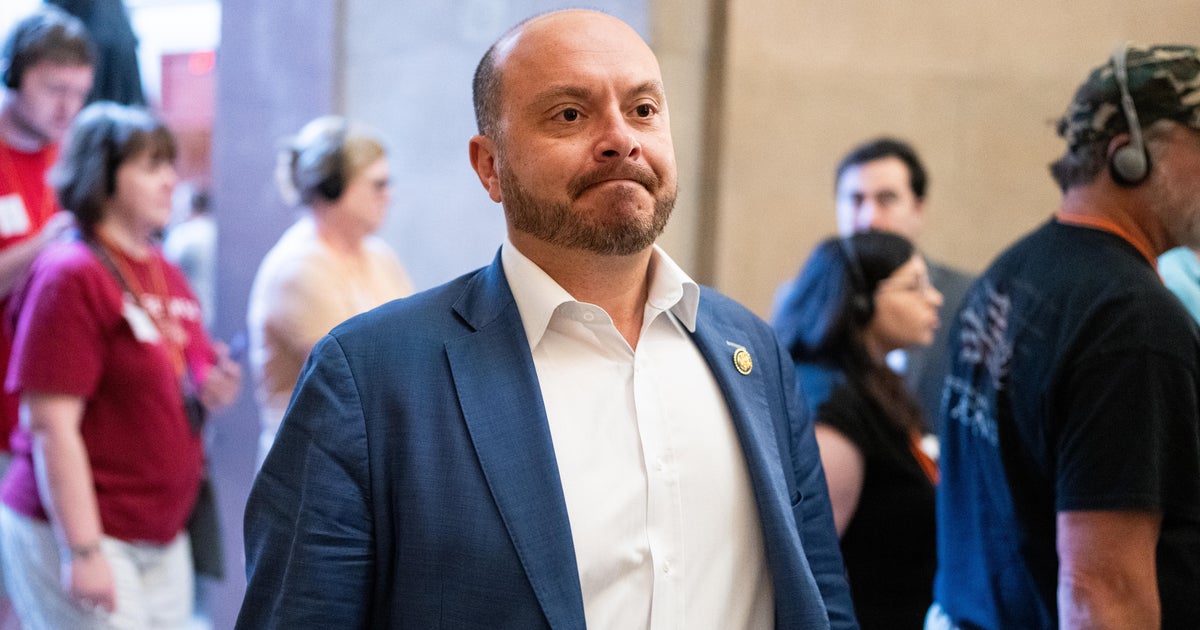
N.Y. Rep. Andrew Garbarino slept through "big, beautiful bill" vote that passed by just 1 vote, speaker says — Jesse Zanger, CBS New York, May 22, 2025. Photo: Getty Images, via CBS New York.