The National Defense Authorization Act is the bill that funds the American military. It comes up every year. It's about as must-pass as legislation gets, and this year's version carried $1.1 trillion.
Lauren Boebert had two jobs on it.
The first was the one she chose for herself: an amendment to write President Trump's transgender military ban into permanent law. She lost that one — and four Republicans helped beat her.
The second was just to show up and vote on the bill. She missed it. She was in a back room, waiting for a phone call.
The amendment failed, and Republicans killed it
On Tuesday, July 21, the House voted 212-217 to reject Boebert's amendment to the 2027 NDAA. The amendment would have codified Trump's January executive order barring transgender people from serving in the military — turning a presidential order into a law that a future president couldn't simply reverse.
Trump's order says that "expressing a false 'gender identity' divergent from an individual's sex cannot satisfy the rigorous standards necessary for military service." That's the language Boebert wanted to make permanent.
Every Democrat who voted, voted against it — two, including Florida's Frederica Wilson, did not vote. So did four Republicans: Brian Fitzpatrick of Pennsylvania, Mike Lawler of New York, James Moylan of Guam, and Kimberlyn King-Hinds of the Northern Mariana Islands.
That's the part worth pausing on. Republicans control the House. Boebert didn't lose this to Democratic obstruction — she lost it because members of her own party wouldn't go along.
There's context she left out, too. In June, the U.S. Court of Appeals for the D.C. Circuit ruled 2-1 that Defense Secretary Pete Hegseth's push to expel currently serving transgender troops was "motivated by animus against transgender people," violating their constitutional rights. The ruling covered troops already serving, not people seeking to enlist. Boebert's response to a court finding the expulsions unconstitutional was to try to make the ban law.
These are people who already volunteered. They already passed the physical standards. They're already doing the job. The "readiness" argument requires you to believe that troops who are currently serving are simultaneously unfit to serve.
Then she missed the vote on the whole bill
The next day, Wednesday, July 22, the House voted on the actual NDAA — the $1.1 trillion one.
Boebert wasn't there.
Her explanation, reported by AOL, is that she was waiting to hear from Hegseth about a different provision, Section 219, which would have the Defense Secretary designate an "executive agent" to synchronize U.S.–Israel cooperative efforts. Boebert opposed it, calling it "a big tech swap between us and Israel."
In her own words on X:
"Unfortunately, the vote was closed sooner than expected and before my conversations with DoW concluded."
And on camera to TMZ DC, describing what happened:
"It's a big issue on the left and the right, and many of my constituents have reached out. They don't want this provision in the bill. Well, White House doesn't want it in the bill, Secretary Hegseth doesn't want it in the bill. So I'm in the back, waiting for a call from the Secretary. I'm told that call is coming; I'm talking to someone underneath him, and I'm told the vote's going to stay open. They close the vote."
She says she wanted to vote for the NDAA. Seven Republicans, including Thomas Massie, voted against it. Boebert voted neither way. Only two other members missed it: Republican Andy Biggs of Arizona and Democrat Frederica Wilson of Florida.
No amendment to strip Section 219 — the thing she was in the back room about — ever got a recorded vote on the defense bill. (The 314-104 vote the Daily Caller News Foundation tied to it was a different Massie amendment, to cut Israel's funding out of a July 15 spending bill — and Boebert voted against that one.)
Boebert says she did eventually get a commitment from Hegseth that Section 219 would be stripped in conference, and that she'll get another vote on the bill when it comes back. Maybe so. But the annual defense authorization passed the House of Representatives, and the congresswoman from Colorado's 4th District is not recorded on it.
In the same TMZ interview where she explained missing the vote, she also had this to say:
"I don't want to be on camera this week and I've been on camera more than any other week. My Botox hasn't caught up on this side. Maybe in two days, this side will catch up to the other side."
That's the week. An amendment targeting transgender servicemembers that her own party helped kill, a missed vote on a trillion-dollar defense bill, and a Botox update.
This is the pattern
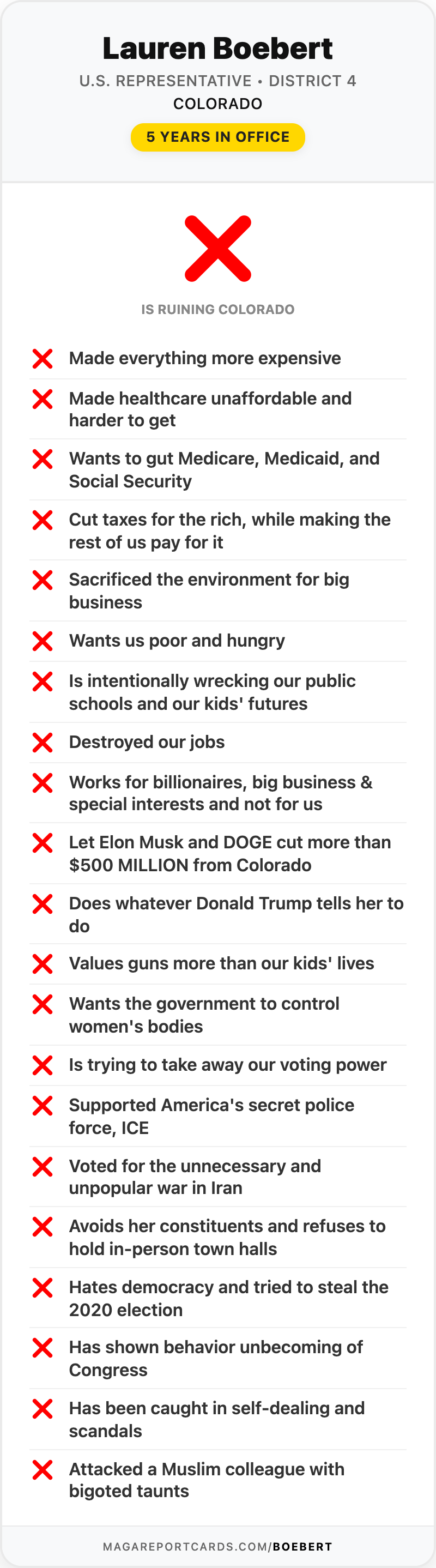
Boebert's time in Congress has a shape to it, and it's not legislating.
She has said she won't hold in-person town halls, telling reporters, "For me personally, it's just not safe to do an in-person town hall because I don't know what to expect." She does telephone town halls instead — like the March 2025 call where she defended Elon Musk and DOGE against constituents' questions about federal workforce cuts.
Her record of controversies is long and well documented — including being ejected from a Denver production of Beetlejuice in September 2023 for vaping and causing a disruption, then initially saying she'd been removed for singing too loudly, until an incident report cited complaints about vaping and being disruptive.
The through-line is that the performance is the point. Attacking transgender troops is a bill she can post about. Showing up for the defense authorization vote is not.
The bottom line
Transgender Americans serving in the military didn't ask for a culture war. They volunteered. A federal appeals court has already found that expelling them was driven by animus, not readiness.
Lauren Boebert's answer was an amendment to lock that policy into law. She lost — because four Republicans wouldn't vote for it.
Then, on the actual bill that pays for the entire United States military, she didn't vote at all.
Colorado's 4th District sent her to Washington to legislate. Last week she managed neither the culture war nor the day job.
Source
Faith Miller, Lauren Boebert Reveals Why She Missed Big NDAA Vote, AOL/Daily Caller News Foundation, July 23, 2026; Sudiksha Kochi, House rejects amendment banning transgender individuals from serving in military, The Hill, July 21, 2026; and Dems defeat Boebert's anti-trans amendment, LGBTQ Nation.