One year ago, on July 4, 2025, President Trump signed HR 1 — the bill he called the "One Big Beautiful Bill." Mariannette Miller-Meeks voted for it. Twice, actually: once when the House first passed it in May, and again on final passage in July.
This week, the DCCC marked the anniversary by tallying up what that vote has cost Iowa. The list is long: clinics closing, premiums jumping, and thousands of Iowans losing help buying groceries.
Here's what makes Miller-Meeks different from most of the Republicans who voted yes: she's a doctor. An ophthalmologist. She chairs the House Veterans' Affairs Subcommittee on Health. If anyone in Congress should have understood what cutting health care funding does to a rural state, it was her.
She voted for it anyway.
What the bill did
HR 1 paired massive tax cuts with the largest Medicaid cut in history. The Washington Post reported that at least 17 million Americans would lose health insurance under the plan. Its SNAP cut is, in the Center on Budget and Policy Priorities' words, the largest cut to SNAP in history.
In Iowa, Democrats on the congressional Joint Economic Committee estimate that more than 102,000 Iowans will lose coverage by 2034 across the state's four districts. In Miller-Meeks' own district — Iowa's 1st — that's about 25,500 people: 9,700 losing ACA marketplace coverage and 15,800 losing Medicaid.
The damage in her district
This isn't a forecast anymore. It's happening.
In March, MercyOne announced its Clinton Medical Center — in Miller-Meeks' district — would stop delivering babies. The last delivery was in May. The hospital blamed increasing costs, staffing shortages, and "reimbursements that do not cover the full cost of care." Medicaid pays for 40% of all births in the United States — and the National Rural Hospital Association has blamed rising costs and Medicaid cuts for closures like this across the country.
So in Clinton, Iowa, the local hospital no longer offers labor and delivery. Expecting mothers have to go somewhere else to have their babies.
Health insurance is getting more expensive too. The Iowa Insurance Division says carriers filed 2026 rate increases ranging from 12.6% to more than 25%, citing the changes to the enhanced subsidies that had kept coverage affordable, along with medical inflation and increased use of care. With the subsidies back at their original levels, premiums go up for people who get them, and people earning 400% of the poverty level or more lose them entirely.
And it's not just health care. Iowa's SNAP enrollment fell by nearly 25,000 — from 272,747 in June 2025 to 247,907 in May 2026, as some people lost eligibility under the new rules and others didn't enroll because of the law's new paperwork. Food pantries are swamped: one Iowa pantry reports a 36% jump in households served since the law was signed, with demand outpacing what it saw during COVID-19.
What she says when Iowans ask about it
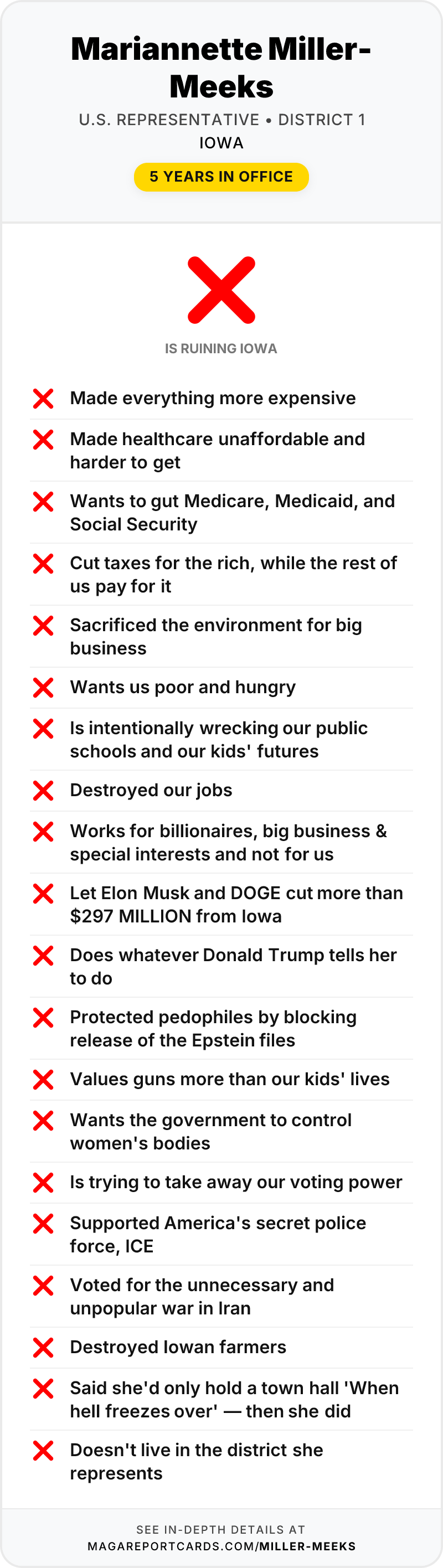
Miller-Meeks went most of 2025 without an in-person town hall — she told Johnson County Republicans she'd hold one "when hell freezes over."
When she finally held one in November, a constituent asked her directly: "Why did you allow your committee to put in place the largest cuts to Medicaid in the program's entire history?"
Her answer:
"Thank you for the applause for the Energy and Commerce Committee voting to strengthen and preserve Medicaid."
The room booed. Some people walked out before it was over, shaking their heads. After 50 minutes, she left the room to loud boos.
That's her story, one year in: the largest Medicaid cut in history was actually "strengthening" it. Tell that to the mothers in Clinton.
Who actually won?
The Congressional Budget Office ran the numbers on who gains and who loses from the law. The answer is blunt: the poorest 10% of households lose about $1,200 a year, because the Medicaid and SNAP cuts take away more than the tax cuts give back. The richest 10% gain about $13,600 a year.
That's the trade Miller-Meeks made: groceries and health coverage for her constituents, in exchange for tax cuts tilted to people at the top. It's worth remembering who funds her campaigns: the PACs of the American College of Emergency Physicians and the American Academy of Ophthalmology are among her top contributors this cycle.
A year later, voters haven't come around. Battleground-district polling by Navigator Research finds the law still underwater by 11 points — and unpopular even in districts Trump won by more than 10 points.
Miller-Meeks is a physician who took an oath to do no harm. Then she voted — twice — for a bill that is closing delivery rooms and cutting food assistance for her own patients' neighbors. And when they asked her why, she thanked them for their applause.
We deserve better.
Source
This post is based on the DCCC release: "One Year Later: Mariannette Miller-Meeks and Zach Nunn's Big, Ugly Bill Remains Deeply Unpopular As Iowans Suffer" (July 2, 2026), with additional reporting from Iowa Public Radio, KWQC, The Gazette, and federal data linked above.