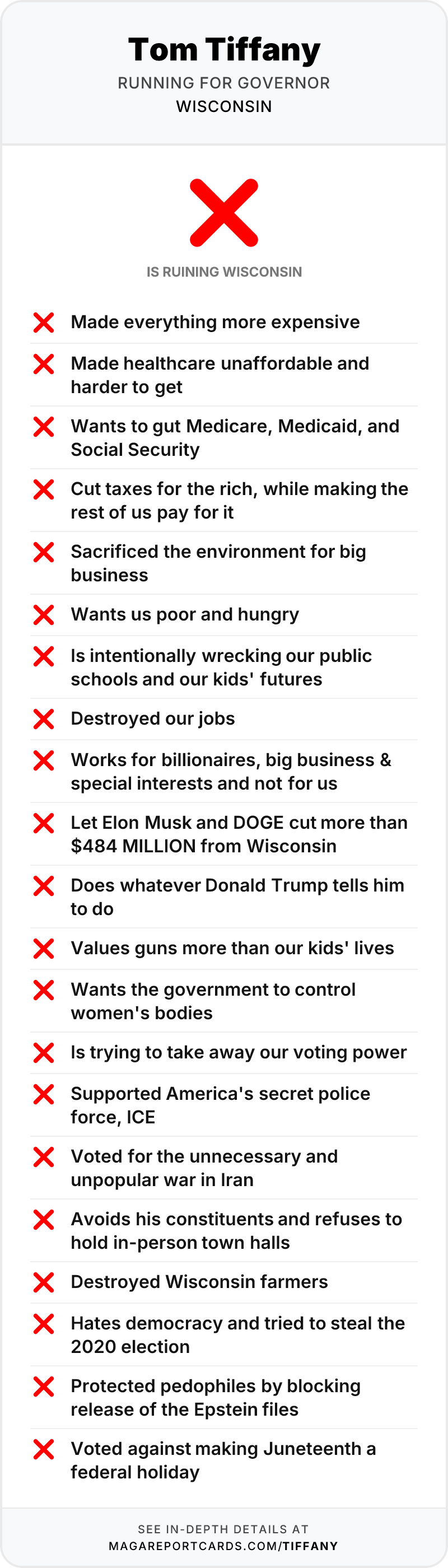
One year ago, on July 4, 2025, President Trump signed HR 1 — the bill he called the "One Big Beautiful Bill." Tom Tiffany voted for it. Now he wants to be Wisconsin's governor.
This week, Wisconsinites marked the bill's first birthday. Not with a party. With a protest.
On June 30, members of Indivisible and the healthcare union SEIU Wisconsin parked a decommissioned ambulance in front of the Wisconsin Republican Party headquarters in Madison. The message: this is what happens to healthcare when a bill cuts $1 trillion from programs people depend on.
Jean Grow, co-leader of Indivisible's Milwaukee chapter, put it plainly:
"Who in this state is primarily responsible for these cuts? Tom Tiffany."
What Tiffany voted for
HR 1 wasn't a small bill. It paired $4.5 trillion in tax cuts over 10 years with $1 trillion in cuts to federal healthcare programs, plus deep cuts to food assistance.
Tiffany voted yes, along with every House Republican but two. Here's what that yes vote means for the state he now wants to run:
- The Congressional Budget Office projected the bill would leave 11.8 million more Americans uninsured by 2034 — at least 17 million once the enhanced ACA subsidies it let expire are counted. House Democrats on the Joint Economic Committee estimate that nearly 148,000 Wisconsinites would lose Medicaid coverage by 2034, and about 212,000 would lose insurance once ACA coverage losses are added.
- It made the largest cut to SNAP in history — a 20% cut by 2034, about $187 billion. In Wisconsin, SNAP is called FoodShare, and more than 330,000 Wisconsin households count on it.
- Medicaid — BadgerCare here in Wisconsin — covers people at or below the poverty line and pays for long-term care, including home healthcare for seniors and people with disabilities.
At a press conference this week focused on Tiffany's record, Secretary of State Sarah Godlewski said the bill "has been brutal for Wisconsin families" — with potentially 270,000 Wisconsinites losing healthcare and tens of thousands losing FoodShare.
The damage has already started
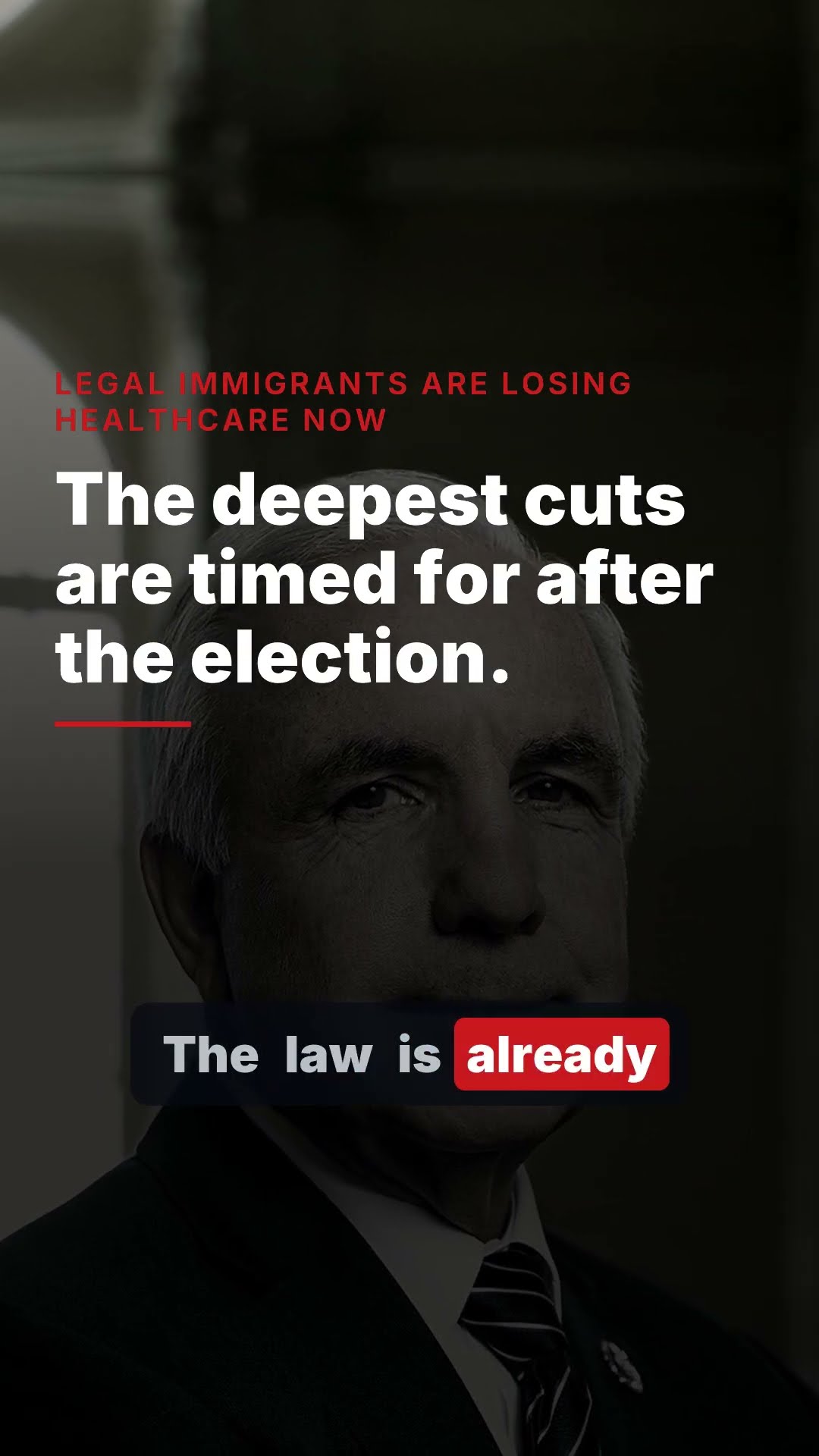
Most of the Medicaid changes don't even kick in until 2027. But the bleeding has begun. Federal data tracked by the Georgetown University Center for Children and Families shows that more than 75,000 Wisconsin Medicaid recipients left the program in just the first five months of 2026.
Sen. Tammy Baldwin explained how the bill does its damage: new work-reporting requirements and red tape that block people who qualify.
"They're trying to kick people who are fully eligible off the program," Baldwin said.
A family doctor from Birchwood, Dr. Kristen Dall-Winther, warned what comes next: when funding drops, healthcare providers take the financial hit — "especially in rural areas where many of our facilities are already operating on razor-thin margins." That should worry Tiffany's own voters: he represents Wisconsin's rural, northern 7th District.
Who actually won?
The bill's defenders said the healthcare cuts would only go after waste, fraud and abuse. The numbers say otherwise.
The Congressional Budget Office found the law makes the poorest 20% of households worse off: they lose more from the healthcare and food cuts than they gain from the tax cuts. The bottom 10% will see their incomes fall by about $1,200 a year. The top 10%? Their incomes rise by an average of $13,600 a year, the Center on Budget and Policy Priorities reported in February.
That's the trade Tiffany made: healthcare and groceries for working Wisconsin families, in exchange for tax cuts tilted to the wealthiest households.
Even Republicans seem to know how it looks. After critics started calling it "the Big Ugly Law," the GOP rebranded the bill in September as "The Working Families Tax Cut." You can change a bill's name. You can't change what it does.
He's done this before
The HR 1 vote isn't a one-off. It fits a pattern on Tiffany's record:
- In January 2026, he voted against restoring lapsed ACA subsidies — even though 17 of his fellow Republicans crossed over to support them, and letting them expire is driving some Wisconsin marketplace premiums up 45% to 800%.
- He's called the Affordable Care Act a "problem" — while about 291,000 Wisconsinites signed up for 2026 ACA marketplace coverage — down from more than 313,000 the year before.
Now he's asking Wisconsin to make him governor — the person in charge of the state programs, like BadgerCare and FoodShare, that his own vote squeezed.
One year in, the bill's results aren't a talking point. They're an emptied ambulance parked outside his party's front door.
Source
This post is based on reporting from the Wisconsin Examiner: "As Trump's 2025 signature bill marks an anniversary, Dems use it as a cudgel" by Erik Gunn, July 3, 2026. Photo by Erik Gunn/Wisconsin Examiner.